
Commercial Sewer Line Services: A Property Owner's Guide
Office buildings, restaurants, and retail properties put harder demands on sewer lines than any home. Here is what commercial sewer service covers and how to plan for it.
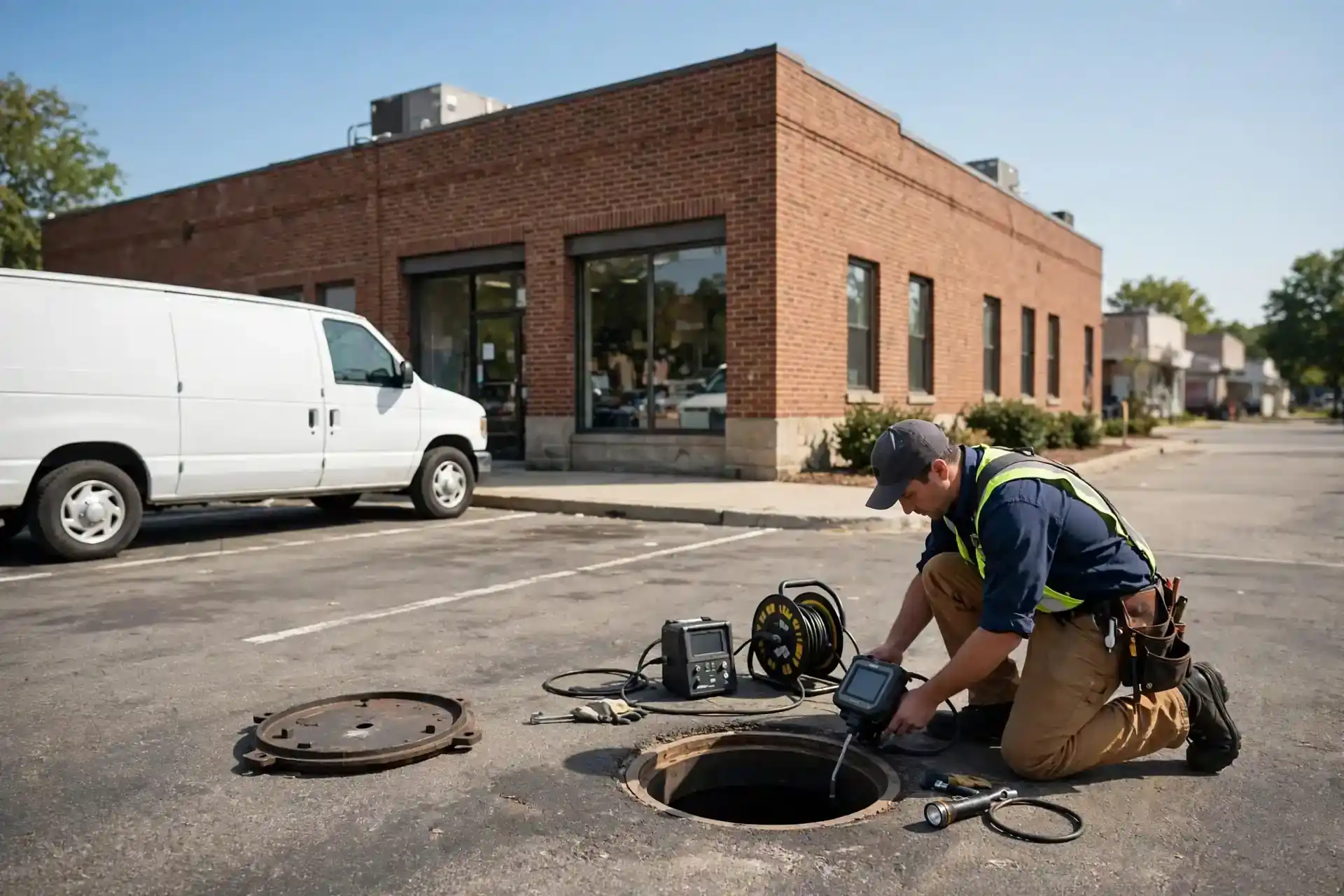
In short: Commercial buildings in Buffalo Grove, IL need scheduled sewer inspection, cleaning, and repair planning — a backup can close a business, not just flood a basement. Services run from camera surveys to trenchless repair and maintenance plans. Call (833) 713-2101 to assess your building.
A commercial building's sewer system works harder than a home's: more fixtures, more users, grease from kitchens, and operating hours that make a backup far more expensive than a service visit. For property owners and managers around Buffalo Grove — the office corridors along Lake-Cook Road, restaurants near the Town Center, medical and retail buildings along Milwaukee Avenue — sewer problems show up as tenant complaints, health-department attention, and lost business days.
Commercial sewer line services cover the full cycle: inspection and diagnosis, cleaning and root control, trenchless repair, full replacement, and the preventive maintenance plans that keep a building out of the emergency column. This guide explains what each service involves, how commercial jobs differ from residential ones, and what to have in place before a problem forces your hand. A sensible first step is a commercial camera survey of the building sewer and lateral, documented for your property records.
How commercial sewer systems differ
Start with scale. A commercial lateral is often six inches or larger, runs farther from the building to the main, and serves dozens of fixtures across multiple tenants. Restaurants add grease interceptors (grease traps) that must be pumped on schedule — a neglected interceptor sends fats downstream, where they congeal in the lateral and catch everything behind them. Office and medical buildings add their own loads: paper towels flushed by hundreds of hands a day, sterilization discharge, and cleaning chemicals.
Responsibility is also more complicated. In a multi-tenant building, the lateral is common infrastructure — one tenant's wipes become everyone's backup. Leases rarely assign sewer responsibility clearly until a backup forces the question. And unlike a homeowner, a business usually cannot wait days for a repair: every day of closure is revenue lost, which changes the math on every decision from emergency response to preventive spending.
Inspection and diagnosis at commercial scale
Commercial diagnosis starts the same way residential does — with a camera — but the deliverable is different. A property owner needs documentation: footage of the full run from the building to the main, measured distances to every defect, and a written assessment that can go into capital planning or a sale file. Mainline cameras with locators map the lateral's exact path and depth, which matters when the line runs under a parking lot that cannot be torn up on a guess.
For buildings with recurring problems, inspection should be scheduled, not reactive. A restaurant with a history of grease backups, or a 1960s office building with clay tile under the lot, benefits from an annual camera check the way a building benefits from a roof inspection — the footage trend over years tells you whether the line is stable or deteriorating. Camera inspection services scaled for commercial lines use larger-diameter equipment and produce the mapped, measured reports that property managers can act on.
Cleaning, jetting, and root control
Commercial cleaning is a program, not an event. High-volume lines accumulate grease, scale, and sediment faster than residential ones, and the cleaning method has to match the buildup: mechanical cutting for root masses, high-pressure jetting for grease and sludge, descaling for cast-iron interiors. A restaurant lateral might need jetting twice a year; an office building with modern PVC might need a camera check and a cleaning every couple of years.
Root control deserves special attention on the older commercial corridors, where 50-year-old clay tile runs under parking-lot islands planted with maples. Roots do not care that the building is commercial — they find the joints the same way. Scheduled sewer line cleaning with root cutting keeps these lines flowing and, just as important, creates the inspection record that proves the building was maintained if a dispute ever arises with a tenant or an insurer.
Trenchless repair for operating businesses
Excavating a sewer lateral under a parking lot or a landscaped corporate campus is disruptive in a way residential digging is not: it closes parking spaces, blocks deliveries, and puts heavy equipment next to customers. That is why trenchless methods dominate commercial work. Pipe lining renews a structurally sound line through existing access points; pipe bursting replaces a failed line by pulling new pipe through the old path — both without opening a trench across the property.
The business case is straightforward: trenchless work can often be staged during off-hours or phased so the building stays open. A retail center in Vernon Hills or an office park off Lake-Cook Road can have a lateral replaced by bursting over a weekend instead of losing a week to excavation and concrete restoration. The per-foot economics favor trenchless even more at commercial diameters, where open-cut restoration — asphalt, concrete, landscaping, striping — dwarfs the pipe cost.
Maintenance plans and compliance
The highest-value commercial service is the least dramatic: a maintenance plan. A good plan schedules camera inspections, jetting, root treatment, and grease-interceptor coordination around the building's own calendar — before the holiday retail rush, before summer patio season for restaurants — and keeps the documentation in one file. When a lender, buyer, or insurer asks about the building's underground infrastructure, that file is the answer.
Compliance is the other half. Food-service buildings face grease-interceptor pumping rules and potential fines; medical buildings have discharge considerations; all commercial properties share the basic duty to keep sewage where it belongs. A sewer maintenance program turns that duty into a routine — predictable visits, predictable costs, and no 2 a.m. emergency calls from a tenant standing in wastewater.
When replacement is the business decision
Sometimes the numbers point to replacement. A lateral that needs emergency jetting three times a year, a clay-tile run under a lot slated for resurfacing anyway, or a line whose camera footage shows progressive deterioration year over year — each is a case where one planned replacement costs less than years of reactive service plus the risk of a backup during business hours. The smart move is to time replacement with other site work: if the parking lot is being repaved next spring, that is the window to address the lateral beneath it.
Get the footage, get the options in writing, and weigh the cost of disruption, not just the cost of pipe. A planned project with a defined schedule beats an emergency excavation every time — in dollars, in tenant relations, and in sleep. Call (833) 713-2101 to put your building's sewer system on a planned footing instead of a reactive one.
Frequently Asked Questions
How often should a commercial building's sewer lines be inspected?
It depends on use and pipe age. Food-service buildings and properties with pre-1980 clay or cast-iron laterals generally merit an annual camera inspection; modern PVC systems in low-grease buildings can often go two to three years between checks. Any building with a backup history should be inspected annually until the footage shows a stable line. The trend across inspections matters more than any single visit.
Can trenchless repair be done without closing our business?
Often, yes. Lining and bursting need only small access points, so work can be phased or scheduled during off-hours to keep the building operating. Drainage may need to be briefly diverted while a liner cures or a burst is pulled, which is why commercial jobs are planned around the building's low-use windows. Discuss scheduling explicitly before approving the work.
Who is responsible for the lateral — the owner or the tenant?
In almost all cases, the building owner is responsible for the lateral from the building to the municipal main, including backups caused by tenant misuse upstream — which is why leases should address drain practices and why owners benefit from maintenance records. Tenants are typically responsible only for fixtures and drain lines within their demised space. Check your lease language and local ordinances; when in doubt, the owner should act as if the lateral is theirs.
Do restaurants need different sewer service than offices?
Yes — grease changes everything. Restaurants need grease-interceptor pumping on schedule plus more frequent jetting of the lateral, because fats, oils, and grease congeal downstream and trap solids. An office building's main enemies are roots and aging pipe; a restaurant's is grease first, everything else second. Service intervals for food service are measured in months, not years.
Sewer Line Problems Don’t Wait. Neither Should You.
Call now and reach a local sewer line specialist serving Buffalo Grove, IL and nearby northwest suburbs — 24/7.
(833) 713-2101Free to call · No obligation · 24/7 emergency line