
Sewer Line Installation in Buffalo Grove, IL
New construction, additions, and septic-to-sewer conversions in Buffalo Grove, IL need a sewer line installed right — proper grade, proper material, proper connections. Call (833) 713-2101.
- 24/7 emergency line
- Northwest suburb specialists
- Free to call
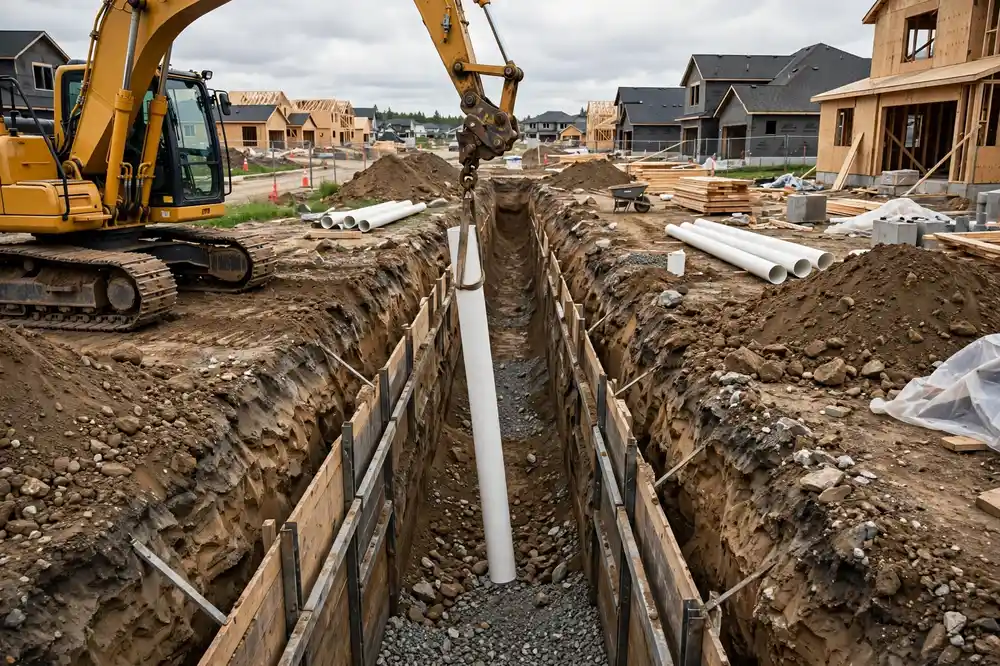
In short: Sewer line installation in Buffalo Grove, IL covers new laterals for construction and additions, replacements of failed lines, and septic-to-sewer conversions — installed to grade with modern materials. Call (833) 713-2101 to plan the installation.
A sewer line installation is the one sewer job that should never need a sequel. Done right — correct pipe, correct slope, correct bedding, correct connections at both ends — a new lateral serves for generations. Done wrong, it bellies, separates, or back-pitches, and the owner pays twice: once for the install, once for the fix.
In Buffalo Grove's northwest suburbs, installations cluster around three situations: new construction and teardown rebuilds (Northbrook's specialty, where new homes too often inherit old laterals), additions and ADUs that need new tie-ins, and Long Grove's septic-to-sewer conversions, where a failing drain field finally meets the municipal main. Each starts the same way: a plan based on the site, not a guess. Call (833) 713-2101 to start with a site evaluation.
Signs You Need Sewer Line Installation
You are building new or rebuilding after a teardown
New structures need new laterals sized for the home — not the 1960s clay tile the old house left behind.
An addition needs its own sewer tie-in
Bathroom and kitchen additions must connect to the lateral at the right point and grade, or they drain poorly from day one.
Converting from septic to municipal sewer
Long Grove properties with failing drain fields convert to sewer where mains are available — the highest-value installation in the service area.
The old line cannot be lined or burst
When the camera shows a line with no viable path — fully collapsed, wrong grade throughout — new installation is the honest answer.
Rerouting around new construction
Pools, additions, and garages built over the old lateral's path require the line to move, not the structure.
Splitting service for a multi-unit property
Duplexes and multi-unit conversions need properly separated laterals with individual cleanouts.
What Causes Sewer Line Installation Problems
Installations are planned, not reactive — but the reasons share a theme: the old arrangement no longer fits. Teardown rebuilds in Northbrook inherit laterals sized for smaller homes with fewer bathrooms. Septic systems in Long Grove reach the end of absorption in clay soils that never drained well. Additions overload laterals that were already marginal. And in the 1970s condo communities, reconfigured buildings need reconfigured building sewers.
The common thread is grade and material. Old installations used clay tile with mortar joints and whatever slope the trench happened to give. Modern installation uses PVC or HDPE with engineered bedding and verified slope — the difference between a line that lasts and a line that bellies.
How Sewer Line Installation Works, Step by Step
- 1Site evaluation and planning
Call (833) 713-2101. The specialist evaluates the site: main location and depth, soil conditions, the structure's needs, and the best route.
- 2Permits and utility locates
Required permits are identified and underground utilities are located and marked before any excavation.
- 3Excavation and bedding
The trench is dug to design depth, and the pipe bed is prepared with proper bedding material for uniform support.
- 4Pipe installation to grade
PVC or HDPE pipe is laid at verified slope, jointed per manufacturer spec, with cleanouts installed at required intervals.
- 5Connections and testing
The line is connected at the structure and the main, tested for flow and integrity, then backfilled in compacted lifts and the surface restored.
Equipment and Materials
- Excavation equipment sized to the site
- PVC and HDPE pipe in code-approved diameters
- Laser levels and grade-checking instruments
- Bedding and backfill compaction equipment
- Cleanout assemblies and fittings
- Test plugs and flow-testing gear
Safety on Every Visit
Installation is excavation work, and excavation rules apply: trenches are sloped or shored, spoil is kept back from the edge, utilities are located before digging, and nobody works under an unsupported wall. The crew maintains a clean, barricaded site and compacts backfill in lifts so the surface does not settle later.
Sewer Line Installation in Buffalo Grove's Northwest Suburbs
Local conditions shape every installation. Glacial-till clay in Buffalo Grove digs heavy but holds a trench well; the high water tables near Diamond Lake, the Des Plaines corridor, and pond-adjacent communities mean dewatering is sometimes part of the plan. Long Grove's estate lots need 100–300-foot runs with well-separation setbacks for septic conversions. Lincolnshire's tree-preservation ordinance routes new lines around protected root zones. And winter installs contend with frozen ground — most planned installations are scheduled for the April-to-November window.
Related Sewer Services
Frequently Asked Questions
How long does a new sewer line installation take?
Most residential installations complete in two to four days: evaluation and permits, excavation and pipe laying, connections, testing, and restoration. Complex routes and commercial work take longer.
What pipe material is used for new installations?
PVC (SDR-35 or Schedule 40) is the standard for new residential laterals in the Chicago suburbs, with HDPE used for trenchless segments. The specialist selects the material and diameter for the structure's needs.
Do I need a permit for a sewer line installation?
Yes — sewer work requires municipal permits and inspections in the northwest suburbs. The specialist identifies the requirements for your municipality during planning.
Can you convert my Long Grove septic to sewer?
Where a municipal main is available, yes — septic-to-sewer conversion is common installation work in Long Grove. The plan accounts for the tank abandonment, the new lateral's route, and well-separation setbacks.
Will installation tear up my whole yard?
The trench follows the planned route — typically a single corridor from the house to the main — not the whole yard. Trenchless segments are used where they fit, and the surface is restored after backfill.
What grade does a sewer line need?
Residential laterals are typically installed at about 1/4 inch of fall per foot — enough for solids to carry, not so much that water outruns them. Grade is verified with instruments during installation, not eyeballed.
Sewer Line Problems Don’t Wait. Neither Should You.
Call now and reach a local sewer line specialist serving Buffalo Grove, IL and nearby northwest suburbs — 24/7.
(833) 713-2101Free to call · No obligation · 24/7 emergency line