
Tree Root Removal in Buffalo Grove, IL
Tree roots in your Buffalo Grove, IL sewer line cause most repeat backups — professional root removal clears them and shows you how to keep them out. Call (833) 713-2101.
- 24/7 emergency line
- Northwest suburb specialists
- Free to call
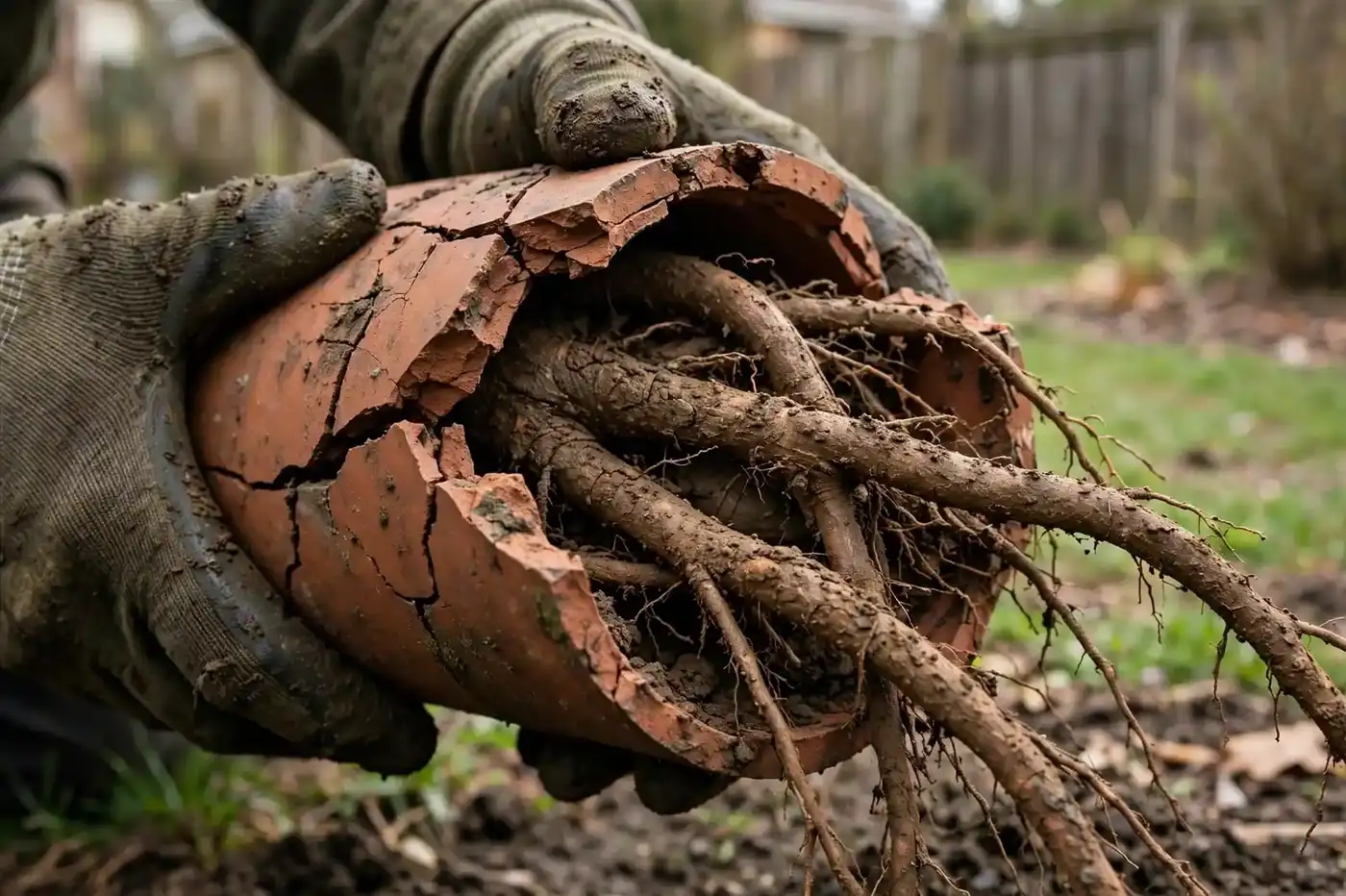
In short: Tree root removal in Buffalo Grove, IL cuts intruding roots from the lateral with specialized heads, then uses a camera to show whether the joints need lining or replacement to keep roots out for good. Call (833) 713-2101.
Tree roots do not break into sewer pipes — they are invited in. A fine root hair finds the moisture seeping from a separated clay-tile joint, follows it inside, and then does what roots do: grow. Within a few seasons, a hair becomes a mat, the mat becomes a blockage, and the blockage becomes the third backup in two years. In the northwest suburbs, with their mature oaks, maples, and 50-to-70-year-old clay tile, roots are the number one sewer problem by a wide margin.
Professional root removal is a two-part job: cutting the intrusion out, then dealing with the joint that let it in. Cutting alone buys time — usually a year or two before regrowth. Cutting plus a camera-verified plan for the joint (lining, sectional repair, or managed cutting on a schedule) buys a solution. Call (833) 713-2101 and the visit covers both parts.
Signs You Need Tree Root Removal
Backups that return every 12–24 months
The classic root cycle: cut, regrow, block, repeat. If your backups keep a calendar, roots are keeping it.
Camera previously showed roots at joints
A prior inspection that found root hairs or masses means the entry points are still open — the roots are still coming.
Large trees within 30 feet of the lateral
Mature trees and old clay tile are the pairing that produces nearly every root call in Buffalo Grove, Deerfield, and Arlington Heights.
Toilets gurgling in dry weather
Root mats restrict flow even without rain. Gurgling during dry spells points to a physical mass in the line — usually roots.
Slow drains that worsen through summer
Roots grow fastest in the growing season. A line that slows from June to September is following the root calendar.
Tissue and waste snagging at the same spot
When paper consistently catches at one footage mark, something is protruding into the flow — most often a root mass at a joint.
What Causes Tree Root Removal Problems
Roots enter through openings, and old pipe is full of openings. Clay tile joints separate under freeze-thaw movement in glacial-till clay; each separated joint weeps moisture that roots detect from feet away. Cast-iron hubs corrode and crack. Even PVC is not immune where a joint was poorly made or disturbed by settlement. Once inside, the nutrient-rich flow is everything a root wants, and growth accelerates.
Certain local pairings are notorious: silver maples and willows over shallow laterals, mature oaks over the 1960s–70s tracts of Deerfield and Palatine, and the 50-year-old street trees of Mill Creek and Old Buffalo Grove standing directly over clay tile mains-to-house runs. The trees are not the enemy — the open joints are.
How Tree Root Removal Works, Step by Step
- 1Call with the history
Call (833) 713-2101 and describe the backup pattern — how often, which fixtures, what season. The history usually confirms roots before the camera does.
- 2Camera to map the intrusions
The camera locates every root entry: which joints, how severe, and the pipe's overall condition — because the fix depends on the joints, not just the roots.
- 3Mechanical root cutting
Specialized cutting heads — saws, blades, or chain flails — shear the intrusion flush with the pipe wall, restoring full flow.
- 4Post-cutting camera pass
A second camera run shows the joints clearly now that the mass is gone, revealing what the roots were hiding.
- 5The lasting plan
You get options matched to the joints: managed cutting on a schedule, lining the affected section, or bursting the run — with the trade-offs explained plainly.
Equipment and Materials
- Root saw and blade cutting heads
- Chain-flail descaling heads
- Sectional cable machines for root masses
- Hydro jetters for flushing cut debris
- Sewer cameras for pre- and post-cutting mapping
- Locators for marking affected joints
Safety on Every Visit
Root cutting uses aggressive heads that demand disciplined handling: proper gloves and eye protection, controlled feed rates, and heads matched to the pipe's material so cutting removes roots without damaging sound pipe. The crew contains the cut debris and verifies flow at every fixture before leaving.
Tree Root Removal in Buffalo Grove's Northwest Suburbs
This is Buffalo Grove's signature sewer problem. Arlington Heights' mature-tree lots over pre-1970 clay tile, Deerfield's dense canopy over long shallow ranch runs, Old Buffalo Grove's 60-year-old plantings over original laterals, Mill Creek's 50-year street trees, and Lincolnshire's old-growth oaks over half-acre laterals — the research cards name root intrusion the number one failure mode in most of the service area. Lincolnshire's tree-preservation ordinance adds a wrinkle: the trees cannot simply be removed, so the fix must be in the pipe — lining or bursting — not in the landscape.
Related Sewer Services
Frequently Asked Questions
Will the roots grow back after cutting?
Yes — cutting removes the intrusion, not the opening. Regrowth typically takes one to three years depending on the tree and the joint. The lasting fix is sealing the entry: lining, sectional repair, or managed cutting on a schedule.
Can you remove the tree instead?
Sometimes, but in Lincolnshire the tree-preservation ordinance protects many mature trees, and everywhere else removal is expensive and often unnecessary. Fixing the pipe — not the landscape — is usually the right answer.
Do chemical root killers work?
Foaming root treatments can slow regrowth between mechanical cuttings, but they do not repair the joint and they are no substitute for cutting a blocking mass. The technician can explain where they fit in a management plan.
How do you know the roots are really gone?
The post-cutting camera pass shows the pipe wall at every joint — you see the result on the monitor, not just take our word for it.
Is root removal covered by homeowner's insurance?
Usually not as maintenance — insurers treat root intrusion as a wear-and-tear issue. The camera documentation helps if a sudden collapse is involved; ask your agent about your specific policy.
How much does root removal cost?
A root-cutting visit is priced as a cleaning service — far less than structural repair. Call (833) 713-2101 with your backup history for the scope; the camera inspection determines whether cutting alone or cutting plus joint repair is warranted.
Sewer Line Problems Don’t Wait. Neither Should You.
Call now and reach a local sewer line specialist serving Buffalo Grove, IL and nearby northwest suburbs — 24/7.
(833) 713-2101Free to call · No obligation · 24/7 emergency line