
Pipe Bursting in Buffalo Grove, IL
Pipe bursting replaces a failed Buffalo Grove, IL sewer line by fracturing the old pipe underground and pulling a new HDPE pipe through — with only two small access pits. Call (833) 713-2101.
- 24/7 emergency line
- Northwest suburb specialists
- Free to call
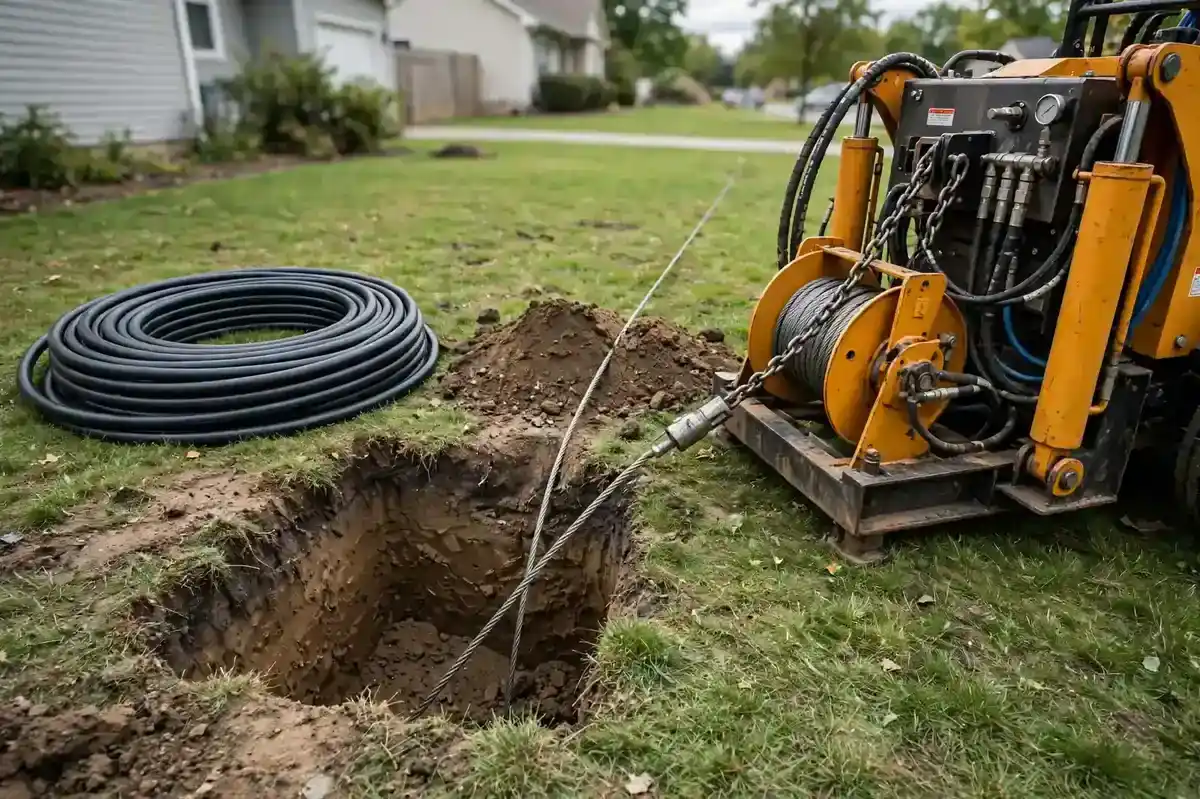
In short: Pipe bursting in Buffalo Grove, IL breaks apart the old sewer pipe underground while pulling a seamless new HDPE pipe into its place, usually in one day and without trenching the whole yard. Call (833) 713-2101 for a camera inspection to confirm your line qualifies.
When a sewer lateral is too damaged for lining — collapsed sections, badly offset joints, or pipe that has lost its shape — pipe bursting replaces it without the open trench of a traditional dig. A hardened bursting head is pulled through the old line, fracturing clay tile, cast iron, or Orangeburg outward into the surrounding soil, while a new high-density polyethylene (HDPE) pipe follows directly behind it into the same path.
For Buffalo Grove homeowners, the appeal is straightforward: the new pipe is seamless, joint-free, and rated for decades of service, and the yard, driveway, and landscaping above stay largely intact. Most residential bursts complete in a single day, with the home's drains back in service the same evening. Call (833) 713-2101 and the first step is always a camera inspection to confirm the line is a bursting candidate.
Signs You Need Pipe Bursting
Camera shows collapsed or missing sections
When inspection reveals the old pipe has caved in or sections are gone entirely, lining cannot bridge the gap — bursting replaces the full run.
Multiple offset joints along the run
Joints that have shifted apart at several points mean the pipe's alignment is lost. Bursting installs one continuous new pipe with no joints to shift.
Orangeburg pipe past its lifespan
Bituminous fiber pipe from the 1945–1972 era deforms and blisters with age. Bursting is the standard replacement for it across the northwest suburbs.
Repeated root blockages after cutting
If roots return within months of every cutting, the joints are too far gone. A seamless HDPE replacement removes every entry point at once.
Bellies that hold standing water
Sagging sections where waste collects cannot be lined flat. Bursting re-establishes proper grade with the new pipe.
Clay tile at 60+ years with heavy root load
Old Buffalo Grove's original laterals and the 1960s–70s tracts of Deerfield, Palatine, and Arlington Heights are prime bursting candidates when roots have won.
What Causes Pipe Bursting Problems
Pipes reach the bursting stage through the slow arithmetic of age and soil. Clay tile joints separate a fraction of an inch per freeze-thaw cycle until roots and soil enter. Cast iron corrodes from the inside until the bottom of the pipe disappears. Orangeburg, the tar-impregnated fiber pipe of the postwar boom, simply was never meant to last 60 years — it ovals, blisters, and collapses. Glacial-till clay soil holds water against the pipe and amplifies every cycle.
Bursting is chosen when the damage is structural and distributed: not one bad joint but a line whose material has failed along its length. The camera inspection is what makes that call — it shows whether the pipe can still guide a bursting head or whether an open-cut dig is required instead.
How Pipe Bursting Works, Step by Step
- 1Camera inspection and locate
Call (833) 713-2101. The technician cameras the full lateral, maps its depth and path, and confirms bursting is viable — adequate cover, no unmovable obstructions.
- 2Two small access pits
An entry pit and an exit pit are dug — typically a few feet square — at the ends of the run. The rest of the yard stays untouched.
- 3Bursting head and new pipe staged
A hardened steel bursting head is attached to a winch cable or hydraulic puller, with the new HDPE pipe fused into one seamless length behind it.
- 4The pull
The head fractures the old pipe outward into the soil while the new HDPE pipe slides into the exact same path. The crew monitors depth and alignment throughout.
- 5Connections and restoration
The new pipe is connected at the house and the main, the pits are backfilled and compacted, and the surface is restored. Drains are tested before the crew leaves.
Equipment and Materials
- Hydraulic or winch-powered pipe bursting rig
- Hardened steel bursting heads sized to the old pipe
- HDPE pipe with heat-fused seamless joints
- Sewer camera with sonde locator for pre-mapping
- Compact excavation equipment for access pits
- Compaction equipment for pit backfill
Safety on Every Visit
Pipe bursting is powerful equipment used with strict controls: pits are shored or sloped to prevent cave-in, underground utilities are located and marked before any pull, the pull zone is kept clear of bystanders, and hydraulic pressures are monitored continuously. The crew verifies the new pipe's connections with a final camera pass before backfilling.
Pipe Bursting in Buffalo Grove's Northwest Suburbs
Northwest-suburb conditions favor bursting. Long laterals under Lincolnshire's half-acre lots and Long Grove's estate runs are expensive to open-cut but burst cleanly; Old Buffalo Grove's short ranch laterals burst in hours; Deerfield's and Palatine's root-destroyed clay tile is the textbook case; and in Lincolnshire, where the tree-preservation ordinance restricts excavation through protected root zones, bursting through two small pits is often the only practical path. The camera inspection first confirms soil and depth conditions typical of glacial-till clay.
Related Sewer Services
Frequently Asked Questions
How much digging does pipe bursting require?
Two small access pits — one at each end of the run. There is no continuous trench, so driveways, patios, and landscaping between the pits stay in place.
What kind of new pipe is installed?
High-density polyethylene (HDPE), heat-fused into one seamless length with no joints. It resists roots, corrosion, and ground movement, and it is the standard replacement pipe for bursting across the Chicago suburbs.
Can bursting handle collapsed sections?
Partially collapsed and heavily damaged pipe is exactly what bursting is for — the head breaks the old material apart as it passes. A fully collapsed run with no remaining path may need a short open-cut section first, which the camera inspection reveals.
How long does a residential burst take?
Most Buffalo Grove residential laterals burst in one day, with drains back in service the same evening. Longer commercial or estate runs can take two days.
Will bursting damage my foundation or the street?
The bursting head displaces soil only around the old pipe's path, and the crew maps depth and nearby utilities before pulling. Entry and exit pits are placed to keep the pull clear of foundations and street infrastructure.
Is pipe bursting more expensive than digging?
Per project it is often comparable, and it avoids the restoration costs of an open trench — new sod, driveway sections, patios, and landscaping. The camera inspection and written scope let you compare both options fairly.
Sewer Line Problems Don’t Wait. Neither Should You.
Call now and reach a local sewer line specialist serving Buffalo Grove, IL and nearby northwest suburbs — 24/7.
(833) 713-2101Free to call · No obligation · 24/7 emergency line