
Sewer Line Replacement in Buffalo Grove, IL
When a Buffalo Grove, IL sewer line is past repair, full replacement — trenchless or open-cut — gives you a brand-new lateral built for decades. Call (833) 713-2101 for a camera diagnosis.
- 24/7 emergency line
- Northwest suburb specialists
- Free to call
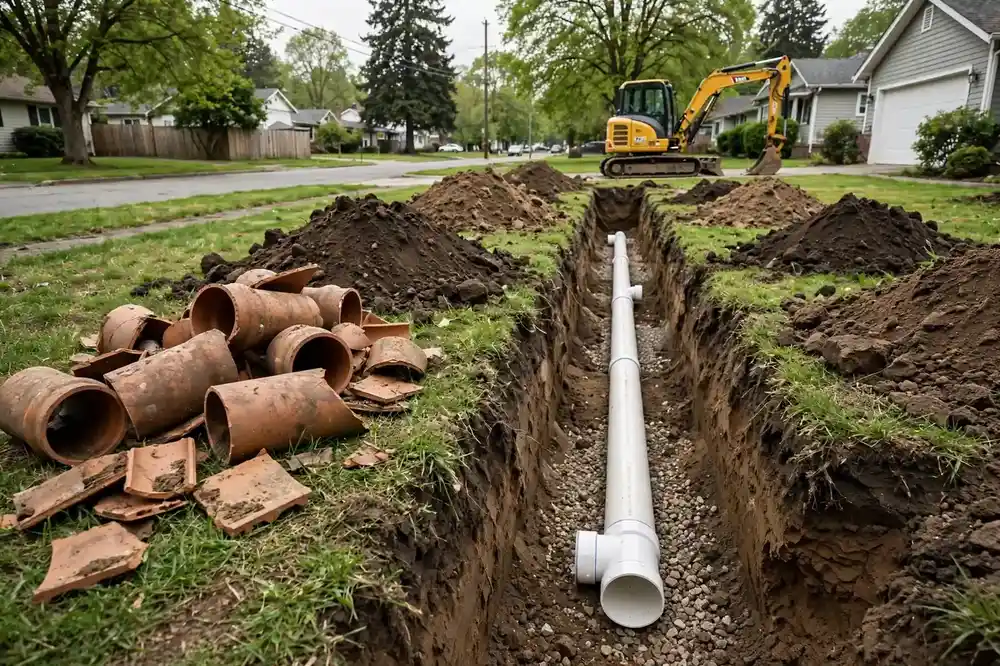
In short: Sewer line replacement in Buffalo Grove, IL installs a completely new lateral when repair is no longer sensible — via trenchless bursting or traditional excavation, whichever fits the site. Call (833) 713-2101 for the camera inspection that determines which method your line needs.
There comes a point where patching a sewer line stops making sense. The clay tile has collapsed in three places, the Orangeburg has ovaled along its whole run, the cast iron is paper-thin — and every repair buys months, not years. Replacement ends the cycle: the failed line comes out of service and a new PVC or HDPE lateral goes in, joint-free or properly jointed, graded and bedded to modern standards.
The method depends on the site. Trenchless pipe bursting replaces the line through two small pits, preserving the yard. Open-cut excavation replaces it through a trench, necessary when the line has lost its path entirely or the grade must be rebuilt. The camera inspection decides — and in Buffalo Grove's 1958–1970s housing stock, it decides 'replacement' more often than owners expect. Call (833) 713-2101 and get the diagnosis before the emergency makes the decision for you.
Signs You Need Sewer Line Replacement
Camera shows collapse in multiple sections
One collapse can be spot-repaired; three collapses mean the pipe's material has failed systemically. Replacement is the honest scope.
Orangeburg pipe along the full run
Ovaled, blistered fiber pipe does not rehabilitate — every foot of it is past design life. Full replacement is standard.
Cast iron worn paper-thin throughout
When descaling reveals the pipe wall is nearly gone along the run, lining has nothing to bond to. Replacement follows.
Repairs that keep failing
A line that has been spot-repaired twice and fails a third time is telling you the remaining pipe is no better than the repaired sections.
Sewage surfacing in the yard
Wastewater reaching the surface means the line is breached and washing out soil — a replacement situation, not a cleaning one.
Home purchase with a failed inspection
Buyers who inherit a failed lateral negotiate the replacement before closing — the inspection video sets the scope.
What Causes Sewer Line Replacement Problems
Replacement-age lines share a birth era: 1945–1975. Clay tile from those decades has endured 50–70 years of freeze-thaw joint movement in glacial-till clay. Orangeburg was a wartime material with a 30-year hope and a 60-year reality. Cast iron from the postwar boom corrodes from the inside, invisibly, until the bottom drops out. Soil settlement, root invasion, and heavy surface loads finish what age started.
In Old Buffalo Grove, the original 1958–1970 laterals are the village's oldest sewer stock and its highest-probability replacement market. In Deerfield, Palatine, and Arlington Heights, the 1960s–70s tracts are arriving at the same decision within the same decade — which is why whole streets end up replacing laterals in the same few years.
How Sewer Line Replacement Works, Step by Step
- 1Camera inspection and method selection
Call (833) 713-2101. The camera maps the failure, and the specialist recommends bursting or open-cut based on the pipe's condition, depth, and the site.
- 2Permits, locates, and planning
Municipal permits are secured, utilities are marked, and the replacement route is planned around landscaping, driveways, and structures.
- 3Trenchless burst or open-cut dig
Bursting fractures the old pipe and pulls new HDPE through two pits; open-cut excavates the run and lays new PVC to engineered grade.
- 4Connections at both ends
The new lateral is connected to the house sewer and the municipal main (or septic, in conversion cases) with proper fittings and cleanouts.
- 5Backfill, compaction, and restoration
Trenches and pits are backfilled in compacted lifts, surfaces are restored, and the line is camera-verified and flow-tested before sign-off.
Equipment and Materials
- Pipe bursting rigs with HDPE pipe
- Excavation equipment for open-cut replacement
- PVC pipe (SDR-35 / Schedule 40) and fittings
- Compaction equipment for trench backfill
- Sewer cameras for pre- and post-replacement verification
- Utility locators and grade instruments
Safety on Every Visit
Replacement is the heaviest sewer work and carries the strictest controls: full utility locates before any digging, trench shoring or sloping, barricaded work zones, hydraulic monitoring on bursting pulls, and protective equipment for any wastewater exposure. The site is left clean, compacted, and restored — not just backfilled.
Sewer Line Replacement in Buffalo Grove's Northwest Suburbs
Replacement patterns are hyperlocal. Old Buffalo Grove's 60-year-old clay tile bursts in a day through short ranch laterals. Lincolnshire's half-acre lots mean 100–200-foot runs where bursting beats open-cut on restoration cost — and the tree ordinance often mandates the trenchless path. Long Grove's estate laterals run 100–300 feet, making method selection a real cost decision. In the condo communities, replacement means building-sewer work through common areas with HOA coordination. Everywhere, the camera inspection first is what keeps a replacement honest.
Related Sewer Services
Frequently Asked Questions
How do I know if I need replacement instead of repair?
The camera inspection answers it: isolated defects get repaired, systemic failure gets replaced. Multiple collapses, full-run Orangeburg, or paper-thin cast iron are replacement indicators — call (833) 713-2101 for the inspection.
Trenchless or open-cut — which is better?
Neither is universally better. Bursting preserves the surface and suits lines that still hold a path; open-cut rebuilds grade and suits collapsed or misaligned runs. The inspection determines which fits your line and site.
How long will I be without sewer service?
For most residential replacements, the outage is measured in hours within a one-to-two-day project — the crew keeps you informed of the exact window and restores service the same day whenever possible.
Will replacement destroy my landscaping?
Trenchless bursting needs only two small pits. Open-cut follows a single trench corridor, not the whole yard, and the surface is restored after compaction. The plan shows you the footprint before work begins.
What is the new pipe made of?
PVC for open-cut installations and HDPE for bursting — both modern materials with decades of expected service, joint-free (HDPE) or properly jointed and bedded (PVC).
Does replacement require a permit?
Yes, in the northwest suburbs sewer replacement requires municipal permits and inspection. The specialist handles the permit identification as part of planning.
Sewer Line Problems Don’t Wait. Neither Should You.
Call now and reach a local sewer line specialist serving Buffalo Grove, IL and nearby northwest suburbs — 24/7.
(833) 713-2101Free to call · No obligation · 24/7 emergency line