
Sewer Line Repair in Arlington Heights, IL
Local sewer line service for Arlington Heights, Illinois 60004 — camera inspection, trenchless repair, and 24/7 emergency response from specialists who know this area's pipe. Call (833) 713-2101.
- 24/7 emergency line
- Northwest suburb specialists
- Free to call
In short: Sewer line repair in Arlington Heights, IL 60004 starts with a camera inspection: the village's mix of pre-1970 clay tile and 60s–70s Orangeburg under mature trees makes root intrusion the leading failure. Call (833) 713-2101 to schedule the inspection.
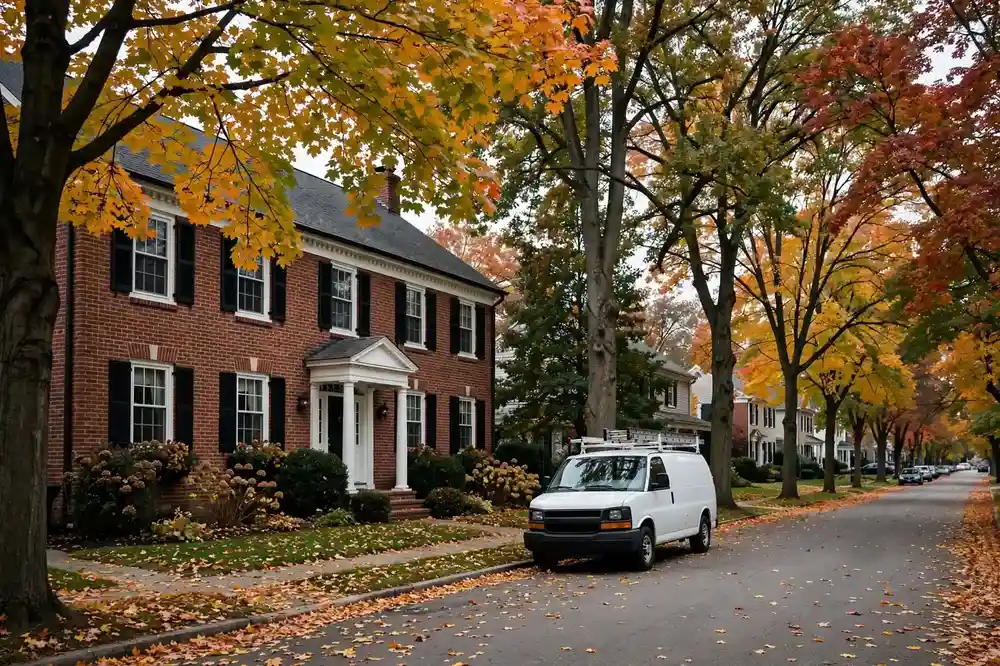
Arlington Heights, IL 60004 is a village of layers, and its sewer lines show every one. The downtown district's housing stock has a median construction year of 1959 — postwar colonials, split-levels, and ranches on mature-tree lots — while the village-wide median sits at 1974, with more than a fifth of homes built in each of the 1960s and 1970s. That spread means a single street can carry 1950s clay tile laterals next to 1970s Orangeburg, each failing in its own way.
The pipe story follows the housing. Pre-1970 homes run clay tile laterals with joints that have spent half a century separating in glacial-till clay; the 1960s–70s tracts run Orangeburg — bituminous fiber pipe from 1945–1972 that ovals, blisters, and collapses with age. Cast-iron interior stacks complete the picture. With full basements standard across the village — many finished — and floor drains in older homes tied to the sanitary line, backups here arrive with real consequences.
Area Facts
- Community
- Arlington Heights, IL
- Primary ZIP
- 60004
- Housing
- Median construction year 1974
- Key routes
- Arlington Park (opened Oct 13, 1927
Sewer Lines in Arlington Heights, IL 60004: Housing, Pipes and Soil
The ground under Arlington Heights is glacial till — silty clay loam of the Markham and Elliott series, somewhat poorly drained — with Buffalo Creek tributaries running through the village. Annual precipitation near 32 inches, 28 inches of snow, winter lows near 19°F, and summer highs near 84°F drive a hard freeze-thaw cycle that heaves separated joints a little wider every year, while spring melt loads cracked laterals with infiltration.
Housing here runs median construction year 1974; 22.7% built 1970-79, 21.7% 1960-69, 17.8% 1980-89; downtown district median 1959. colonials, split-levels and ranches on mature-tree lots. The pipe below it runs clay tile laterals in the pre-1970 core; orangeburg (bituminous fiber, 1945-1972) in 60s-70s tracts; cast-iron interior stacks. pvc only on post-1980 infill. Foundations are full basements standard (chicago-area norm); older homes with floor drains tied to sanitary — which decides how a technician gets access and which methods fit.
Sewer Pipe Materials in Arlington Heights, IL 60004
The pipe below tells its own story. Clay tile laterals in the pre-1970 core; Orangeburg (bituminous fiber, 1945-1972) in 60s-70s tracts; cast-iron interior stacks. PVC only on post-1980 infill.
Homes, Foundations and Access in Arlington Heights
The housing stock shapes every sewer job here. Median construction year 1974; 22.7% built 1970-79, 21.7% 1960-69, 17.8% 1980-89; downtown district median 1959. Colonials, split-levels and ranches on mature-tree lots.
The homes above dictate the work below. Full basements standard (Chicago-area norm); older homes with floor drains tied to sanitary.
Weather and Soil Pressure in Arlington Heights
Weather and soil add the pressure. NW Chicago suburbs: ~32 in annual precip, ~28 in snowfall, avg winter low ~19F, summer high ~84F. Freeze-thaw heave; spring urban flooding.
The seasonal forces acting on these lines. Glacial till, silty clay loam (Markham/Elliott series); somewhat-poor drainage. Buffalo Creek tributaries run through the village.
How Sewer Service Works in Arlington Heights
Every job in Arlington Heights starts with a camera locate, because mixed-era laterals demand it: clay tile in the 1950s core behaves nothing like Orangeburg in the 60s–70s tracts, and quoting without seeing is guessing. Mature street-tree roots make root intrusion the number one failure mode, so root cutting is usually step one — followed by the joint decision: sectional lining at root-entry couplings, or bursting where Orangeburg has lost its shape. Full basements with finished lower levels push trenchless pipe lining over open-cut, protecting established landscaping that took decades to grow. Landmarks technicians use for routing include Arlington Park at IL-53 and Euclid Avenue, Dundee Road, the Metra UP-NW station, and downtown.
Sewer Care Calendar for Arlington Heights, IL
Arlington Heights runs the full northwest-suburb seasonal cycle, and the sewer line feels each season. Winter's freeze-thaw — average lows near 19°F — heaves the silty clay loam and works separated clay tile joints a fraction wider with every cycle; this is when offsets grow. Spring brings the double load: roughly 32 inches of annual precipitation concentrated in the thaw months, plus Buffalo Creek tributaries running high, pushing groundwater through every cracked joint. Summer is root-growing season — the mature canopy's peak demand for moisture coincides with the year's lowest water tables, so roots push hardest into weeping joints from June through September. Fall is the smart season to act: a camera inspection and root cutting in October or November clears the summer's growth before winter freeze locks it in. Schedule the annual check for fall, and treat spring backups as the signal to camera-inspect rather than just clear.
Common Sewer Issues in Arlington Heights, IL 60004
Root intrusion at clay tile joints
Fifty-plus years of root growth over separated clay joints. Cutting clears the mass; lining the affected joints keeps it from returning.
Orangeburg deformation in 60s–70s tracts
Ovaling and blistering fiber pipe that cleaning cannot fix — bursting replaces it with seamless HDPE.
Finished-basement backups
Full basements, many finished, with older floor-drain tie-ins. Backwater valves and prompt root management protect the lower level.
Freeze-thaw joint separation
Silty clay loam heaves every winter, working old joints wider. Spring camera checks catch the new openings early.
Spring infiltration and surcharging
Buffalo Creek tributaries and 32 inches of annual precipitation push groundwater through cracked joints each spring.
Downtown's 1959-median laterals
The downtown district's housing is the oldest in the village — and its laterals are too. Priority camera territory before any symptom appears.
Service Routes Across Arlington Heights, IL 60004
Service routing follows the area's real roads. Arlington Park (opened Oct 13, 1927; sold to Chicago Bears 2023, 326 acres) at IL-53 & Euclid Ave; Dundee Rd; Metra UP-NW Arlington Heights station; Hersey HS (Dist 214); downtown Arlington Heights.
Most-Requested Services in Arlington Heights
When to Call (833) 713-2101 in Arlington Heights
Call (833) 713-2101 when more than one fixture slows at once, when a toilet gurgles as the washer drains, or when backups return within a year of the last clearing — the classic Arlington Heights root cycle. Call immediately for sewage at a floor drain, sewage odors through the whole house, or a soggy foul-smelling patch in the yard over the lateral's path. If you are buying a home in the village — especially downtown's 1959-median stock or a 60s–70s tract — call for a pre-purchase camera inspection before closing, not after the first backup.
Frequently Asked Questions
What sewer pipe materials are common in Arlington Heights?
Pre-1970 homes typically have clay tile laterals; 1960s–70s tracts often have Orangeburg (bituminous fiber pipe, 1945–1972); interiors are frequently cast iron. PVC appears only on post-1980 infill. A camera inspection identifies exactly what your lateral is made of — call (833) 713-2101 to schedule one.
Why are tree roots such a problem here?
Arlington Heights pairs 50-to-70-year-old clay tile joints with mature street trees. Separated joints weep moisture that roots detect from feet away, and decades of growth turn hairs into blocking mats. It is the number one failure mode in the village.
Can my line be lined instead of dug up?
Often, yes — if the pipe still holds its shape. Lining seals root-entry joints from the inside with no trench, which matters under decades-old landscaping. The pre-lining camera inspection confirms whether your line qualifies.
My basement is finished. What protects it from backups?
A backwater valve on the lateral plus managed root cutting on a schedule. Finished basements raise the stakes of every backup, so prevention — camera checks and timely cutting — pays for itself.
How do I know if my lateral is Orangeburg?
Homes built roughly 1945–1972 in the tract developments are the candidates. The camera shows it definitively: Orangeburg ovals and blisters in a way no other material does. If yours is deformed, bursting is the standard replacement.
Do you serve the downtown Arlington Heights area?
Yes — the whole 60004 ZIP, including the downtown district with its 1959-median housing stock, the neighborhoods around Arlington Park, and the areas near the Metra UP-NW station. Call (833) 713-2101.
How often should I have my Arlington Heights lateral inspected?
For pre-1970 clay tile under mature trees, a camera check every 2–3 years is prudent — annually if roots were cut within the last two years. The inspection is quick, and it catches joint separation while it is still a lining job rather than a replacement. Call (833) 713-2101 to schedule.
Will a camera inspection damage my old pipes?
No. The camera head is smooth, sized for the pipe, and purely diagnostic — it cannot damage clay tile, Orangeburg, or cast iron. It is the safest service in the trade, and the only way to see what 60 years have done to your joints.
What pipe materials are actually under Arlington Heights streets?
It depends on the block's era, which is why the camera matters more than the address. Pre-1970 neighborhoods typically run vitrified clay tile with mortar joints — the root-intrusion stock — and some 1940s–50s runs used Orangeburg fiber pipe, which blisters and collapses with age. The 1960s–70s tracts transition to cast iron inside and clay tile outside. Each material fails differently: clay tile separates at joints, Orangeburg deforms along its length, cast iron scales and thins. The camera inspection identifies the material in your specific lateral and the failure mode it is actually exhibiting, so the fix — cutting, lining, bursting, or replacement — matches the pipe, not the guess. Call (833) 713-2101 for the inspection.
Do you serve the neighborhoods near downtown Arlington Heights?
Yes — all of Arlington Heights 60004 and 60005, including the downtown district with its 1959-median housing, the 1960s–70s tracts, and the corridors along IL-68, IL-53, and IL-62. The downtown stock gets priority scheduling for camera inspections because its laterals are the oldest in the village; the tract neighborhoods get the standard root-cycle program of fall cutting and camera mapping. Routing runs through the village center and out along the arterial corridors, so most addresses are minutes from the next scheduled visit. Call (833) 713-2101 to book the camera inspection for your block's era.
Sewer Line Problems Don’t Wait. Neither Should You.
Call now and reach a local sewer line specialist serving Buffalo Grove, IL and nearby northwest suburbs — 24/7.
(833) 713-2101Free to call · No obligation · 24/7 emergency line
Serving Arlington Heights, IL 60004