
How Long Does Sewer Line Repair Take?
From a one-visit camera diagnosis to a multi-day replacement, sewer timelines vary widely. Here is what each type of Buffalo Grove sewer job realistically takes.
In short: In Buffalo Grove, IL, a sewer camera diagnosis usually takes a single visit; clearing a blockage often the same day; trenchless lining or bursting typically one to two days; and open-cut replacement several days including restoration. Call (833) 713-2101 for a timeline based on your line's actual condition.
“How long will this take?” is the first question most Buffalo Grove homeowners ask after “what's wrong?” — and the honest answer is that sewer work has no single timeline. A camera diagnosis is a morning's work. A full lateral replacement with street restoration is a multi-day project. Everything in between depends on the method, the pipe's condition, access, weather, and permits. This guide breaks the work into phases so you can see where the time actually goes and plan around it.
The single biggest timeline factor is the repair method, which is why no responsible contractor quotes a schedule before the camera inspection. Once the footage shows the defect, the timeline becomes predictable — the ranges below cover the jobs we see most often across Buffalo Grove and the northwest suburbs.
Phase 1: diagnosis — usually a single visit
The camera inspection itself typically takes under an hour on site for a standard residential lateral: the technician runs the camera from the cleanout to the municipal main, locates the pipe's path and depth, and records the footage. What extends this phase is access — a home with no cleanout may need one installed first, or the camera may need to go through a pulled toilet — and interpretation. A careful technician reviews the footage with you before recommending anything, because the diagnosis determines every downstream decision.
For straightforward blockages, diagnosis and clearing often happen in the same visit: the camera finds roots or grease, the cutting head or jetter clears it, and a second camera pass confirms the line is open. You go from problem to flowing drains in one appointment. The permanent repair, if one is needed, is a separate scheduled job — which is exactly how it should be, since permanent decisions deserve daylight and a clear head.
Clearing and spot repairs: hours, not days
When the problem is a blockage rather than a broken pipe, the timeline is short. Mechanical root cutting or hydro jetting of a residential lateral is typically completed in a few hours, including the before-and-after camera runs. These are the most common same-day jobs in Buffalo Grove, especially in spring when root growth surges and in fall when grease buildup peaks.
Spot repairs — excavating one bad section of pipe and replacing it — usually take a day: dig, cut out the failed section, install the new pipe with proper bedding and slope, backfill, and compact. Add time if the bad section sits under a driveway or patio that needs careful cutting and restoration, or if the excavation is deep enough to require shoring. A spot repair is the right call when the camera shows one localized defect in an otherwise sound line.
Trenchless lining and bursting: one to two days
Trenchless methods trade excavation time for process time. A CIPP lining job on a typical residential lateral usually spans one to two working days: inspection and thorough cleaning first, then liner installation and curing. The cure is the fixed clock in the process — resin chemistry does not hurry — and winter jobs in frozen ground use heated cure methods that add some time but keep the schedule predictable.
Pipe bursting follows a similar one-to-two-day pattern for most homes: dig small entry and exit pits, pull the bursting head and new pipe through the old line, connect at both ends, and restore the pits. Longer runs, deeper pipes, and multiple branch reconnections extend the work. Compared with open-cut replacement, bursting eliminates the days of trenching and surface restoration that dominate traditional timelines — which is why it is often the quickest path to a fully new pipe.
Open-cut replacement: several days
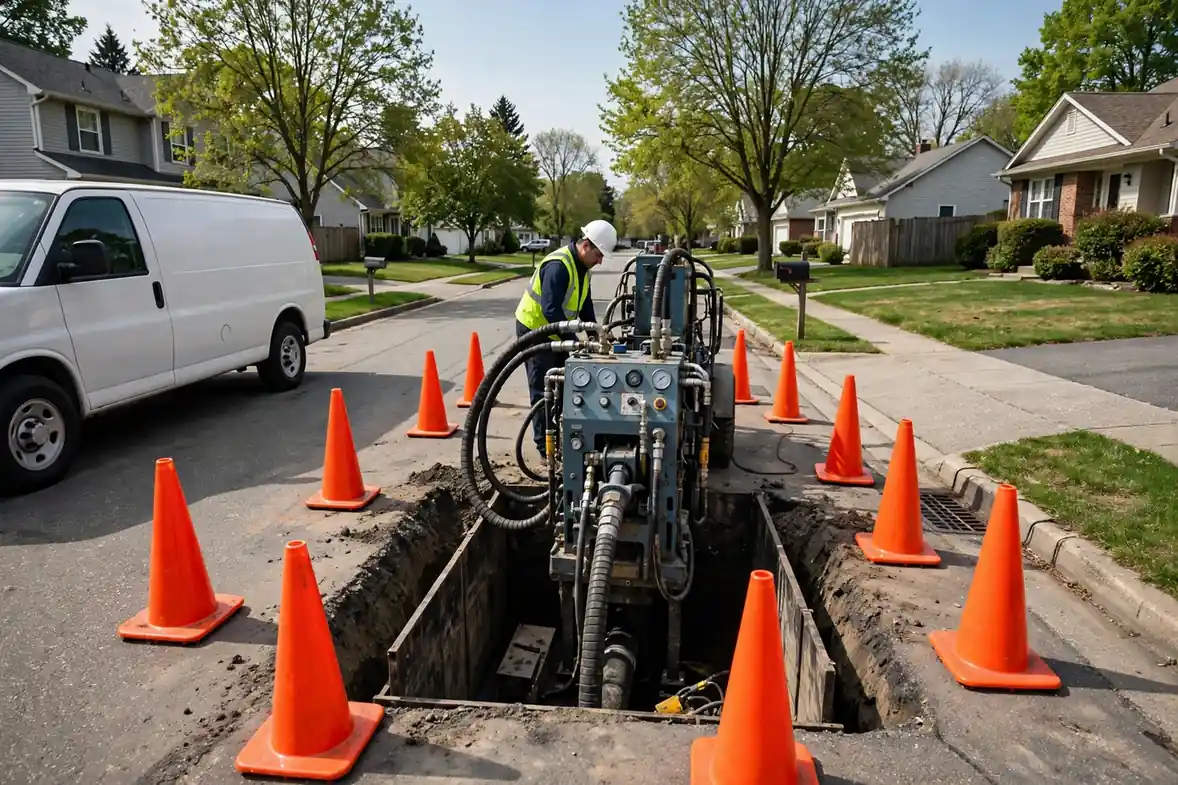
Full open-cut replacement is the longest residential timeline, and most of the time is not the pipe — it is everything around the pipe. Excavating a 60- to 100-foot trench, laying new pipe with proper bedding and slope, backfilling in compacted lifts, and restoring the surface (sod, driveway sections, sidewalk, landscaping) typically spans several working days. Deep excavations need shoring and wider trenches; lines running under streets need traffic control and pavement restoration to municipal standards.
Weather is the wildcard. A trench cannot be worked safely in a downpour, and Buffalo Grove's spring storms have delayed more than a few projects by a day. Frozen ground in deep winter slows excavation too. A realistic schedule builds in a buffer day rather than promising the ideal case — and any contractor who promises a fixed day count before seeing the site is selling certainty they do not have.
What stretches any timeline
Beyond the method itself, five factors move schedules. Permits: most municipalities around Buffalo Grove require a sewer repair permit, and while routine permits are quick, right-of-way work involving streets or sidewalks adds review time. Utility marking: state law requires buried utilities to be located before digging, which takes a few business days of lead time. Access: fences, decks, and mature trees that overhang the work area slow every phase. Restoration: matching a 20-year-old paver patio takes longer than rolling out sod. And decision time: homeowners who get the footage, sleep on the options, and approve the next day get better outcomes than anyone rushed into a same-day signature.
The practical takeaway: schedule the camera inspection as soon as you suspect trouble, and the timeline takes care of itself. Early diagnosis turns every downstream phase from an emergency into a plan — and planned work is always faster than emergency work. For a realistic schedule based on your line's actual condition, call (833) 713-2101.
Frequently Asked Questions
Can I use my plumbing while the sewer line is being repaired?
During lining or bursting, drainage is typically interrupted for part of the work — usually a matter of hours while the liner cures or the new pipe is pulled and connected. Your contractor should tell you exactly when to avoid water use. For multi-day open-cut replacements, temporary arrangements are planned in advance. Brief, scheduled interruptions beat the alternative of an uncontrolled backup.
Does trenchless repair really finish faster than digging?
Usually, yes — not because the pipe work itself is dramatically quicker, but because trenchless methods skip the excavation and surface restoration that dominate traditional timelines. A bursting job that finishes in two days replaces a dig-and-restore job that takes most of a week. The pipe ends up new either way; the difference is what happens to your yard and driveway.
Will rain delay my sewer repair?
It can, especially for open-cut work — an open trench and heavy rain do not mix, and saturated soil cannot be properly compacted for backfill. Trenchless work is less weather-sensitive since the ground stays largely undisturbed, though severe weather can still pause any outdoor job. Build a buffer day into your expectations during spring storm season.
How long does the yard take to recover after replacement?
The pipe work and the lawn recovery are different timelines. Sodded areas typically look presentable within weeks in growing season; seeded areas take a full season to fill in. Driveway and sidewalk concrete needs its standard curing time before vehicles return. Ask your contractor what restoration is included and what the surface will look like at handover versus three months later.
Sewer Line Problems Don’t Wait. Neither Should You.
Call now and reach a local sewer line specialist serving Buffalo Grove, IL and nearby northwest suburbs — 24/7.
(833) 713-2101Free to call · No obligation · 24/7 emergency line