
Sewer Line Cleaning vs. Hydro Jetting: Which Do You Need?
Snaking punches through blockages; hydro jetting scours the pipe clean. They solve different problems — here is how to know which one your line needs.
In short: Sewer line cleaning in Buffalo Grove, IL usually means mechanical snaking or root cutting; hydro jetting uses high-pressure water to scour grease, scale, and sludge from pipe walls. Snaking restores flow; jetting restores the pipe. Call (833) 713-2101 for a camera diagnosis first.
When a Buffalo Grove homeowner calls about a slow or backed-up sewer line, the fix is usually described with one vague word: 'cleaning.' But sewer cleaning covers two very different methods — mechanical cleaning (snaking, root cutting) and hydro jetting (high-pressure water scouring) — and they do different jobs at different prices with different results. Choosing the wrong one means paying twice: once for the method that did not work, once for the one that does.
This guide explains what each method actually does inside your pipe, the situations where each is the right call, and the situations where neither is enough and the camera footage is telling you to repair instead of clean. As always, the decision starts with seeing the blockage — not guessing at it.
What 'sewer line cleaning' usually means
In most service calls, sewer line cleaning means mechanical cleaning: a motor-driven cable with a cutting head is fed through the line from a cleanout, boring through the blockage and restoring flow. Different heads do different jobs — a spiral auger for soft blockages, a root-cutting saw blade for root masses, a chain flail for heavy scale inside cast iron. The cable follows the pipe, the head chews through whatever is in the way, and water flow resumes.
Mechanical cleaning is fast, effective at restoring flow, and the right first response to most blockages. Its limitation is what it leaves behind: a root cutter shaves the root mass back to the pipe wall but leaves the joint it grew through; an auger punches a hole through grease but leaves the grease coating the walls. The pipe flows again, but its interior is largely as it was — which is why the same line often needs the same service again. Professional sewer line cleaning pairs the mechanical work with a camera check, so you see what was cleared and what remains.
Hydro jetting: a pressure washer for your sewer
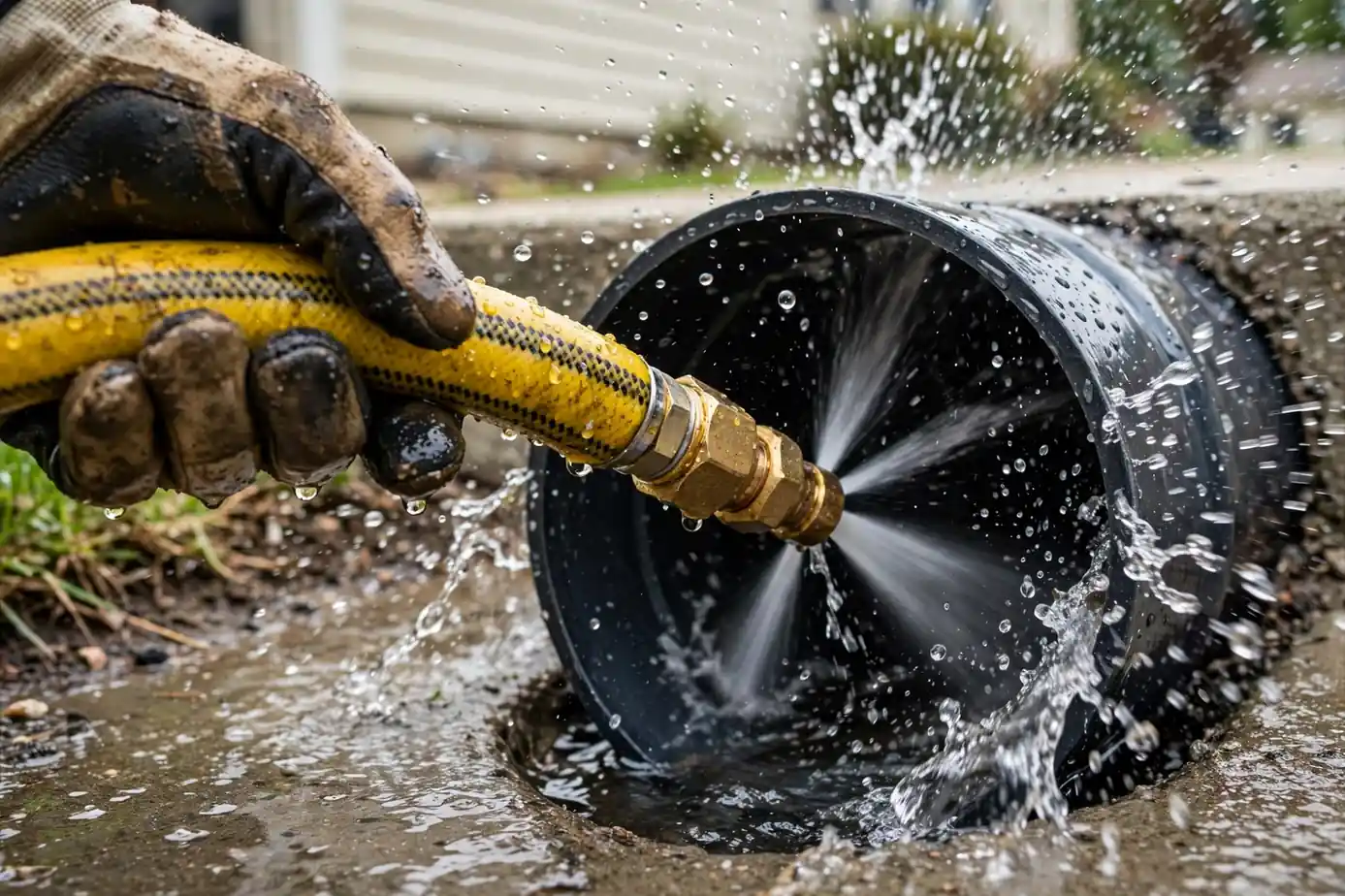
Hydro jetting replaces the cutting head with water: a specialized nozzle on a high-pressure hose propels itself through the line, firing jets backward and forward at pressures that scour the pipe wall. Grease liquefies and flushes downstream. Sludge, sand, and sediment blast loose. Scale flakes off cast iron. Light root hairs shear away. What emerges downstream is everything the pipe had been accumulating, and what remains is a pipe interior close to its original diameter and smoothness.
The difference is visible on the follow-up camera: after snaking, the footage shows a cleared path through remaining buildup; after jetting, it shows clean pipe wall. That is why jetting is the specified method for grease-choked restaurant laterals, for lines with heavy scale, and as the preparation step before CIPP lining — a liner needs the surgically clean surface that only jetting reliably produces. It is also why jetting takes longer and needs more equipment: a jetter truck, water supply, and proper downstream containment.
When snaking is enough
Choose mechanical cleaning when the problem is a discrete blockage in an otherwise sound line: a root mass at a known joint, a wad of wipes, a one-time grease plug. If your lateral has a history of root intrusion at the same joint and you are managing it between permanent repairs, periodic root cutting is the economical maintenance strategy — it buys time at a fraction of lining or replacement.
Snaking is also the right emergency response. When sewage is backing up tonight, the priority is restoring flow now, and a cable machine does that faster than setting up a jetter. The camera run after the clearing then tells you whether the line needs jetting, lining, or nothing at all. Emergency first, optimization second — that sequence saves both money and basements.
When the line needs the jetter
Choose hydro jetting when the problem is buildup rather than blockage: chronic grease accumulation, heavy tuberculation scaling a cast-iron line down to half its diameter, sludge and sediment in a bellied section, or a line being prepared for lining. Jetting is also the answer when snaking keeps failing — if the cable punches through and the line reclogs in weeks, the walls themselves are the problem, and only scouring addresses it.
There is one important caution: jetting pressure must match the pipe's condition. A skilled operator dials pressure to the pipe — lower for fragile Orangeburg or badly deteriorated clay, full force for sound cast iron or PVC. This is another reason the camera goes first: jetting a collapsed section at full pressure can worsen the collapse. The footage tells the operator what pressure the pipe can take, and a responsible company shows you that footage before the hose goes in.
When neither is enough
Sometimes the camera shows something cleaning cannot fix: a collapsed section, a severely offset joint, a belly holding inches of standing water, a pipe crushed under a driveway. No amount of cutting or jetting repairs structure — and repeated cleanings on a structurally failed line are just subscription payments on a problem that needs a one-time fix. The warning sign is frequency: if your line needs professional clearing more than about once a year, the footage is almost certainly showing a defect that wants repair, not another cleaning.
That is the moment to stop budgeting for cleanings and start evaluating trenchless lining, bursting, or spot repair against the footage. A good company will tell you when you have crossed that line — because a contractor who keeps selling you cleanings for a collapsed pipe is selling you the wrong product. Ask for the footage, ask what defect the cleaning is treating, and ask what the permanent fix would be. Then decide with the evidence in front of you.
Frequently Asked Questions
Will hydro jetting damage old pipes?
When matched to the pipe's condition, no — and that matching is the whole skill. Fragile Orangeburg, badly deteriorated clay, or collapsed sections need reduced pressure or a different approach entirely; sound cast iron, PVC, and HDPE handle full jetting pressure routinely. This is why the camera inspection comes first: it tells the operator exactly what pressure each section of your line can take.
How often should a sewer line be jetted?
There is no universal interval — it depends on what accumulates. Grease-heavy restaurant laterals might need jetting once or twice a year; a residential line with scale buildup might need it every few years; a clean PVC line may never need it. Let the camera footage set the schedule: jet when buildup is measurably narrowing the pipe, not on a calendar.
Is chemical drain cleaner a substitute for jetting?
No — and on old pipes it can be worse than nothing. Consumer drain cleaners rarely clear a main-line blockage; they sit in the line, generate heat, and can damage pipe walls, joints, and the rubber seals in fixtures. For a main sewer line, mechanical or water-based professional cleaning is the safe effective route; save the chemicals for nothing, honestly.
Why does my line clog again so soon after snaking?
Because snaking restores flow without restoring the pipe — it punches through the blockage but leaves the buildup, roots at the joint, or scale that caused it. Rapid re-clogging usually means the underlying condition needs jetting (for buildup) or repair (for structural defects). The follow-up camera footage after a snaking shows exactly which one you are dealing with.
Sewer Line Problems Don’t Wait. Neither Should You.
Call now and reach a local sewer line specialist serving Buffalo Grove, IL and nearby northwest suburbs — 24/7.
(833) 713-2101Free to call · No obligation · 24/7 emergency line