
Sewer Line Maintenance Tips That Prevent Big Repairs
Sewer lines fail slowly and expensively — but most failures are preventable. These maintenance habits keep Buffalo Grove laterals flowing for decades.
In short: Sewer line maintenance in Buffalo Grove, IL comes down to habits: watch what goes down drains, manage tree roots, know where your cleanout is, and get a camera check on older lines every few years. Call (833) 713-2101 to set up a maintenance baseline.
Here is the unfair truth about sewer lines: they give you decades of silent service and then fail expensively, all at once, usually at the least convenient moment. But 'all at once' is an illusion — sewer failures develop over years, and most of them respond to maintenance. Roots can be managed before they become blockages. Grease can be kept out before it becomes a plug. A line can be inspected before it becomes an emergency.
None of this requires special skill or equipment — just habits and attention, tuned to Buffalo Grove conditions: clay soil that shifts with the seasons, mature trees over half the laterals in town, and winters that punish every weak joint. These are the maintenance tips that actually move the needle, organized from daily habits to the professional checks worth scheduling.
Watch what goes down the drains
The toughest enemies of your sewer line arrive through your own plumbing. Fats, oils, and grease — poured down the kitchen sink — cool and congeal inside the lateral, trapping everything behind them; wipe cooled grease into the trash instead. So-called flushable wipes are the other great fiction: they do not break down like toilet paper, and they snag on every root hair and scale flake in an older line. Toilet paper, human waste, and water are the only things a sewer line is designed to carry.
The less obvious offenders: coffee grounds and eggshells from the disposal (they settle in bellies and low spots), dental floss and hair (they braid into nets that catch solids), and harsh chemical drain cleaners used repeatedly (they can damage pipe walls and joints without clearing the actual blockage). A household that treats its drains with modest respect extends its lateral's life by years — this single habit prevents more service calls than any other.
Manage the trees, not just the pipes
In Buffalo Grove, tree roots are the number one lateral problem, and root maintenance is a yard decision as much as a plumbing one. Know where your lateral runs — a camera inspection with locating marks its path — and think twice before planting thirsty species like willows, silver maples, or elms anywhere near it. Existing mature trees over the line are not a reason to panic, but they are a reason for a plan.
The plan has two parts: mechanical and chemical. Mechanical root cutting every year or two keeps root masses from becoming blockages in lines with known intrusion. Between cuttings, foaming root treatments applied through the cleanout discourage regrowth at the joints — they are a maintenance tool, not a repair, and they work most effectively on lines that have been cut clean first. And when roots keep returning to the same joint despite treatment, that joint is telling you it wants a permanent fix: a lined section or spot repair ends the cycle. Professional root removal paired with a follow-up camera shows whether you are managing or merely postponing.
Seasonal checks for northwest suburbs
Spring: after thaw, walk the lateral's path and look for soggy spots, sunken areas, or unusually lush grass — all signs of a line leaking or struggling. This is also when root growth surges, so spring is the season for scheduled root cutting on lines with a history. Summer: the dry months are ideal for planned camera inspections and any repair work — dry soil, easy excavation, no storm interference.
Fall: before the leaves drop, make sure gutters and downspouts drain away from the foundation, not into it — foundation drainage problems masquerade as sewer problems and vice versa. Clear the area around your cleanout so it is findable in an emergency. Winter: know that freeze-thaw heave stresses every joint in the ground, and that a sudden backup in January often traces to a joint that shifted. Keep the cleanout cap accessible above snow, and never pour boiling water down drains as a 'preventive' — thermal shock stresses pipes without helping anything.
Know your cleanout — and keep it accessible
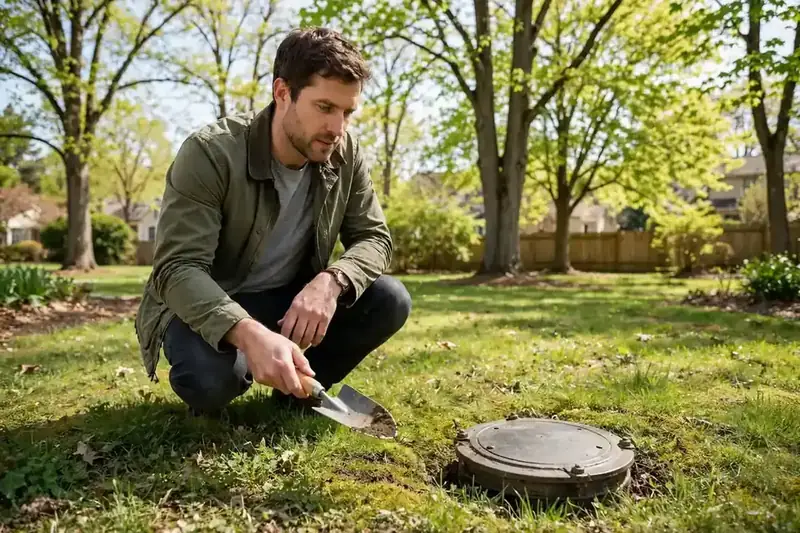
The cleanout is your sewer system's service panel, and an astonishing number of homeowners cannot find theirs. It is usually a capped pipe, three to four inches across, sticking a few inches out of the ground near the foundation or out in the yard along the lateral's path — sometimes in the basement near where the line exits. Find it, mark it, and keep it clear of mulch, plantings, and patio furniture.
If your home has no cleanout — common in houses built before the 1970s — installing one is the highest-value sewer upgrade available. Every future service, from a simple snaking to a camera inspection to a lining job, gets faster and cheaper with proper access; without it, technicians work through a pulled toilet or dig to create access, adding time and cost to everything. A scheduled cleaning visit is the natural moment to have a missing cleanout installed.
When to bring in a professional
DIY maintenance has a clear boundary: habits and observation are yours; anything involving the line itself belongs to a professional with a camera. Schedule a professional inspection if your home was built before 1980 and has never been camera-inspected — you are managing an asset you have never seen. Schedule one after any backup, even if flow restored itself, because the cause is still down there. And schedule one before finishing a basement, selling the home, or planting significant landscaping over the lateral's path.
Between inspections, a sewer maintenance plan turns all of this from good intentions into a routine: scheduled camera checks, preventive cleaning, and root treatment on a calendar, with documentation you can hand to a buyer or an insurer. Sewer lines reward the boring and the regular. A little attention on schedule beats a lot of money in an emergency, every time.
Frequently Asked Questions
How often should a residential sewer line be inspected?
For homes with pre-1980 pipe or a history of root intrusion, a camera inspection every two to three years tracks whether conditions are stable or progressing. Modern PVC lines with no history can go longer — five years is a reasonable interval. Always inspect after a backup, before finishing a basement, and when buying an older home.
Are chemical root killers safe for my pipes?
Foaming root treatments applied correctly are generally safe for intact pipes and are a legitimate maintenance tool between mechanical cuttings — but they are maintenance, not repair. They discourage regrowth; they do not fix the cracked joint the roots entered through. Do not use them as a substitute for addressing a structurally failed section, and never pour harsh chemicals into a fully blocked line.
What should never go down the drains?
The short list: fats, oils, and grease; so-called flushable wipes; paper towels and feminine products; coffee grounds and eggshells in quantity; dental floss and hair; paint, solvents, and harsh chemicals. Toilet paper, human waste, and water are what sewer lines are built to carry — everything else is a future service call.
My drains are fine. Do I still need maintenance?
Yes — that is exactly when maintenance costs the least. Sewer problems develop silently for years before symptoms appear; a camera inspection on a symptom-free older line often finds early-stage root intrusion or scaling that is inexpensive to manage now and expensive to repair later. 'Fine' is the ideal time to look.
Sewer Line Problems Don’t Wait. Neither Should You.
Call now and reach a local sewer line specialist serving Buffalo Grove, IL and nearby northwest suburbs — 24/7.
(833) 713-2101Free to call · No obligation · 24/7 emergency line