
What Really Drives Sewer Line Repair Costs
No honest contractor prices a sewer job sight unseen — because the cost depends on factors you can actually understand. Here they are, without a single price tag.
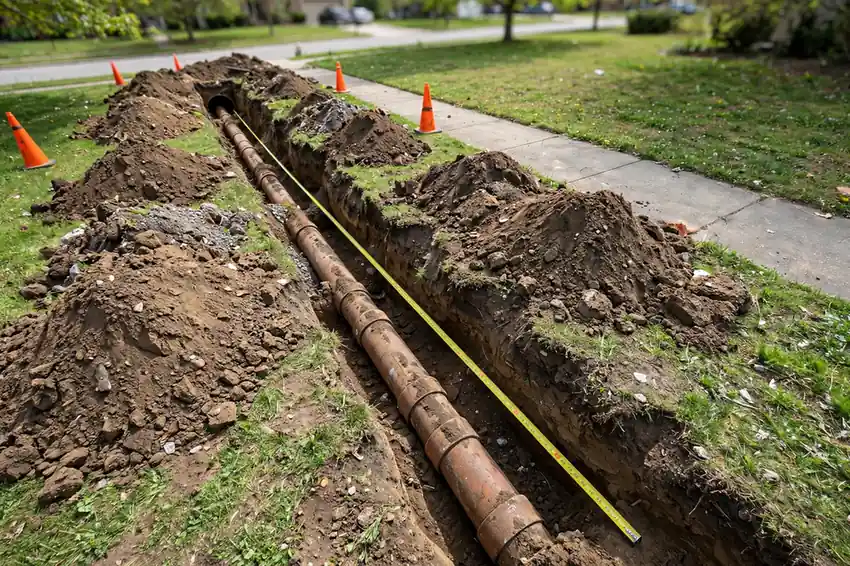
In short: Sewer repair costs in Buffalo Grove, IL are driven by the repair method, the line's length and depth, access conditions, the pipe's condition, permits, and surface restoration — not by the symptom. A camera inspection when you call (833) 713-2101 is what turns these factors into a real quote.
Ask ten contractors what a sewer line repair costs and you will get ten different answers — or one suspiciously round number quoted over the phone. Both responses miss the point. Sewer work is not a product with a price tag; it is a project whose scope is set by physical facts underground: how long the line is, how deep it runs, what is wrong with it, what sits on top of it, and which method fixes it. Understand those factors and you can read any quote intelligently, spot the padded ones, and see why the lowest bid is rarely the greatest value.
This guide names no prices — deliberately. Prices move with markets, and any number printed here would be wrong by the time you read it. Instead, here are the factors that determine what any Buffalo Grove sewer job involves, roughly in order of impact, so you know what you are actually paying for when the quote arrives.
Factor 1: the repair method
The method is the single biggest cost driver because it determines the kind of work being done. At one end of the spectrum, clearing a blockage or cutting roots is a service visit with a cable machine or jetter — hours of labor, no excavation. In the middle, trenchless methods (lining a section, bursting a full run) bring specialized equipment and materials but minimal digging. At the other end, open-cut replacement means excavation, pipe, backfill, compaction, and surface restoration across the full length — the most labor and the most restoration.
Here is the counterintuitive part: the 'expensive' trenchless method is often the cheaper total project once restoration is counted. Bursting a lateral under a driveway avoids cutting and repouring concrete; lining under a mature garden avoids landscape reconstruction. When comparing quotes, compare total project scope — pipe work plus restoration — not just the line item for the pipe. A trenchless approach that looks costly on the pipe line can be the economical choice on the project line.
Factor 2: length and depth of the line
Sewer work scales with the pipe. A 40-foot lateral from a house close to the street is a fundamentally smaller project than a 150-foot run across a deep lot in Lincolnshire or Long Grove — more pipe material, more excavation or more liner, more labor hours, more restoration. Depth multiplies everything: a line at four feet is a straightforward dig; the same line at nine feet needs shoring, wider excavation, dewatering in wet soil, and more careful backfill. Depth is also a safety and regulatory threshold, not just a digging inconvenience.
This is why the camera inspection with locating matters commercially, not just technically: it establishes the length and depth numbers that every honest quote is built on. A quote prepared without measured length and depth is built on assumptions, and assumptions in sewer work always resolve in the contractor's favor. Ask any bidder: what length and depth are you quoting against?
Factor 3: access and obstacles
What sits above the line shapes the work as much as what is wrong with it. A lateral running under open lawn is the easy case. The same lateral under a concrete driveway, a paver patio, a deck, or mature trees that cannot be disturbed becomes a harder project: surfaces must be cut and restored, or trenchless methods chosen specifically to avoid them. Limited access — narrow side yards, no equipment path to the backyard — slows every phase and sometimes dictates the method entirely.
Underground obstacles count too. The pre-job utility locate sometimes reveals gas, electric, or fiber lines running close alongside the sewer, requiring hand-digging near them or adjusted methods. In Buffalo Grove's clay soil, high groundwater in spring can require dewatering during open-cut work. Each of these is a line item in a thorough quote and a surprise in a thin one — which is why detailed quotes, even when higher, are usually the more honest document.
Factor 4: the pipe's condition and material
Two lines with identical symptoms can need very different work. A clay-tile lateral with root intrusion at every joint is a different project from a PVC line with one cracked section; a collapsed Orangeburg run is different from a scaled-but-sound cast iron line that can be lined. Material and condition determine whether the fix is cleaning, lining, bursting, spot repair, or full replacement — and those are different projects at different scales.
This factor is also where diagnosis pays for itself. The camera footage distinguishes a fifty-dollar-per-visit maintenance situation from a full-replacement situation, and it does so before anyone commits. Contractors who quote replacement without footage are quoting the most expensive factor on the menu without establishing that it applies. The footage-first rule from our camera inspection guide is, among other things, a cost-control rule.
Factor 5: permits, inspections, and restoration
The visible pipe work is only part of the project. Municipal permits, the inspection visits they require, and restoration to village standards for any street or sidewalk work are real scope with real scheduling impact. Right-of-way work — where the lateral meets the main under a street — follows municipal restoration specifications that are more demanding (and more carefully inspected) than a lawn patch.
Surface restoration is the factor homeowners most underestimate. Restoring a trench line across a lawn is straightforward; cutting and repouring a driveway section, rebuilding a paver patio to match, or restoring mature landscaping is skilled work with its own timeline. When a quote seems high, check how much of it is restoration — and when a quote seems low, check whether restoration is included at all. The lowest bid that excludes restoration is not actually lower; it is incomplete.
Factor 6: timing — planned versus emergency
The same repair costs more as an emergency than as a planned project. Emergency work carries after-hours labor, expedited scheduling, and decisions made under pressure; planned work gets competitive quotes, scheduled inspections, and restoration timed for good weather. A backup at midnight that requires immediate clearing plus a later permanent repair is two mobilizations where one planned project would have sufficed.
The practical implication is not 'never call for emergency service' — when sewage is in the house, call immediately — but rather 'do not let the emergency be the whole story.' Use the emergency visit to stabilize, then get the footage, get multiple quotes on the permanent fix, and schedule it deliberately. The most expensive sewer project is the one done twice: once in a panic, once properly. Planned work, informed by a camera inspection, is how you pay once.
Frequently Asked Questions
Why do sewer quotes vary so much between contractors?
Because they are quoting different scopes, often without saying so. One quote includes full restoration and permits; another excludes them. One assumes trenchless; another assumes open-cut. One is based on camera footage with measured length and depth; another is based on a phone description. Ask every bidder for the same breakdown — method, length, depth, restoration, permits — and the variance usually explains itself.
Does a longer sewer line always mean a much bigger project?
Length matters, but depth and access matter more per foot. A short, deep line under a driveway can be a bigger project than a long, shallow line under open lawn. Length sets the material quantity; depth and obstacles set the difficulty. All three appear in a thorough quote.
Is trenchless repair always more expensive than digging?
Not as a total project. Trenchless methods can carry higher pipe-work costs but eliminate most excavation and surface restoration, which often dominate traditional project totals — especially under driveways, patios, and mature landscaping. Compare complete project scopes, not isolated line items.
How can I tell if a quote is fair without knowing prices?
Look for structure, not numbers: measured length and depth from camera footage, a named method matched to the footage, itemized restoration, permits listed, and a written scope. A detailed quote built on evidence is checkable — you can get a second quote against the same scope. A vague quote built on symptoms is not.
Sewer Line Problems Don’t Wait. Neither Should You.
Call now and reach a local sewer line specialist serving Buffalo Grove, IL and nearby northwest suburbs — 24/7.
(833) 713-2101Free to call · No obligation · 24/7 emergency line