
Sewer Pipe Materials: The Complete Homeowner's Guide
From 1950s clay tile to modern HDPE, six materials carry Buffalo Grove's wastewater. What each one is, where you'll find it, and how it fails.
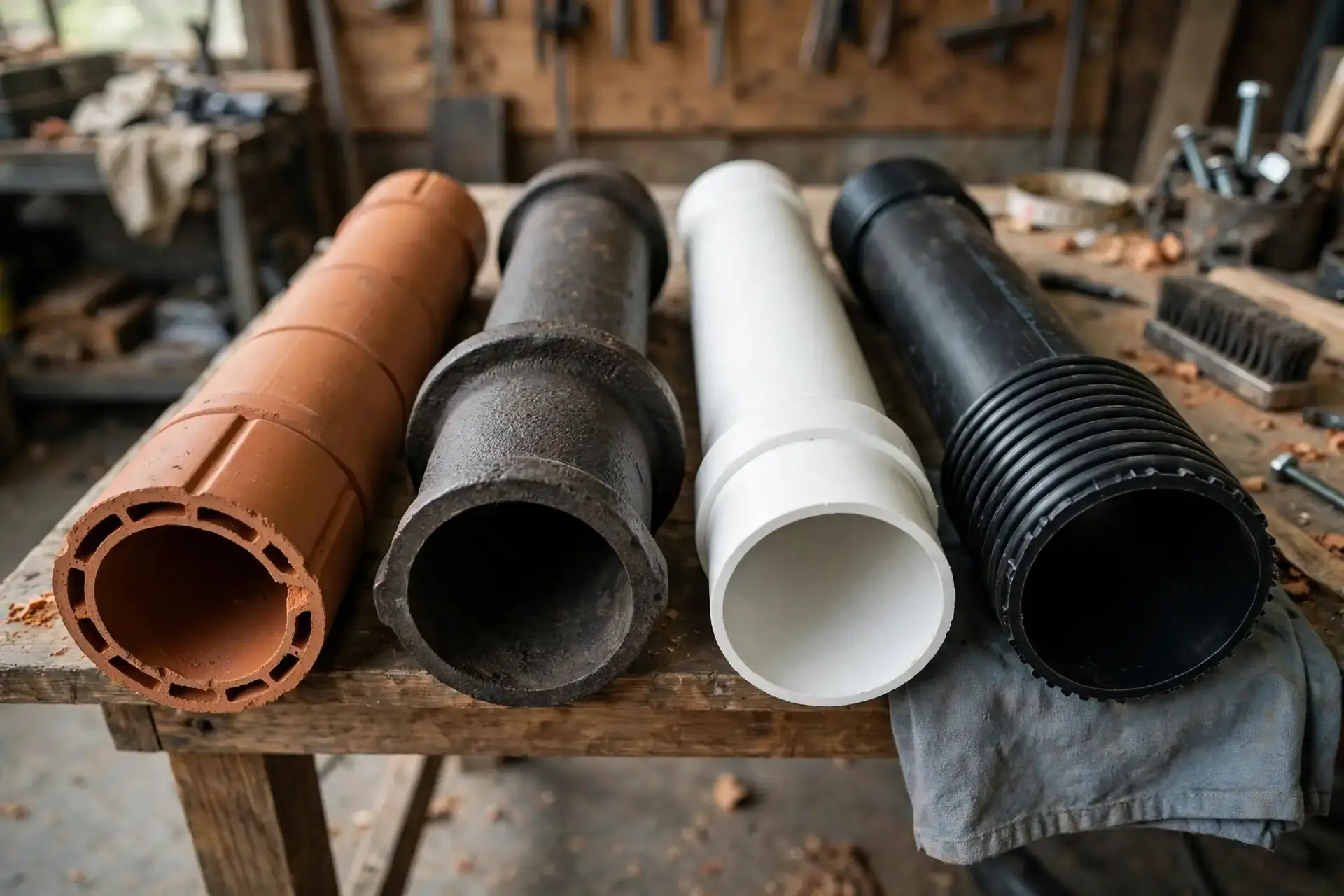
In short: Buffalo Grove, IL sewer laterals are typically clay tile, cast iron, Orangeburg, or PVC depending on the home's era — each with a distinct lifespan and failure mode. A camera inspection when you call (833) 713-2101 identifies your material and its condition.
Your sewer lateral's material is its destiny — or at least its biography. The pipe under your lawn was chosen in the decade your home (or its last sewer project) was built, from the palette of materials that era trusted. Buffalo Grove's housing spans the 1950s to today, which means its laterals span nearly the full history of residential sewer materials: clay tile, cast iron, Orangeburg fiber, concrete, PVC, ABS, and modern HDPE.
This guide covers each material: what it is, where you will find it in the northwest suburbs, how long it typically serves, and how it fails. By the end, you will be able to make an educated guess about your own line from your home's age — and you will know exactly what a camera inspection needs to confirm.
Clay tile (vitrified clay): the 20th-century workhorse
Vitrified clay — clay fired like pottery into a glass-hard pipe — carried residential sewage from the early 1900s through the 1970s, and it underlies much of Buffalo Grove's pre-1980 housing. It arrives in short sections (typically two to three feet) joined with mortar or rubber gaskets, which means a 80-foot lateral can have thirty or more joints. The pipe itself is nearly immortal: vitrified clay resists chemical attack and does not corrode. The joints are the story.
Every joint is a potential root entry and a point where freeze-thaw soil movement creates offsets. A clay lateral's condition is really a census of its joints: a few compromised joints in a line of sound ones is a repair situation; root intrusion at most joints is a replacement situation. Clay under Buffalo Grove's mature tree canopy lives or dies by its joints, which is why camera inspections of clay lines focus on joint condition more than pipe-wall condition.
Cast iron: strong, quiet, and rusting from within
Cast iron served both inside the house (stacks and branches) and underground (laterals) from the early 1900s through the 1970s. Thick-walled and heavy, it resists crushing, dampens drain noise better than any plastic, and handles hot wastewater without complaint. In Buffalo Grove's 1950s–60s homes, the interior drainage stack is often cast iron even where the buried lateral has been replaced with something newer.
Its failure mode is internal corrosion — tuberculation — where wastewater chemistry builds rough rust nodules that progressively narrow the pipe. A cast-iron lateral can look fine from outside while flowing through a two-inch opening inside a four-inch pipe. Hub joints add root-entry points. Well-installed cast iron serves 50 to 80 years; scaled-but-sound cast iron is an excellent candidate for epoxy lining, which gives it a smooth new interior without excavation.
Orangeburg: the material with an expiration date
Orangeburg — bituminous fiber pipe, essentially tar-impregnated wood pulp — was installed widely from about 1945 to 1972 as a cheap alternative to clay and iron, and it appears in Buffalo Grove's 1960s tracts. It was never meant to last this long. Orangeburg deforms under soil pressure (going oval, then collapsing), delaminates in layers, and is crushed by the root and soil loads that clay shrugs off.
If your home dates to the Orangeburg era and the lateral has never been replaced, assume the pipe is living on borrowed time — camera footage of Orangeburg typically shows deformation, blistering, or partial collapse. Orangeburg cannot be lined (there is no sound host pipe) and spot repairs do not hold in deformed fiber pipe; replacement, usually by pipe bursting, is the standard answer. Finding Orangeburg on a pre-purchase inspection is one of the clearest 'budget for replacement' signals in sewer work.
Concrete and asbestos-cement: the municipal cousins
Reinforced concrete pipe and asbestos-cement pipe appear mostly in municipal mains rather than residential laterals, but Buffalo Grove homeowners encounter them at the connection point and in older large-diameter building sewers. Concrete pipe is strong and long-lived but vulnerable at its joints and to certain wastewater chemistries; asbestos-cement (used mid-century) becomes brittle with age. Neither is a DIY concern — they matter when your lateral's tap into the main needs work, which is municipal-coordination territory.
The practical takeaway: if a camera inspection shows your lateral transitioning to a different material at the property line or the main, note it. Dissimilar-material transitions are stress points — different stiffness, different joint systems — and they concentrate root intrusion and separation. Repairs at transitions need couplings designed for the specific material pair, not generic fittings.
PVC and ABS: the plastic era
PVC (polyvinyl chloride) took over residential sewer work in the late 1970s–80s, with ABS (acrylonitrile butadiene styrene, the black plastic pipe) used in some regions and eras for interior drainage. Nearly every Buffalo Grove home built after about 1985 has a PVC lateral: smooth interior, corrosion-proof, with solvent-welded or gasketed joints that resist root intrusion far better than clay hubs. It is the reason post-1980 sewer problems are comparatively rare.
PVC's failures are installation failures more than material failures: bellies from poor bedding, flat spots from careless grading, cracked sections from heavy equipment, separated gasket joints from freeze-thaw heave. The material does not corrode, but it can be deformed by heat and harsh chemicals, and it becomes brittle with extreme age and UV exposure (not a factor underground). A PVC lateral's camera inspection is really an installation-quality audit — and most pass.
HDPE: the modern replacement standard
High-density polyethylene — the seamless, fused-joint pipe installed by pipe bursting — is what failed laterals become in the modern era. HDPE laterals have no joints for roots to exploit (sections are heat-fused into one continuous pipe), flex without cracking under soil movement, and resist both corrosion and scaling. It is the closest thing to a permanent residential sewer pipe, with service expectations measured in a century.
You will find HDPE wherever a lateral has been burst-replaced in the last couple of decades — increasingly common across the northwest suburbs as Orangeburg and clay lines reach end of life. If your home's lateral was replaced by bursting, you likely have HDPE and a line that needs little beyond periodic inspection. When evaluating a full sewer line replacement, HDPE via bursting is the option that resets the clock the furthest.
How to identify your pipe material
Start with your home's age: pre-1960, expect clay tile or cast iron; 1960s–early 70s, add Orangeburg to the suspects; late 70s–80s, the transition to PVC/ABS; post-1985, almost certainly PVC. Village building permits sometimes record the material. But age is a hint, not a diagnosis — laterals get replaced, repaired in sections with different materials, and transition at property lines.
The definitive answer is a camera inspection: cast iron looks rough and dark inside, clay shows its segment joints every few feet, Orangeburg looks fibrous and often deformed, PVC looks smooth and light. The footage also shows transitions — where one material meets another — which are often where the trouble lives. Guess from the age, confirm with the camera, and plan from the footage: that sequence never wastes money.
Frequently Asked Questions
What is the longest-lasting sewer pipe material?
Vitrified clay pipe itself resists corrosion indefinitely — century-old clay pipe walls are often sound — but its joints limit the system's life. In practice, modern HDPE and PVC are expected to deliver the longest trouble-free service because they combine durable walls with root-resistant joints. Material longevity always interacts with installation quality and soil conditions.
Is Orangeburg pipe dangerous?
Not dangerous in a health sense — it is a structural problem, not a contamination problem. The risk is sudden failure: Orangeburg deforms and collapses with little warning, turning a functioning drain into a blocked one. If your home is from the Orangeburg era and the lateral is original, a camera inspection is the prudent next step, not panic.
Can different pipe materials be joined together?
Yes, with the right transition couplings — shielded rubber couplings designed for the specific material pair and diameter difference. What you cannot do is solvent-weld dissimilar plastics or mortar mismatched materials and expect it to hold. Transitions are also inspection priorities, since the stiffness change concentrates stress and root intrusion.
Does pipe material affect trenchless repair options?
Directly. Lining needs a host pipe with intact shape — sound clay, cast iron, or concrete qualify; collapsed or severely deformed pipe (including failed Orangeburg) does not. Bursting needs a fragmentable host — clay, cast iron, concrete, and Orangeburg burst well; it cannot burst PVC or HDPE, which is fine, because those rarely need bursting. The camera footage plus the material tells you which trenchless menu applies.
Sewer Line Problems Don’t Wait. Neither Should You.
Call now and reach a local sewer line specialist serving Buffalo Grove, IL and nearby northwest suburbs — 24/7.
(833) 713-2101Free to call · No obligation · 24/7 emergency line