
7 Signs Your Sewer Line Is Failing
Sewer lines rarely fail without warning — the warnings are just easy to dismiss. These seven signs, and what each one is telling you.
In short: The top signs of a failing sewer line in Buffalo Grove, IL: multiple slow drains, gurgling fixtures, sewage smells, soggy or sunken lawn patches, and recurring backups. One sign merits watching; several merit a camera inspection. Call (833) 713-2101.
Sewer lines are optimists' infrastructure: out of sight, out of mind, until the day they demand attention. But 'sudden' sewer failures are almost always preceded by months or years of signals — signals that are easy to explain away. The slow drain is 'just the old plumbing.' The gurgling toilet is 'just air in the pipes.' The suspiciously green patch of lawn is 'just good fertilizer.' Each rationalization buys the problem more time.
Buffalo Grove's housing stock — much of it 40 to 70 years old, sitting in root-filled clay soil — makes these signals worth taking seriously. Here are the seven signs that actually predict sewer line failure, what each one means mechanically, and the point at which watching becomes calling.
1–2. Drainage symptoms: slow drains and recurring backups
Sign one: multiple fixtures draining slowly at once. A single slow sink is a branch-line issue — hair, a local clog. But when the kitchen sink, the tub, and the basement laundry sink all slow down together, the restriction is downstream of where their drains join: in the main building drain or the lateral itself. That pattern — several fixtures, one shared slowness — is the classic fingerprint of a lateral problem, whether roots, scale, or a developing belly.
Sign two: backups that keep coming back. A backup that clears with a plunger and never returns was an event. A backup that returns every few months — especially in the same fixture, usually the lowest one in the house — is a condition. Recurring backups mean something in the line is progressively worsening: a root mass regrowing, scale narrowing the pipe, a belly deepening. Each clearing buys less time than the last. When the interval between backups starts shrinking, the line is telling you the underlying defect needs addressing, not just the symptom.
3–4. Sounds and smells: gurgling and sewer odor
Sign three: gurgling fixtures. That glug-glug from the toilet when the washing machine drains, or the bathroom sink that bubbles when the tub empties, is air being forced through trap water — which means the drain system is not venting or draining normally. A partial blockage downstream creates pressure fluctuations that push and pull on every trap in the house. Occasional gurgling after heavy simultaneous use can be benign; regular gurgling tied to specific fixtures is the line asking for a camera.
Sign four: the smell of sewage where it should not be. Persistent sewer odor in the basement, near a floor drain, or in one bathroom signals a pathway between the sewer system and your air — a dried trap (the easy fix), a failed wax ring, a blocked vent, or a cracked pipe venting gas continuously. Smell plus any drainage symptom is a particularly meaningful combination: it suggests the line is not just restricted but breached. Do not mask it; track when and where it occurs and report the pattern.
5–6. Outdoor evidence: the lawn is talking
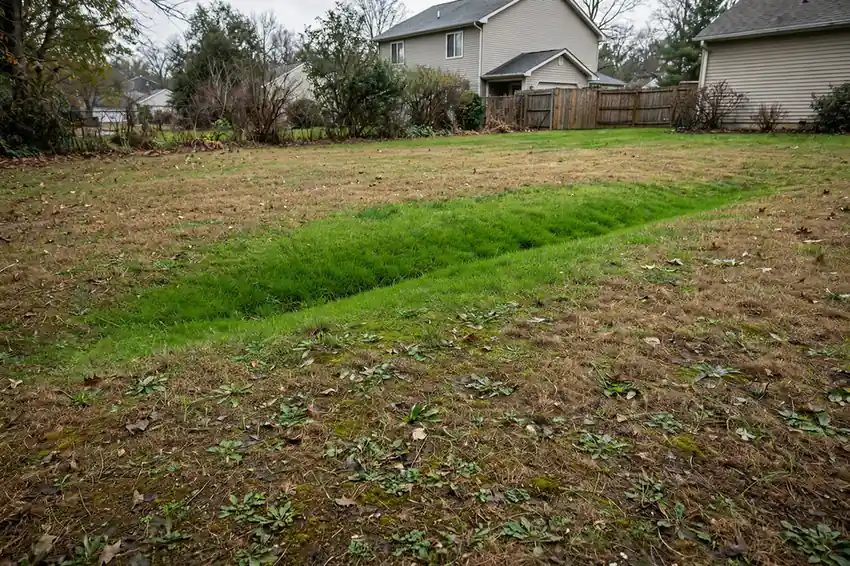
Sign five: a patch of lawn that is conspicuously lusher, greener, or faster-growing than its surroundings. Wastewater is fertilizer, and a lateral leaking nutrient-rich water into the soil produces a visible green stripe or patch along the pipe's path. Homeowners often mow around it for a season before connecting the dots. If the lush patch sits roughly between your house and the street — the lateral's likely route — treat it as a leak indicator, not a gardening win.
Sign six: soggy ground, sunken areas, or exposed pipe. A persistently wet or sunken strip along the lateral's path means soil is being washed into a broken pipe (the ground settles as soil migrates into the break) or wastewater is surfacing. In winter, a patch of ground that never quite freezes along the lateral's route is the same signal in seasonal form — leaking water keeps the soil warm. Any of these means the pipe's integrity is compromised, and the question is no longer whether to inspect but how soon.
7. The history itself: age, material, and neighbors
Sign seven is not a symptom but a circumstance: your line's age and material, and what is happening on your street. A 1965 clay-tile lateral under mature maples has a predictable failure profile — joint-by-joint root intrusion — whether or not it has shown symptoms yet. Orangeburg pipe from the same era is on a countdown regardless of how well the drains behave today. And when two neighbors on your block replace their laterals in the same year, it is not coincidence: same subdivision, same pipe, same soil, same age.
This is the sign that rewards proactivity. A camera inspection on a symptom-free but high-risk line — 50-year-old clay under big trees, original Orangeburg, a line that has never been inspected — costs a fraction of an emergency replacement and converts unknown risk into a managed plan. The ideal time to learn your line's condition is before it starts sending the other six signals.
What to do when you spot the signs
One mild sign — a occasionally slow drain, a faint occasional gurgle — merits watching and household habit review: ease off the grease and wipes, note whether it recurs. Two or more signs, any recurring backup, or any outdoor evidence merits a camera inspection without delay. The inspection converts suspicion into footage, and footage into a plan: root cutting and monitoring, a sectional lining, or a scheduled replacement on your timeline rather than the pipe's.
Do not wait for the backup to force the decision. Every sign on this list is cheaper to address early — roots cut before they become a mass, a cracked section lined before it collapses, a replacement scheduled in summer rather than excavated in a January emergency. If several signs are present at your Buffalo Grove home, call (833) 713-2101 and ask for an inspection: knowing is always cheaper than wondering, and the camera does not lie.
Frequently Asked Questions
Which sign means I should call immediately?
Any active sewage backup — wastewater entering the home — is an immediate call, as is a sudden sinkhole or collapse along the lateral's path. The other signs warrant prompt (not emergency) attention: schedule a camera inspection within days to weeks. The distinction is whether damage is happening now versus developing.
Can a sewer line fail with no warning signs at all?
Rarely with truly zero warning — but warnings get missed. Orangeburg collapse can feel sudden because the deformation is invisible until it is critical, and a line that has never been inspected can harbor advanced root intrusion behind normally functioning drains. This is why age-and-material risk (sign seven) justifies inspection even without symptoms.
My neighbor just replaced their sewer line. Should I worry?
Pay attention, not panic. Same-era subdivisions often share pipe material, soil, and age, so a neighbor's failure raises your line's risk profile — but your line has its own history of roots, repairs, and soil conditions. A camera inspection answers the question for your specific lateral in about an hour.
Do these signs always mean full replacement?
No — often the opposite. Most of these signs point to diagnosable, sometimes repairable conditions: root masses get cut, cracked sections get lined, single bad joints get spot-repaired. Replacement is for widespread or structural failure. The signs say 'inspect'; only the footage says 'replace.'
Sewer Line Problems Don’t Wait. Neither Should You.
Call now and reach a local sewer line specialist serving Buffalo Grove, IL and nearby northwest suburbs — 24/7.
(833) 713-2101Free to call · No obligation · 24/7 emergency line