
Trenchless Sewer Repair Limitations: When It Won't Work
Trenchless methods are excellent — within their limits. Here is an honest account of when lining and bursting can't do the job, and what to do instead.
In short: Trenchless sewer repair in Buffalo Grove, IL can't fix collapsed pipe, severe bellies, wrong slope, or lines without access — the method needs a workable host pipe and entry points. A camera inspection when you call (833) 713-2101 determines candidacy honestly.
Trenchless sewer repair has earned its reputation: less digging, faster projects, intact landscaping. It is genuinely the right answer for a large share of Buffalo Grove sewer problems — which is exactly why its limits deserve an honest hearing. Nothing undermines a good method faster than overselling it, and nothing costs a homeowner more than a trenchless method applied where it cannot work.
This guide is the other half of the trenchless story: the conditions that disqualify a line from lining, the conditions that disqualify it from bursting, and the situations where open-cut excavation — the method trenchless was invented to avoid — is actually the right call. If you are evaluating a trenchless quote, read this first; if a contractor cannot explain these limits, get a second opinion.
What trenchless methods need to succeed
Both major trenchless methods — CIPP lining and pipe bursting — need two things: a host pipe they can work with, and access at the ends. Lining needs a host pipe that still has its shape; the liner follows the old pipe's interior, so whatever geometry the old pipe has, the new pipe inherits. Bursting needs a host pipe that can be fragmented and a clear path to pull through; the bursting head follows the old line's route, so whatever route the old pipe takes, the new pipe follows.
Access means workable entry and exit points — typically a cleanout, an existing excavation, or two small pits the crew digs. A lateral with no accessible ends, or one whose ends sit under structures that cannot be disturbed, starts at a disadvantage. And both methods need accurate diagnostics: the camera footage that proves the line qualifies. Trenchless without a camera inspection first is not trenchless — it is guessing with expensive equipment.
Limitation 1: collapsed and severely deformed pipe
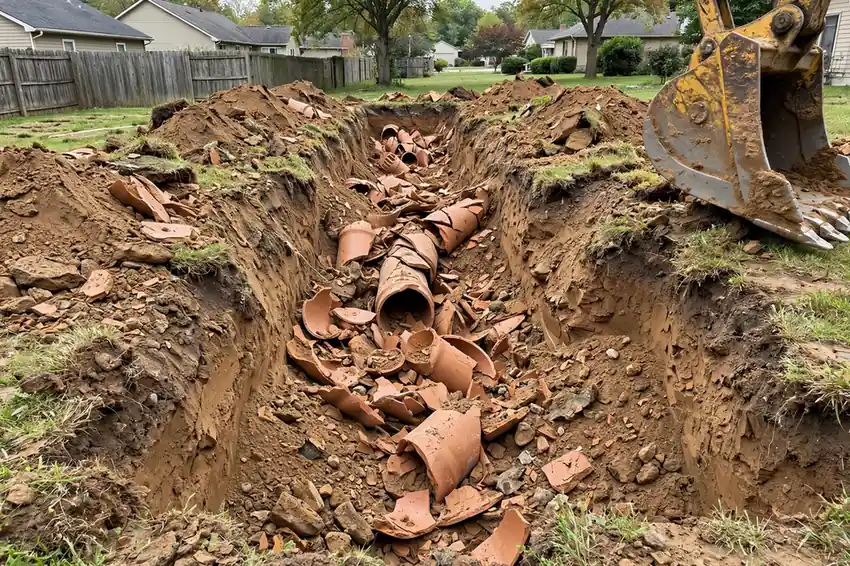
A collapsed section is the hard stop for lining. The liner is a flexible tube that must travel through the old pipe and then hold a round shape while it cures; a collapsed section is a roadblock the liner cannot pass and a void it cannot bridge. Severely deformed pipe — Orangeburg gone fully oval, clay tile crushed into shards — presents the same problem: there is no host shape to line. A contractor who proposes lining over a collapse is proposing a very expensive way to create a blocked liner.
Bursting handles some of what lining cannot — it is designed for failed pipe, fragmenting the old line as it goes. But even bursting has its collapse limit: a fully collapsed section filled with compacted soil can stop the bursting head, or the head can wander off the old path in the void. The camera footage distinguishes 'failed but followable' from 'collapsed beyond trenchless' — and that distinction is a judgment call that belongs to an experienced technician looking at actual footage, not a sales script.
Limitation 2: grade problems — bellies and back-pitch
Neither trenchless method fixes slope. A belly — a low spot where the pipe sags and holds standing water — will still be a belly after lining, because the liner cures into the sag. A line installed at the wrong slope, running flat or even uphill in sections, keeps its wrong slope after bursting, because the new pipe follows the old path. Trenchless methods renew the pipe; they do not re-engineer it.
This matters enormously in Buffalo Grove's clay soil, where freeze-thaw heave and soil settlement create bellies over time. A camera that shows the lens swimming through standing water in an otherwise intact line is showing a grade problem, and the honest recommendation is open-cut correction of that section — excavate, re-bed, re-lay at proper slope — not a liner that preserves the defect in smoother material. Lining a belly is polishing a problem, not solving it.
Limitation 3: access, bends, and nearby utilities
Trenchless equipment needs room to work. Lining needs an insertion point large enough for the liner and inversion equipment; bursting needs entry and exit pits with space for the pulling rig. Laterals that dive under additions, pools, or detached garages with no accessible endpoints can defeat both methods — the cure would be worse than the disease if reaching the pipe requires demolishing the structure anyway.
Sharp bends and severe offsets stop both methods too: a liner wrinkles or stalls at a hard bend, a bursting head jams at a severe offset. And the soil-displacement of bursting demands clearance from parallel utilities — gas, electric, fiber running close alongside the sewer must be located and given room, and in congested utility corridors the safe answer may be careful open excavation instead. The pre-job utility locate is not paperwork; for bursting, it is a go/no-go input.
Limitation 4: when the line needs to change
Sometimes the right fix is not renewing the old line but building a better one: rerouting around an impossible obstacle, upsizing beyond what bursting can achieve, correcting a route that was poorly chosen decades ago, or separating a combined problem (like a lateral that also carries foundation drainage it should not). Trenchless methods follow the existing pipe; they cannot improve on its route.
There is also the simple matter of connection quality. A lateral whose problems concentrate at the municipal tap — a bad tap, a misaligned connection, root intrusion at the main — may need open work at the street regardless of what trenchless does for the rest of the run. The method serves the diagnosis, not the other way around: define what the line needs, then pick the method that delivers it, even if the answer is a trench.
What to do when trenchless won't work
First, do not despair — 'not trenchless' is not 'not fixable.' Open-cut replacement remains the definitive repair: it fixes grade, replaces any material, reroutes where needed, and gives the inspector full visibility of the work. For a line disqualified from trenchless on grade or collapse grounds, open-cut is not the consolation prize; it is the correct engineering answer, and it comes with the longest track record in the business.
Second, consider hybrid approaches: burst the long straight run trenchlessly, open-cut just the bellied section that needs regrading. Good contractors think in combinations, not in single methods. And third, get the disqualification in writing with the footage that supports it — 'lining won't work because of the belly at 52 feet, visible here' is a professional opinion you can verify; 'trenchless won't work, trust me' is not. The same camera that qualifies lines for trenchless also disqualifies them, honestly, when the evidence points that way.
Frequently Asked Questions
Can a collapsed sewer line be fixed without digging?
Generally no. A truly collapsed section defeats lining (the liner cannot pass or hold shape) and usually defeats bursting (the head cannot follow a destroyed path reliably). Collapsed sections are the core case for open-cut excavation — or, in limited situations, a hybrid where the collapsed section is excavated and the rest is handled trenchlessly.
Will trenchless work on Orangeburg pipe?
It depends on the Orangeburg's condition. Intact, round Orangeburg can sometimes be lined; deformed or collapsing Orangeburg usually cannot be lined and is a candidate for bursting, which fragments the fiber pipe effectively. The camera footage decides — Orangeburg that has gone oval is past lining but often perfect for bursting.
Does trenchless repair last as long as traditional replacement?
The trenchless products themselves — cured epoxy liners, fused HDPE pipe — meet or exceed the longevity of traditionally installed pipe. What matters is matching the method to the condition: a liner correctly applied to a qualifying line lasts as long as the pipe it renews would have; a liner misapplied to a collapsing line fails early. Longevity follows correct application, not the method's name.
How do I know if a contractor's 'trenchless won't work here' is honest?
Ask to see the footage and the specific defect behind the verdict — a visible collapse, a measured belly holding water, a severe offset. An honest disqualification points at evidence; a dishonest one leans on authority. And remember the incentive runs both ways: some contractors push trenchless where it does not fit, others push excavation where trenchless would do — the footage is the neutral referee.
Sewer Line Problems Don’t Wait. Neither Should You.
Call now and reach a local sewer line specialist serving Buffalo Grove, IL and nearby northwest suburbs — 24/7.
(833) 713-2101Free to call · No obligation · 24/7 emergency line