
Trenchless vs. Traditional Sewer Repair: A Fair Comparison
Two philosophies for fixing the same pipe: renew it from the inside (or through its own path) versus dig it up and replace it. An honest comparison.
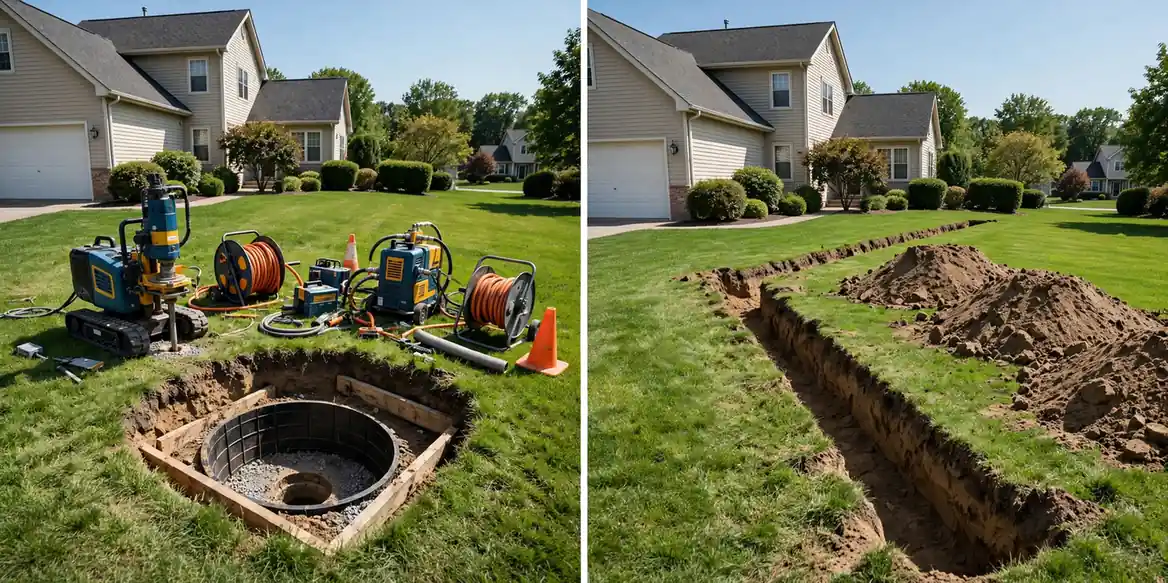
In short: Trenchless sewer repair in Buffalo Grove, IL renews or replaces pipe with minimal digging; traditional open-cut excavates the full line. Trenchless usually means less disruption and faster restoration; traditional is required for grade fixes and reroutes. Call (833) 713-2101 to compare against your footage.
Every sewer repair conversation in Buffalo Grove eventually reaches the fork: trenchless or traditional? The terms get thrown around like rival brands, and partisans on both sides oversell their case — trenchless evangelists who never mention its limits, excavation loyalists who dismiss methods they do not offer. The reality is less dramatic: these are two toolkits for different situations, and the right choice is the one matched to your pipe's condition, not to anyone's sales pitch.
This guide compares them fairly across the dimensions that actually matter to a homeowner: what each method does, disruption to your property, timeline, the quality and longevity of the result, and — most importantly — the situations where each one is genuinely the better answer. No method wins in the abstract. The pipe decides.
What each approach actually means
'Traditional' sewer repair means open-cut excavation: digging a trench along the pipe's path, removing the old pipe, laying new pipe with proper bedding and slope, backfilling, compacting, and restoring the surface. It is the oldest method, the most visually dramatic, and the only one that gives the crew — and the inspector — full visual access to the entire installation. When people picture sewer work, they picture this.
'Trenchless' covers two distinct methods. CIPP lining renews the pipe from the inside: a resin-saturated liner is inverted into the old pipe and cured, creating a new jointless pipe within the old one. Pipe bursting replaces the pipe through its own path: a bursting head fragments the old line while pulling new HDPE pipe behind it. Both need only small access points rather than a continuous trench. Lining preserves the old pipe as a host; bursting destroys it and installs new. What they share is minimal surface disruption — and what neither can do is change the pipe's route or grade.
Round 1: disruption to your property
This is trenchless's home turf, and it is not close. Open-cut excavation tears up everything above the line: lawn, gardens, driveways, patios, sidewalks, fences — anything in the trench's path, plus room for equipment and soil stockpiles. Restoration is a genuine second project with its own timeline: sod or seed, concrete repouring, paver matching, landscape rebuilding. For a lateral under a finished yard, restoration can rival the pipe work in scope.
Trenchless confines the mess to access points — a cleanout, or entry and exit pits a few feet square. The lawn between them stays lawn; the driveway stays driveway; the 40-year-old oak stays exactly where it is. In villages with tree-preservation rules like Lincolnshire, that difference is not just cosmetic — it is the difference between a permittable project and a regulatory fight. On disruption, trenchless wins decisively wherever it applies.
Round 2: timeline
Trenchless projects are typically shorter, but the reasons are worth understanding. A lining or bursting job on a residential lateral usually completes its pipe work in one to two days; the schedule is dominated by the process (cleaning, liner cure, the pull) rather than by earthmoving. Open-cut replacement of the same lateral takes several days, and most of the extra time is excavation, backfill in compacted lifts, and surface restoration — not pipe laying.
The gap widens with complexity: deeper lines, longer runs, and street work all stretch open-cut timelines while barely affecting trenchless ones. But timelines also depend on factors neither method controls — permits, utility marking lead time, inspector scheduling, weather. A trenchless job waiting on a permit takes as long as an open-cut job waiting on the same permit. Compare realistic schedules for your specific project, not method stereotypes.
Round 3: quality and longevity of the result
Here the comparison gets more interesting, because both methods, correctly applied, produce excellent pipe. A CIPP liner creates a smooth, jointless, corrosion-proof interior rated for decades of service; it is a new pipe by every functional measure. Pipe bursting installs continuous fused HDPE — jointless, root-proof, flexible — arguably the finest residential sewer pipe available. Neither is a compromise product; both are specified by municipalities for their own infrastructure.
Open-cut's quality advantage is visibility and control: the crew sees the bedding, verifies the slope continuously, inspects every joint, and the municipal inspector sees it all too. A perfectly installed open-cut PVC or HDPE line is the gold standard — but note the qualifier. Open-cut's quality depends entirely on the crew doing the unglamorous work right: bedding, slope, compaction. A sloppy open-cut job with bellies and poor compaction is worse than a good trenchless job. Method matters less than execution; the stronger method poorly installed loses to the alternative well installed.
When traditional wins outright
Traditional excavation is not the outdated option — it is the necessary option in several situations. Grade problems: bellies, back-pitch, and wrong slope can only be corrected by exposing the pipe and re-laying it; trenchless preserves grade defects. Collapsed sections beyond bursting's ability: when the old path is destroyed, only open excavation re-establishes it. Reroutes: when the line needs a better path — around a new addition, away from a failing corridor — only digging creates it.
Bad taps and municipal connection problems also favor open work at the street end, and lines with no accessible endpoints for trenchless equipment leave no alternative. In these cases traditional is not the fallback; it is the correct engineering answer, and a contractor who recommends it is doing their job. The full replacement process exists precisely for lines that need more than renewal.
When trenchless wins outright
Trenchless wins wherever the pipe's path and grade are sound but the pipe itself is failing — the most common residential scenario. A clay-tile lateral with root-invaded joints but correct slope is a textbook lining candidate. A collapsed Orangeburg or deteriorated clay run under a finished landscape is a textbook bursting candidate. In both cases trenchless delivers a renewed or new pipe while the yard, driveway, and patio carry on undisturbed.
It also wins on risk: less excavation means less chance of utility strikes, less soil settlement afterward, and less exposure to weather delays. And it wins whenever surface restoration would dominate the project — under driveways, parking areas, mature landscaping, or anywhere the 'after' matters as much as the 'during.' For the large middle of Buffalo Grove's sewer problems — aging but correctly routed lines — trenchless methods are not just less disruptive; they are the proportionate response.
Making the call for your line
The decision procedure is the same as ever: camera inspection first, with measured distances to every defect. Then map the findings to the methods: localized defect in sound pipe — spot repair or sectional lining; widespread joint failure with sound grade — full lining or bursting; collapse, grade problems, or needed reroute — open-cut. The footage usually makes the answer obvious, which is why method debates resolve quickly once everyone is looking at the same video.
Beware the contractor who offers only one method — their recommendation will mysteriously always be the method they sell. Get the footage, get options mapped to it, and if the recommendation surprises you, get a second opinion with its own camera run. Trenchless versus traditional is not a loyalty test; it is a matching problem, and the pipe is the question.
Frequently Asked Questions
Is trenchless repair just as durable as digging and replacing?
Yes, when correctly matched to the pipe's condition. Cured-in-place liners and fused HDPE pipe (from bursting) are engineered products with long design lives, specified for municipal as well as residential use. Durability follows correct application — the right method for the footage — more than the category of method.
Why would anyone choose traditional digging if trenchless exists?
Because trenchless cannot fix everything: collapsed sections it cannot pass, grade problems it cannot correct, routes it cannot change, and access situations it cannot reach. In those cases open-cut is not the worse option — it is the only correct one. Traditional also gives full visual verification of bedding, slope, and joints.
Can the two methods be combined on one project?
Absolutely, and good contractors do it routinely: burst the long straight run trenchlessly while open-cutting just the bellied section that needs regrading, for example. Hybrid approaches get the disruption savings of trenchless where it applies and the corrective power of excavation where it is needed.
Does trenchless work on every pipe material?
No. Lining needs an intact host shape — sound clay, cast iron, or concrete qualify; collapsed pipe and fully deformed Orangeburg do not. Bursting fragments brittle hosts (clay, cast iron, concrete, Orangeburg) but cannot burst PVC or HDPE. The camera footage plus the material determines which trenchless menu, if any, applies to your line.
Sewer Line Problems Don’t Wait. Neither Should You.
Call now and reach a local sewer line specialist serving Buffalo Grove, IL and nearby northwest suburbs — 24/7.
(833) 713-2101Free to call · No obligation · 24/7 emergency line