Sewer Line Repair · Buffalo Grove, IL

Commercial Sewer Services in Arlington Heights, IL

Commercial sewer lines in Arlington Heights carry more than residential ones ever will. We keep downtown restaurants and shops near Arlington Park and the Metra UP-NW station flowing with planned maintenance and fast response.

  • Camera-Verified Diagnosis
  • Trenchless Options
  • Day & Night Service
Commercial Sewer Services in Arlington Heights, IL

In short: If your Arlington Heights business depends on working drains — downtown restaurants and shops do — this page explains commercial sewer care for 60004. The first step when you call (833) 713-2101 is always a conversation about your building, your hours, and your trouble history.

Commercial Sewer Services in Arlington Heights: What Local Businesses Should Know

Walk behind any restaurant in Arlington Heights and you will find the same setup: a grease interceptor the size of a bathtub, a mop sink that drains to the main line, and a lateral running to the street that also serves the restrooms. For downtown restaurants and shops near Arlington Park and the Metra UP-NW station, that lateral is often clay tile and Orangeburg laterals — decades old, narrowed by grease, and asked to carry far more than it was designed for. The first sign of trouble is rarely a full backup; it is the kitchen drain that runs a little slower each month.

That slow decline is exactly what commercial maintenance programs are for. A jetting visit in Arlington Heights strips the grease back to bare pipe wall, a camera pass documents the line's real condition, and the schedule repeats before the buildup returns — timed to the business cycle, not the calendar year. Downtown restaurants and shops that wait for a backup pay for it in lost service and cleanup; downtown restaurants and shops on a program mostly forget the sewer exists, which is the whole point.

Warning Signs Your Arlington Heights Business Has a Sewer Problem

Your building talks before it fails. Downtown restaurants and shops in Arlington Heights near Arlington Park and the Metra UP-NW station that notice these symptoms early usually need a cleaning or a spot repair; the ones that wait usually need both, plus cleanup.

Backups that return weeks after snaking

A cable that punches through grease leaves the walls coated — the blockage rebuilds on schedule. For downtown restaurants and shops in Arlington Heights near Arlington Park and the Metra UP-NW station on clay tile and Orangeburg laterals, recurring backups are the business case for hydro-jetting: full-diameter cleaning instead of another temporary hole.

Multiple tenants complaining at once

When several suites or units report slow drains in the same week, the shared building sewer is the common denominator. Arlington Heights properties near Arlington Park and the Metra UP-NW station with shared clay tile and Orangeburg laterals need a main-line camera inspection — fixture-level fixes will keep failing.

Restroom backups during busy periods

Toilets that burp or back up when the building is full point to a main line at capacity, not a fixture problem. In Arlington Heights commercial buildings near Arlington Park and the Metra UP-NW station on clay tile and Orangeburg laterals, this is the classic sign the building sewer needs jetting — and a camera look at why it keeps happening.

Floor drains that won't stay clear

Mop sinks and kitchen floor drains tie straight into the lateral, so chronic slow drainage there means the main is constricted. For downtown restaurants and shops near Arlington Park and the Metra UP-NW station in Arlington Heights, snaking the fixture buys days; jetting the clay tile and Orangeburg laterals serving the building buys months.

Kitchen drains slow down during rush

When the lunch or dinner rush slows the kitchen line in a Arlington Heights restaurant, grease is narrowing the pipe faster than the off-hours flow can clear it. Downtown restaurants and shops near Arlington Park and the Metra UP-NW station that notice the pattern should schedule jetting before the line closes completely — a planned visit costs a fraction of a mid-service backup.

Grease interceptor backing up or overflowing

An interceptor that needs pumping every few weeks instead of every few months is telling you the downstream line is restricted. For downtown restaurants and shops in Arlington Heights near Arlington Park and the Metra UP-NW station, the fix is rarely a bigger trap — it is cleaning the grease-loaded clay tile and Orangeburg laterals between the trap and the street.

Persistent odors staff can't source

Sewer gas that survives a deep clean is coming from the lines, not the surfaces — dry traps, a cracked vent, or buildup in clay tile and Orangeburg laterals under the building. Downtown restaurants and shops in Arlington Heights near Arlington Park and the Metra UP-NW station should treat unexplained odor as a sewer symptom, because customers notice it before the health inspector does.

Parking lot or pavement settling over the line

A dip in the asphalt that follows the lateral's path to the street can mean soil washing into a broken pipe. Downtown restaurants and shops in Arlington Heights near Arlington Park and the Metra UP-NW station should get that section camera-inspected: a void under pavement becomes a collapse, and collapses do not schedule themselves.

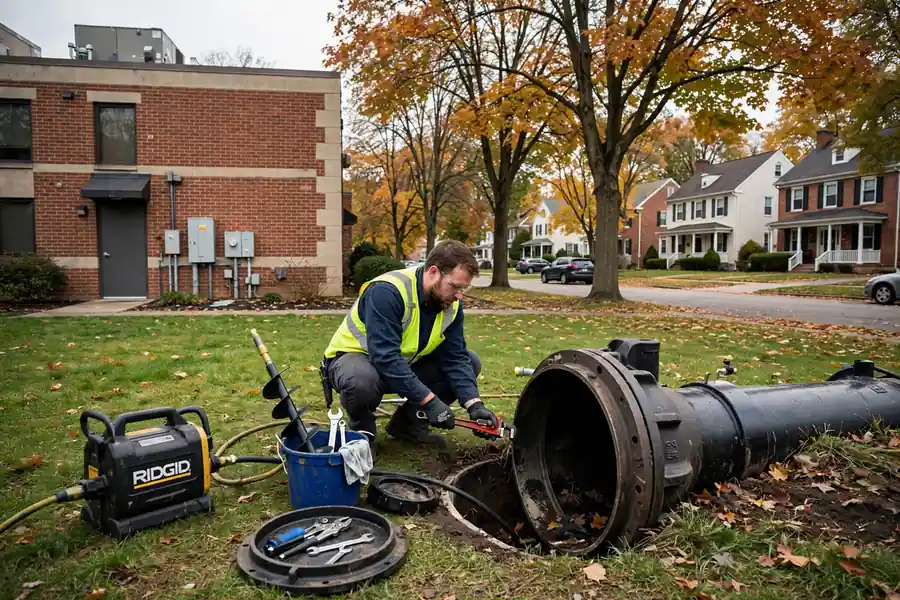
How Commercial Sewer Services Works

Every commercial engagement in Arlington Heights starts with a site survey, not a sales pitch. A technician walks the property near Arlington Park and the Metra UP-NW station with the manager, locating cleanouts, opening the grease interceptor, and noting the fixtures that drain to each line. For downtown restaurants and shops, that walk produces a map: which clay tile and Orangeburg laterals serve the kitchen, which serve the restrooms, and where they join before leaving the building.

The camera comes next. It travels the building sewer from the cleanout to the city main, recording grease depth, scale, root entry, bellies, and offsets — the full condition of clay tile and Orangeburg laterals under downtown restaurants and shops in Arlington Heights. The footage is shared with the manager, so decisions about jetting, repair, or replacement are made with evidence. Most commercial lines near Arlington Park and the Metra UP-NW station show a mix: heavy grease near the kitchen tie-in, roots near the street.

Hydro-jetting is the core commercial service: a high-pressure hose scours the full interior diameter of the pipe, stripping grease and scale back to bare wall and flushing it to the municipal main. On clay tile and Orangeburg laterals serving downtown restaurants and shops near Arlington Park and the Metra UP-NW station, a jetting pass is sized to the line — bigger nozzles, longer runs, and interceptor-to-main coverage that a residential visit never needs. Where roots have entered joints, mechanical cutting precedes the jetter.

Then comes the part residential pages skip: the program. Downtown restaurants and shops in Arlington Heights near Arlington Park and the Metra UP-NW station get a written schedule — jetting intervals matched to grease load, interceptor pumping on a calendar, and an annual camera check that catches new problems while they are small. Repairs, when needed, are planned around business hours: after-close excavation, weekend lining work, and trenchless options that keep the parking lot intact.

Arlington Heights's Sewer Conditions — and How They Change This Service

Area Facts

ZIP code
60004
Housing stock
Median construction year 1974
Typical sewer lines
Clay tile laterals in the pre-1970 core
Soil
Glacial till, silty clay loam (Markham/Elliott series)
Key local factor
Mixed-era laterals mean every job starts with a camera locate: clay tile in the 1950s core vs Orangeburg in the 60s-70s tracts.

The clay tile and Orangeburg laterals under Arlington Heights define how commercial work is done here. Mature street-tree roots invading clay tile joints means the camera survey matters more than the jetter on the first visit: the technician maps exactly where grease, roots, or scale concentrate in the lines serving downtown restaurants and shops near Arlington Park and the Metra UP-NW station, so cleaning and repair target those sections instead of treating the whole run blindly.

Finished basements that rule out messy interior work shapes the logistics of every commercial job. Because Median construction year 1974 and the buildings around them come with that constraint in Arlington Heights, crews plan access, staging, and work hours before they arrive — confirming cleanout locations, scheduling around occupants and customers, and choosing methods that keep the property open. It is routine work for teams serving 60004 every week, but it is planned work, not improvised.

NW Chicago suburbs: ~32 in annual precip, ~28 in snowfall, avg winter low ~19F, summer high ~84F. Freeze-thaw heave In Arlington Heights, Glacial till, silty clay loam (Markham/Elliott series) near Arlington Park and the Metra UP-NW station, which is why commercial programs here watch how water moves around the building sewer, not just what flows through it. A cleared line with proper flow handles spring melt and summer storms the way it was designed to; a partially blocked one turns the first heavy rain into an emergency call — during business hours.

From First Call to Maintenance Program

Step 1: Walk the building with you

Call (833) 713-2101 and a specialist visits your Arlington Heights property near Arlington Park and the Metra UP-NW station — mapping lines, opening interceptors, and hearing the trouble history from the people who live with the drains. For downtown restaurants and shops, this survey is the foundation every later decision rests on.

Step 2: Camera inspection and diagnosis

The building sewer gets a full camera pass from cleanout to city main, and you watch the footage. Downtown restaurants and shops near Arlington Park and the Metra UP-NW station see exactly what is inside their clay tile and Orangeburg laterals: grease depth, root entry points, bellies, and breaks — no guesswork in the diagnosis.

Step 3: Written plan and schedule

You get a plain-language proposal: what needs cleaning now, what needs repair, and what belongs on a maintenance calendar. Work windows are set around your business hours in Arlington Heights — after close, weekends, or phased so the operation never stops.

Step 4: Cleaning and immediate repairs

Hydro-jetting restores full diameter to the clay tile and Orangeburg laterals serving your building, mechanical cutting clears root masses, and interceptors are pumped and serviced. Urgent defects found on camera — a broken section threatening collapse — are stabilized first.

Step 5: Planned repairs, trenchless where possible

Sections that cleaning cannot save get repaired on schedule — pipe bursting or lining under parking lots and landscaping near Arlington Park and the Metra UP-NW station, open-cut only where it makes sense. Downtown restaurants and shops in Arlington Heights approve the method knowing the disruption in advance.

Step 6: Maintenance program kickoff

The line is re-cameraed to verify the work, and the maintenance calendar starts: jetting intervals matched to your grease load, interceptor pumping dates, and an annual inspection. Your Arlington Heights building near Arlington Park and the Metra UP-NW station joins the route — the sewer becomes a managed asset, not a recurring surprise.

FAQs

Frequently Asked Questions

What should staff stop putting down the drains?

Grease, food solids, coffee grounds, and 'flushable' wipes — the four horsemen of commercial blockages in clay tile and Orangeburg laterals. Downtown restaurants and shops in Arlington Heights near Arlington Park and the Metra UP-NW station also do well to keep mop water with floor finish, paint, and harsh chemical openers out of the lines; a staff huddle on drain habits is the simplest sewer maintenance there is.

What does a commercial sewer maintenance program include?

Scheduled hydro-jetting, interceptor service, and an annual camera inspection of the building sewer — with the footage and a written condition report after every visit. For Arlington Heights properties near Arlington Park and the Metra UP-NW station with clay tile and Orangeburg laterals, the program also tracks trouble spots over time, so a joint that collects roots gets watched instead of rediscovered.

How often should a restaurant's sewer line be jetted in Arlington Heights?

It depends on grease load, not the calendar alone. A busy kitchen among downtown restaurants and shops near Arlington Park and the Metra UP-NW station on clay tile and Orangeburg laterals often needs jetting every few months; lighter food operations can go longer. The first camera inspection sets the real interval: if the walls were half-closed with grease, the schedule tightens; if they were mostly clear, it relaxes.

Can trenchless repair work under our parking lot?

Usually yes — that is exactly what trenchless methods are for. Pipe bursting and lining replace clay tile and Orangeburg laterals under pavement near Arlington Park and the Metra UP-NW station through small access pits instead of trenching the lot. The camera inspection confirms the line is a candidate: it needs enough structural integrity to guide the new pipe.

Do you service grease interceptors in Arlington Heights?

Yes — pumping, cleaning, and the line between the interceptor and the street, which is where most 'interceptor problems' actually live. For downtown restaurants and shops near Arlington Park and the Metra UP-NW station in Arlington Heights, we size the service to the trap and the kitchen's output on clay tile and Orangeburg laterals, and put pumping on a calendar so it never becomes an emergency.

How is commercial sewer service different from residential?

Scale, scheduling, and documentation. Commercial lines in Arlington Heights are larger, carry grease and solids residential lines never see, and serve downtown restaurants and shops that cannot close for a repair. Service is scheduled around business hours near Arlington Park and the Metra UP-NW station, and every visit leaves camera footage and a written record — the paper trail property managers and multi-location operators need.

Who is responsible for the lateral — tenant or owner?

It depends on the lease, but the building owner typically owns the lateral to the city main in Arlington Heights. Tenants among downtown restaurants and shops near Arlington Park and the Metra UP-NW station usually handle fixtures and grease practices inside their space. When responsibility is disputed, the camera footage settles it: the location of the defect decides whose line it is.

Can you work without closing our business?

That is the default plan, not a favor. For downtown restaurants and shops in Arlington Heights near Arlington Park and the Metra UP-NW station, cleaning and inspection happen after close or before open; larger repairs are phased or scheduled over weekends. Emergency containment — stopping an active backup — happens immediately regardless of the hour, then the permanent fix is planned around your operation.

Get Your Arlington Heights Sewer Line Back on Track

Commercial sewers fail on the business's schedule, never the sewer's — unless you plan it that way. Across Arlington Heights, 60004, downtown restaurants and shops keep their lines managed with camera-verified cleaning and repairs scheduled around operations. Call (833) 713-2101 any time to walk your building with a specialist.

Sewer Line Problems Don’t Wait. Neither Should You.

Call now and reach a local sewer line specialist serving Buffalo Grove, IL and nearby northwest suburbs — 24/7.

(833) 713-2101

Free to call · No obligation · 24/7 emergency line

Serving Arlington Heights, IL 60004

Call Now · (833) 713-2101