Sewer Line Repair · Buffalo Grove, IL

Emergency Sewer Repair in Deerfield, IL

Sewage backing up in your Deerfield home? Crews respond day and night across 60015 — stop the damage now, then plan the permanent fix.

  • Camera-Verified Diagnosis
  • Trenchless Options
  • Day & Night Service
Emergency Sewer Repair in Deerfield, IL

In short: Emergency sewer repair in Deerfield, IL 60015 means restoring flow and stopping damage in 1950s-70s brick Capes, ranches, and split-levels east of Waukegan Avenue — day or night. Call (833) 713-2101: the first step is always a calm set of questions so the crew arrives ready.

Sewer Emergencies in Deerfield: What to Know Before You Need Us

The anatomy of a sewer emergency in Deerfield is almost always the same. Water — or worse — appears where it should never be: the basement floor, the shower pan, the laundry tub. The fixtures involved point upstream to the cause: one bad drain is local, but several failing together means the lateral itself. Under 1950s-70s brick Capes, ranches, and split-levels east of Waukegan Avenue, that lateral is clay tile and Orangeburg laterals under dense tree canopy, sitting in Fine glacial till (Zurich/Wauconda series) that shifts with every freeze-thaw cycle.

Speed matters, but so does sequence. A crew that snakes blindly through an emergency can punch through a collapse and make it worse; a crew that cameras first knows whether the line needs clearing, cutting, or a section replaced before anyone picks up a tool. That discipline is what Deerfield emergency response east of Waukegan Avenue is built on: contain, verify, restore flow — then, with the house safe, talk about the permanent repair your clay tile and Orangeburg laterals under dense tree canopy actually need.

Signs You Have a Sewer Emergency in Deerfield

When in doubt, treat it as urgent: a 'minor' backup in clay tile and Orangeburg laterals under dense tree canopy rarely stays minor. Deerfield homeowners east of Waukegan Avenue who call early usually need a cleaning; those who wait usually need a cleaning plus repairs.

A sudden sinkhole or settled trench line

Ground that drops along the lateral's route means soil is washing into a broken pipe — the surface follows the void. Deerfield homeowners east of Waukegan Avenue should keep people and cars off it and call (833) 713-2101: the pipe below has failed.

Basement floor drain overflowing

Floor drains sit at the lowest point of 1950s-70s brick Capes, ranches, and split-levels, so they flood first when the lateral backs up. Deerfield homeowners east of Waukegan Avenue with finished basements should treat an overflowing floor drain as a race against the water — call (833) 713-2101 before it spreads.

Sewage backing up into tubs or showers

When flushing a toilet pushes sewage up into the tub, the main line is blocked and the lowest fixtures become the overflow point. In 1950s-70s brick Capes, ranches, and split-levels east of Waukegan Avenue on clay tile and Orangeburg laterals under dense tree canopy, this is the defining emergency — stop using water and call (833) 713-2101 immediately.

No drainage anywhere in the house

When nothing drains — sinks, toilets, tubs — the lateral is fully blocked or collapsed. Deerfield homes east of Waukegan Avenue on clay tile and Orangeburg laterals under dense tree canopy reach this point after a partial blockage finally closes; every flush now adds to the backup.

Multiple drains failing at once

One slow drain is local; every drain in the house failing together is the lateral. For Deerfield homes east of Waukegan Avenue with clay tile and Orangeburg laterals under dense tree canopy, simultaneous failure means the blockage or break is in the main line — the one repair that cannot wait.

Toilets bubbling when the washer drains

The washing machine discharges a large volume fast; if toilets bubble during the cycle, the main line cannot pass that volume. In 1950s-70s brick Capes, ranches, and split-levels east of Waukegan Avenue with clay tile and Orangeburg laterals under dense tree canopy, this system-stress moment reveals a lateral near its limit.

Water pooling in the yard over the lateral

A soggy, sunken, or foul-smelling patch above the sewer's path to the street means the line is broken open underground. For 1950s-70s brick Capes, ranches, and split-levels east of Waukegan Avenue in Deerfield, that is a collapse or major break in clay tile and Orangeburg laterals under dense tree canopy — it will not improve on its own.

Gurgling toilets plus sewage odor

Gurgling means air is trapped by a blockage downstream; odor means the water seal is failing. Together in a Deerfield home east of Waukegan Avenue on clay tile and Orangeburg laterals under dense tree canopy, they are the last warning before a full backup — the emergency is hours away, not days.

How Emergency Sewer Repair Works

The emergency call to (833) 713-2101 starts with triage, not a sales script. The dispatcher asks what is backing up, which fixtures are affected, whether water is still rising, and where your cleanout is — for 1950s-70s brick Capes, ranches, and split-levels east of Waukegan Avenue, those answers tell the crew what equipment to load and what to expect inside your clay tile and Orangeburg laterals under dense tree canopy before the truck moves.

While the crew rolls, you get the two instructions that matter most: stop running water, and keep people away from any standing sewage. Every gallon sent down a blocked lateral in Deerfield has nowhere to go but back into the house. If you know where the main cleanout is east of Waukegan Avenue, clear a path to it — that is where the work starts.

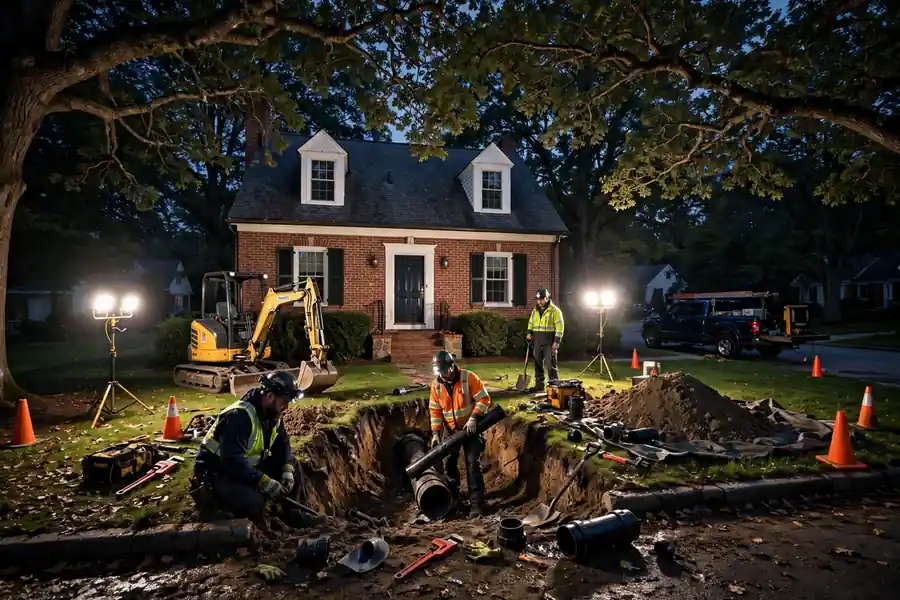
On arrival, the technician contains first and diagnoses second. The immediate goal is stopping sewage from entering the home: relieving pressure at the cleanout, then restoring flow — usually with hydro-jetting to scour the clay tile and Orangeburg laterals under dense tree canopy, or mechanical cutting when roots have claimed the line. For Deerfield emergencies east of Waukegan Avenue, the camera goes in with or right after the cleaning tools, because clearing without seeing risks missing a break.

With flow restored and the house safe, the emergency ends and the planning begins. The camera footage shows exactly what failed in your clay tile and Orangeburg laterals under dense tree canopy — a root-choked joint, a collapsed section, a belly holding water — and the technician lays out the permanent options: spot repair, sectional lining, or full replacement by bursting. Deerfield homeowners east of Waukegan Avenue decide with video evidence in hand, on a schedule they choose, instead of under pressure at midnight.

Deerfield's Sewer Conditions — and How They Change This Service

Area Facts

ZIP code
60015
Housing stock
1950s-1970s stock: 1950s brick Cape Cods east of Waukegan Ave
Typical sewer lines
Clay tile laterals in 50s stock
Soil
Fine glacial till (Zurich/Wauconda series)
Key local factor
Deerfield is a root-intrusion market: 50-70-year-old clay tile and Orangeburg laterals under one of the densest mature tree canopies in the service area, with long shallow ranch runs.

The clay tile and Orangeburg laterals under dense tree canopy under Deerfield decide what an emergency looks like here. Long shallow ranch laterals under dense tree canopy means the camera matters as much as the jetter on an emergency call: the technician must see whether the line serving your 1950s-70s brick Capes, ranches, and split-levels east of Waukegan Avenue is blocked, broken, or both — because a break cleared like a blockage will fail again within weeks.

NW-suburb freeze-thaw In Deerfield, Fine glacial till (Zurich/Wauconda series) east of Waukegan Avenue: saturated ground loads old joints and freeze-thaw shifts them, which is why so many Deerfield emergencies arrive in spring. Crews here check not just the blockage but the joints around it in your clay tile and Orangeburg laterals under dense tree canopy — clearing the symptom without reading the line is how emergencies repeat.

Decades-old landscaping that trenchless methods spare changes how emergency crews stage the job. With 1950s-1970s stock: 1950s brick Cape Cods east of Waukegan Ave in Deerfield, access, parking for equipment, and protecting finished spaces all get planned on the drive over — 60015 is served weekly, so the constraints east of Waukegan Avenue are familiar, but every emergency still gets a fresh plan, not a routine.

What Happens When You Call

Step 1: Call and triage

Call (833) 713-2101 and describe what is happening in your Deerfield home east of Waukegan Avenue — which fixtures, how fast it is getting worse, any odors or flooding. Two minutes of questions lets the dispatcher send the right crew for your clay tile and Orangeburg laterals under dense tree canopy.

Step 2: Protect the house while we roll

Stop running water, keep people and pets away from standing water, and move valuables off the basement floor if you safely can. For 1950s-70s brick Capes, ranches, and split-levels east of Waukegan Avenue, these minutes of containment limit what the emergency costs you.

Step 3: Contain on arrival

The technician's first move at your Deerfield home is stopping the damage: relieving the line at the cleanout and keeping sewage out of living space. Containment comes before diagnosis — the house gets safe first.

Step 4: Camera inspection and locate

With the immediate danger past, the camera travels your clay tile and Orangeburg laterals under dense tree canopy from cleanout to street, marking the exact location and depth of the failure. Deerfield homeowners east of Waukegan Avenue watch the monitor and see the cause themselves.

Step 5: Restore flow

Hydro-jetting scours the line back to full diameter; mechanical cutting shreds root masses at the joints. The goal for your Deerfield lateral east of Waukegan Avenue is simple: water flows out, nothing flows back.

Step 6: Plan the permanent fix

With video evidence in hand, you choose the lasting repair for your clay tile and Orangeburg laterals under dense tree canopy — spot repair, lining, or bursting — on your schedule, not in crisis mode. Your Deerfield home east of Waukegan Avenue gets a written plan and a line you can trust.

FAQs

Frequently Asked Questions

The backup stopped on its own — do I still need service?

Yes — a backup that 'fixes itself' usually means the blockage shifted, not that it left. In clay tile and Orangeburg laterals under dense tree canopy under 1950s-70s brick Capes, ranches, and split-levels east of Waukegan Avenue, the material is still in the line and the next backup is a matter of time. A camera inspection now finds what moved and what is still there, while the house is calm.

What happens after the emergency is over?

You get the camera footage, a written diagnosis of your clay tile and Orangeburg laterals under dense tree canopy, and options for the permanent fix — spot repair, lining, or bursting — with the disruption of each explained. Deerfield homeowners east of Waukegan Avenue schedule that work at their convenience; the emergency visit already restored flow, so the repair happens on your terms.

How fast can you get to Deerfield?

Crews serve 60015 every week and roll with emergency equipment on board, day and night. Exact arrival depends on where the on-call crew is when you call (833) 713-2101 from Deerfield — the dispatcher gives you a straight answer on timing during triage, not a vague window.

What should I do while waiting for the crew in Deerfield?

Stop using water — toilets, showers, laundry, dishwasher. Every gallon competes for space in your blocked clay tile and Orangeburg laterals under dense tree canopy. Keep people and pets away from standing sewage, and if you know where the cleanout is east of Waukegan Avenue, clear access to it. Do not pour chemical drain openers into a backed-up line.

Is it safe to stay in the house during a sewage backup?

Limit contact: sewage carries bacteria you do not want on skin or in the air. Keep children and pets away, avoid the affected rooms in your 1950s-70s brick Capes, ranches, and split-levels east of Waukegan Avenue, and ventilate if you can. The crew contains the source on arrival — until then, treat standing water as contaminated.

What counts as a sewer emergency in Deerfield?

Sewage entering the home, no drainage anywhere, a collapsed line, or flooding that is getting worse by the hour. A single slow drain in 1950s-70s brick Capes, ranches, and split-levels east of Waukegan Avenue can wait for a scheduled visit; sewage in the tub cannot. When in doubt, call (833) 713-2101 — triage is free and takes two minutes.

Will you have to dig up my yard east of Waukegan Avenue?

Not necessarily. Most Deerfield emergencies are resolved through the cleanout — jetting, cutting, and camera work need no excavation. Digging only enters the picture if the camera finds a collapse or break in your clay tile and Orangeburg laterals under dense tree canopy that trenchless methods cannot bridge, and even then it is a small, planned excavation.

Can heavy rain cause a sewer backup in Deerfield?

It can overload the system, especially where Fine glacial till (Zurich/Wauconda series) holds water against old joints east of Waukegan Avenue. Inflow through cracked clay tile and Orangeburg laterals under dense tree canopy plus a partially blocked line is the classic spring combination in 60015. If backups follow storms, the camera inspection should focus on infiltration points, not just blockages.

Get Your Deerfield Sewer Line Back on Track

Nobody plans a sewer emergency — but Deerfield homeowners east of Waukegan Avenue can plan their response: save (833) 713-2101 now, stop the water, and let a crew that knows clay tile and Orangeburg laterals under dense tree canopy handle the rest. The emergency ends the night it starts; the permanent fix follows on your schedule.

Sewer Line Problems Don’t Wait. Neither Should You.

Call now and reach a local sewer line specialist serving Buffalo Grove, IL and nearby northwest suburbs — 24/7.

(833) 713-2101

Free to call · No obligation · 24/7 emergency line

Serving Deerfield, IL 60015

Call Now · (833) 713-2101