Sewer Line Repair · Buffalo Grove, IL

Emergency Sewer Repair in Prospect Heights, IL

Sewage backing up in your Prospect Heights home? Crews respond day and night across 60070 — stop the damage now, then plan the permanent fix.

  • Camera-Verified Diagnosis
  • Trenchless Options
  • Day & Night Service
Emergency Sewer Repair in Prospect Heights, IL

In short: Emergency sewer repair in Prospect Heights, IL 60070 means restoring flow and stopping damage in 1970s homes and condo blocks along Milwaukee Avenue — day or night. Call (833) 713-2101: the first step is always a calm set of questions so the crew arrives ready.

Sewer Emergencies in Prospect Heights: What to Know Before You Need Us

The anatomy of a sewer emergency in Prospect Heights is almost always the same. Water — or worse — appears where it should never be: the basement floor, the shower pan, the laundry tub. The fixtures involved point upstream to the cause: one bad drain is local, but several failing together means the lateral itself. Under 1970s homes and condo blocks along Milwaukee Avenue, that lateral is 1970s cast-iron and clay tile systems, sitting in Glacial till that shifts with every freeze-thaw cycle.

Speed matters, but so does sequence. A crew that snakes blindly through an emergency can punch through a collapse and make it worse; a crew that cameras first knows whether the line needs clearing, cutting, or a section replaced before anyone picks up a tool. That discipline is what Prospect Heights emergency response along Milwaukee Avenue is built on: contain, verify, restore flow — then, with the house safe, talk about the permanent repair your 1970s cast-iron and clay tile systems actually need.

Signs You Have a Sewer Emergency in Prospect Heights

Emergencies escalate by the hour, not the day. If your Prospect Heights home along Milwaukee Avenue shows any of these, call (833) 713-2101 now — the triage questions take two minutes and the crew rolls right after.

Multiple drains failing at once

One slow drain is local; every drain in the house failing together is the lateral. For Prospect Heights homes along Milwaukee Avenue with 1970s cast-iron and clay tile systems, simultaneous failure means the blockage or break is in the main line — the one repair that cannot wait.

No drainage anywhere in the house

When nothing drains — sinks, toilets, tubs — the lateral is fully blocked or collapsed. Prospect Heights homes along Milwaukee Avenue on 1970s cast-iron and clay tile systems reach this point after a partial blockage finally closes; every flush now adds to the backup.

Water pooling in the yard over the lateral

A soggy, sunken, or foul-smelling patch above the sewer's path to the street means the line is broken open underground. For 1970s homes and condo blocks along Milwaukee Avenue in Prospect Heights, that is a collapse or major break in 1970s cast-iron and clay tile systems — it will not improve on its own.

Toilets bubbling when the washer drains

The washing machine discharges a large volume fast; if toilets bubble during the cycle, the main line cannot pass that volume. In 1970s homes and condo blocks along Milwaukee Avenue with 1970s cast-iron and clay tile systems, this system-stress moment reveals a lateral near its limit.

A sudden sinkhole or settled trench line

Ground that drops along the lateral's route means soil is washing into a broken pipe — the surface follows the void. Prospect Heights homeowners along Milwaukee Avenue should keep people and cars off it and call (833) 713-2101: the pipe below has failed.

Sewage backing up into tubs or showers

When flushing a toilet pushes sewage up into the tub, the main line is blocked and the lowest fixtures become the overflow point. In 1970s homes and condo blocks along Milwaukee Avenue on 1970s cast-iron and clay tile systems, this is the defining emergency — stop using water and call (833) 713-2101 immediately.

Basement floor drain overflowing

Floor drains sit at the lowest point of 1970s homes and condo blocks, so they flood first when the lateral backs up. Prospect Heights homeowners along Milwaukee Avenue with finished basements should treat an overflowing floor drain as a race against the water — call (833) 713-2101 before it spreads.

Gurgling toilets plus sewage odor

Gurgling means air is trapped by a blockage downstream; odor means the water seal is failing. Together in a Prospect Heights home along Milwaukee Avenue on 1970s cast-iron and clay tile systems, they are the last warning before a full backup — the emergency is hours away, not days.

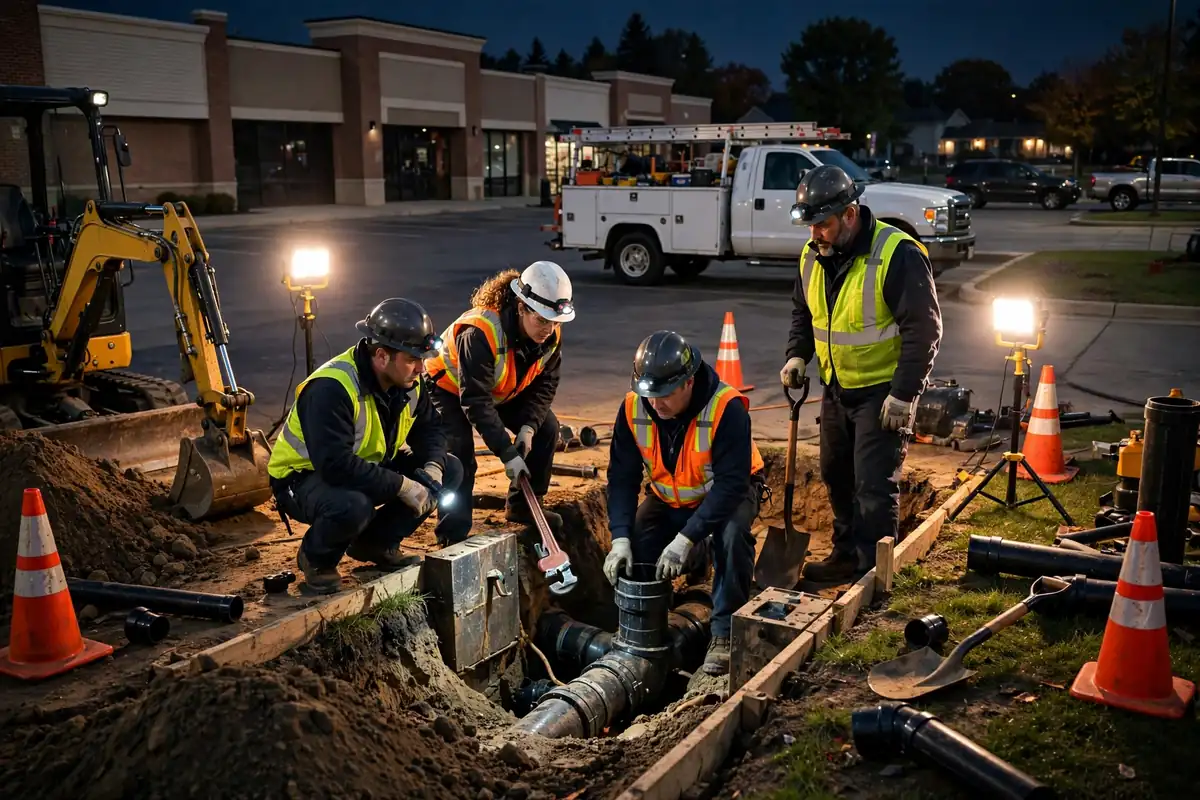
How Emergency Sewer Repair Works

The emergency call to (833) 713-2101 starts with triage, not a sales script. The dispatcher asks what is backing up, which fixtures are affected, whether water is still rising, and where your cleanout is — for 1970s homes and condo blocks along Milwaukee Avenue, those answers tell the crew what equipment to load and what to expect inside your 1970s cast-iron and clay tile systems before the truck moves.

While the crew rolls, you get the two instructions that matter most: stop running water, and keep people away from any standing sewage. Every gallon sent down a blocked lateral in Prospect Heights has nowhere to go but back into the house. If you know where the main cleanout is along Milwaukee Avenue, clear a path to it — that is where the work starts.

On arrival, the technician contains first and diagnoses second. The immediate goal is stopping sewage from entering the home: relieving pressure at the cleanout, then restoring flow — usually with hydro-jetting to scour the 1970s cast-iron and clay tile systems, or mechanical cutting when roots have claimed the line. For Prospect Heights emergencies along Milwaukee Avenue, the camera goes in with or right after the cleaning tools, because clearing without seeing risks missing a break.

With flow restored and the house safe, the emergency ends and the planning begins. The camera footage shows exactly what failed in your 1970s cast-iron and clay tile systems — a root-choked joint, a collapsed section, a belly holding water — and the technician lays out the permanent options: spot repair, sectional lining, or full replacement by bursting. Prospect Heights homeowners along Milwaukee Avenue decide with video evidence in hand, on a schedule they choose, instead of under pressure at midnight.

Prospect Heights's Sewer Conditions — and How They Change This Service

Area Facts

ZIP code
60070
Housing stock
1970s-heavy (most homes built in the 1970s
Typical sewer lines
1970s cast-iron stacks + clay tile site laterals
Soil
Glacial till
Key local factor
Prospect Heights pairs 1970s condo-block shared sewers with Des Plaines River high-water-table infiltration: backup calls here are often groundwater, not blockages, so sump/backwater-valve work rides along with every lateral job.

The 1970s cast-iron and clay tile systems under Prospect Heights decide what an emergency looks like here. Groundwater infiltration that mimics blockages means the camera matters as much as the jetter on an emergency call: the technician must see whether the line serving your 1970s homes and condo blocks along Milwaukee Avenue is blocked, broken, or both — because a break cleared like a blockage will fail again within weeks.

Freeze-thaw In Prospect Heights, Glacial till along Milwaukee Avenue: saturated ground loads old joints and freeze-thaw shifts them, which is why so many Prospect Heights emergencies arrive in spring. Crews here check not just the blockage but the joints around it in your 1970s cast-iron and clay tile systems — clearing the symptom without reading the line is how emergencies repeat.

1970s condo-block shared sewers managed by HOAs changes how emergency crews stage the job. With 1970s-heavy (most homes built in the 1970s in Prospect Heights, access, parking for equipment, and protecting finished spaces all get planned on the drive over — 60070 is served weekly, so the constraints along Milwaukee Avenue are familiar, but every emergency still gets a fresh plan, not a routine.

What Happens When You Call

Step 1: Call and triage

Call (833) 713-2101 and describe what is happening in your Prospect Heights home along Milwaukee Avenue — which fixtures, how fast it is getting worse, any odors or flooding. Two minutes of questions lets the dispatcher send the right crew for your 1970s cast-iron and clay tile systems.

Step 2: Protect the house while we roll

Stop running water, keep people and pets away from standing water, and move valuables off the basement floor if you safely can. For 1970s homes and condo blocks along Milwaukee Avenue, these minutes of containment limit what the emergency costs you.

Step 3: Contain on arrival

The technician's first move at your Prospect Heights home is stopping the damage: relieving the line at the cleanout and keeping sewage out of living space. Containment comes before diagnosis — the house gets safe first.

Step 4: Camera inspection and locate

With the immediate danger past, the camera travels your 1970s cast-iron and clay tile systems from cleanout to street, marking the exact location and depth of the failure. Prospect Heights homeowners along Milwaukee Avenue watch the monitor and see the cause themselves.

Step 5: Restore flow

Hydro-jetting scours the line back to full diameter; mechanical cutting shreds root masses at the joints. The goal for your Prospect Heights lateral along Milwaukee Avenue is simple: water flows out, nothing flows back.

Step 6: Plan the permanent fix

With video evidence in hand, you choose the lasting repair for your 1970s cast-iron and clay tile systems — spot repair, lining, or bursting — on your schedule, not in crisis mode. Your Prospect Heights home along Milwaukee Avenue gets a written plan and a line you can trust.

FAQs

Frequently Asked Questions

Is it safe to stay in the house during a sewage backup?

Limit contact: sewage carries bacteria you do not want on skin or in the air. Keep children and pets away, avoid the affected rooms in your 1970s homes and condo blocks along Milwaukee Avenue, and ventilate if you can. The crew contains the source on arrival — until then, treat standing water as contaminated.

Can heavy rain cause a sewer backup in Prospect Heights?

It can overload the system, especially where Glacial till holds water against old joints along Milwaukee Avenue. Inflow through cracked 1970s cast-iron and clay tile systems plus a partially blocked line is the classic spring combination in 60070. If backups follow storms, the camera inspection should focus on infiltration points, not just blockages.

What happens after the emergency is over?

You get the camera footage, a written diagnosis of your 1970s cast-iron and clay tile systems, and options for the permanent fix — spot repair, lining, or bursting — with the disruption of each explained. Prospect Heights homeowners along Milwaukee Avenue schedule that work at their convenience; the emergency visit already restored flow, so the repair happens on your terms.

What should I do while waiting for the crew in Prospect Heights?

Stop using water — toilets, showers, laundry, dishwasher. Every gallon competes for space in your blocked 1970s cast-iron and clay tile systems. Keep people and pets away from standing sewage, and if you know where the cleanout is along Milwaukee Avenue, clear access to it. Do not pour chemical drain openers into a backed-up line.

What counts as a sewer emergency in Prospect Heights?

Sewage entering the home, no drainage anywhere, a collapsed line, or flooding that is getting worse by the hour. A single slow drain in 1970s homes and condo blocks along Milwaukee Avenue can wait for a scheduled visit; sewage in the tub cannot. When in doubt, call (833) 713-2101 — triage is free and takes two minutes.

Will you have to dig up my yard along Milwaukee Avenue?

Not necessarily. Most Prospect Heights emergencies are resolved through the cleanout — jetting, cutting, and camera work need no excavation. Digging only enters the picture if the camera finds a collapse or break in your 1970s cast-iron and clay tile systems that trenchless methods cannot bridge, and even then it is a small, planned excavation.

The backup stopped on its own — do I still need service?

Yes — a backup that 'fixes itself' usually means the blockage shifted, not that it left. In 1970s cast-iron and clay tile systems under 1970s homes and condo blocks along Milwaukee Avenue, the material is still in the line and the next backup is a matter of time. A camera inspection now finds what moved and what is still there, while the house is calm.

How fast can you get to Prospect Heights?

Crews serve 60070 every week and roll with emergency equipment on board, day and night. Exact arrival depends on where the on-call crew is when you call (833) 713-2101 from Prospect Heights — the dispatcher gives you a straight answer on timing during triage, not a vague window.

Get Your Prospect Heights Sewer Line Back on Track

The hardest part of a backup is the helplessness. Calling (833) 713-2101 ends that part: triage in two minutes, a crew rolling with the right equipment, and a camera that finds the real problem in your 1970s cast-iron and clay tile systems. For 1970s homes and condo blocks across Prospect Heights, 60070, that is how emergencies become footnotes instead of disasters.

Sewer Line Problems Don’t Wait. Neither Should You.

Call now and reach a local sewer line specialist serving Buffalo Grove, IL and nearby northwest suburbs — 24/7.

(833) 713-2101

Free to call · No obligation · 24/7 emergency line

Serving Prospect Heights, IL 60070

Call Now · (833) 713-2101