Sewer Line Repair · Buffalo Grove, IL

Pipe Bursting in Deerfield, IL

Trenchless sewer replacement in Deerfield, IL 60015: two small pits, one powerful pull, and 1950s-70s brick Capes, ranches, and split-levels east of Waukegan Avenue get a new lateral without the trench.

  • Camera-Verified Diagnosis
  • Trenchless Options
  • Day & Night Service
Pipe Bursting in Deerfield, IL

In short: This page covers pipe bursting in Deerfield, IL 60015: how trenchless replacement works, which clay tile and Orangeburg laterals under dense tree canopy qualify, and what it costs your yard (almost nothing). When you call (833) 713-2101, the first step is a camera inspection to confirm your lateral is a bursting candidate.

Replacing Your Deerfield Sewer Line Without the Trench

Ask Deerfield homeowners east of Waukegan Avenue what they fear about sewer replacement and the answer is rarely the pipe — it is the trench. The torn-up lawn, the demolished driveway section, the mature plantings that took decades to establish. Pipe bursting answers that fear directly: the work happens underground, along the exact route of your existing clay tile and Orangeburg laterals under dense tree canopy, while the surface sees only an entry pit and an exit pit. In 60015, where 1950s-1970s stock: 1950s brick Cape Cods east of Waukegan Ave sit on established lots, that difference is the whole sale.

The pull itself is the dramatic part clients never see. A hydraulic winch draws the bursting head and new HDPE through the old line foot by foot, expanding the soil cavity just enough to seat the new pipe. Technicians monitor tension and alignment from both pits; when the head emerges at the far end, your Deerfield lateral east of Waukegan Avenue is new from foundation to main. A final camera pass documents the result — continuous, joint-free HDPE where clay tile and Orangeburg laterals under dense tree canopy used to be.

Signs Your Deerfield Lateral Is Ready for Replacement

Pipe bursting is a replacement method, so it is prescribed for lines that are done being repaired. For 1950s-70s brick Capes, ranches, and split-levels in Deerfield east of Waukegan Avenue on clay tile and Orangeburg laterals under dense tree canopy, these are the signs the lateral has reached that point.

Roots return within a year of cutting

When root masses grow back through the same joints season after season, the clay tile and Orangeburg laterals under dense tree canopy are too compromised to defend. Deerfield homeowners east of Waukegan Avenue in this cycle spend more on repeated cuttings than a single bursting job — and still own the old pipe.

Cast iron scaling down to a trickle

Old cast-iron house sewers corrode from the inside until the diameter is a fraction of original — the camera shows a rough, narrowing tunnel. Where clay tile and Orangeburg laterals under dense tree canopy in Deerfield east of Waukegan Avenue have scaled past cleaning, bursting pulls a full-diameter HDPE line through the old shell.

The lateral runs under something you love

Mature trees, a new driveway, an expensive patio — 1950s-70s brick Capes, ranches, and split-levels east of Waukegan Avenue in Deerfield often have clay tile and Orangeburg laterals under dense tree canopy running under exactly the feature open-cut would destroy. Bursting was designed for this conflict: the surface feature survives, the pipe gets replaced.

Multiple cracks or breaks on camera

A camera survey showing fractures at several points along your Deerfield lateral east of Waukegan Avenue means spot repairs would chase failures down the line. Bursting replaces the whole run of clay tile and Orangeburg laterals under dense tree canopy in one pull — the economics flip once breaks are plural.

A belly that keeps collecting debris

A low spot in the lateral holds water and everything in it, and no cleaning changes the grade. If your Deerfield line east of Waukegan Avenue has a belly the camera keeps finding in clay tile and Orangeburg laterals under dense tree canopy, bursting installs a correctly graded HDPE replacement — the only fix that addresses the slope.

Orangeburg pipe deforming or blistering

Bituminous fiber pipe from the 60s-70s does not crack — it deforms, blisters inward, and eventually pancakes. For 1950s-70s brick Capes, ranches, and split-levels east of Waukegan Avenue in Deerfield with Orangeburg among their clay tile and Orangeburg laterals under dense tree canopy, bursting is the clean exit: the old pipe splits easily and HDPE takes its place.

A previous spot repair failed

One patched section holding while the rest of the clay tile and Orangeburg laterals under dense tree canopy continues to deteriorate is the classic prelude to full replacement. Deerfield homeowners east of Waukegan Avenue who have already paid for a spot repair know the line's trajectory — bursting finishes the job the patch started.

Repeated backups despite regular cleaning

A lateral that is jetted on schedule and still backs up is telling you cleaning is not the problem — the pipe is. Deerfield homes east of Waukegan Avenue on aging clay tile and Orangeburg laterals under dense tree canopy reach a point where each cleaning buys less time; bursting buys decades.

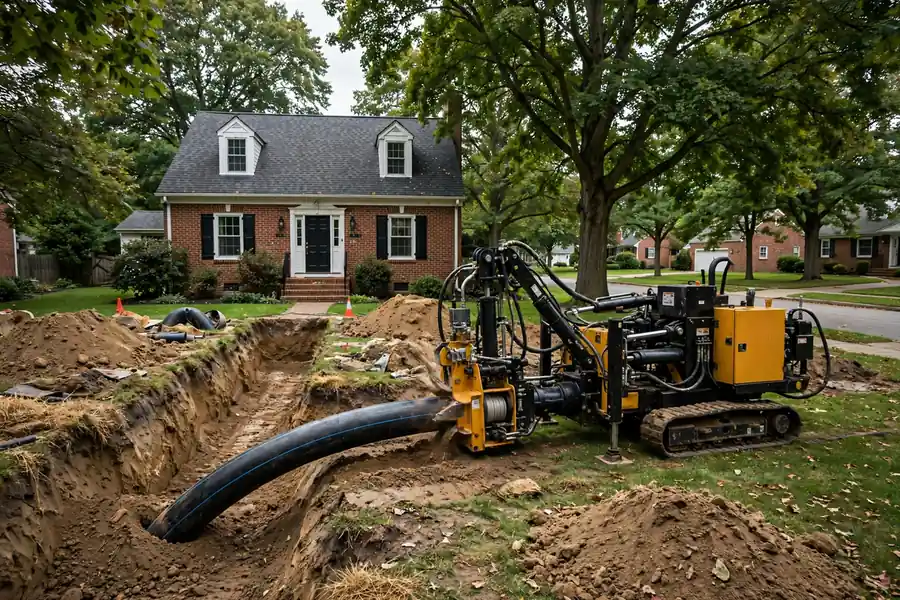
How Pipe Bursting Works, Step by Underground Step

Candidacy comes first, and it is decided on camera. The technician inspects your Deerfield lateral east of Waukegan Avenue end to end, confirming the clay tile and Orangeburg laterals under dense tree canopy form a continuous path the bursting head can follow. Collapsed voids with no pipe to guide the head, or extreme bellies, get flagged — sometimes a small spot repair first makes the line burstable. You see the footage and the verdict together.

Next the crew locates and marks the line's exact path and depth across your 60015 property, then digs two pits: an entry pit at the house end and an exit pit at the street or main connection. For 1950s-70s brick Capes, ranches, and split-levels east of Waukegan Avenue, that is the total excavation — everything else happens underground. Utilities along the route are located and cleared before any pulling begins.

The pull is the centerpiece. A steel cable is threaded through the old clay tile and Orangeburg laterals under dense tree canopy, attached to the bursting head, with the new HDPE pipe fused into one continuous length behind it. The hydraulic rig draws the assembly through foot by foot: the head fractures the old pipe outward into the surrounding soil while the HDPE slides into the enlarged cavity. Technicians at both pits monitor tension so the new line beds evenly.

Connections and proof close the job. The new HDPE is tied into your house drain at the entry pit and the city main at the exit pit — the two joints in the entire run. Everything between is one continuous, seamless pipe. Deerfield homeowners east of Waukegan Avenue watch it on the final camera pass: joint-free HDPE where clay tile and Orangeburg laterals under dense tree canopy used to be, from foundation to street.

Deerfield's Sewer Conditions — and How They Change This Service

Area Facts

ZIP code
60015
Housing stock
1950s-1970s stock: 1950s brick Cape Cods east of Waukegan Ave
Typical sewer lines
Clay tile laterals in 50s stock
Soil
Fine glacial till (Zurich/Wauconda series)
Key local factor
Deerfield is a root-intrusion market: 50-70-year-old clay tile and Orangeburg laterals under one of the densest mature tree canopies in the service area, with long shallow ranch runs.

The clay tile and Orangeburg laterals under dense tree canopy under Deerfield are why bursting fits here so well. Long shallow ranch laterals under dense tree canopy — and brittle materials like clay tile and Orangeburg are exactly what a bursting head wants: they fracture cleanly instead of resisting. The camera survey on your 1950s-70s brick Capes, ranches, and split-levels east of Waukegan Avenue confirms candidacy in one visit, and most Deerfield lines of this era pass.

NW-suburb freeze-thaw In Deerfield, Fine glacial till (Zurich/Wauconda series) east of Waukegan Avenue actually helps the method: glacial till holds the expanded cavity open while the HDPE seats, and the new fused joints ignore the freeze-thaw movement that cracked the old clay tile and Orangeburg laterals under dense tree canopy. Bursting here is not just less disruptive — in these soils, it is the technically right call for end-of-life clay and Orangeburg.

Decades-old landscaping that trenchless methods spare is the reason Deerfield homeowners choose bursting over open-cut. With 1950s-1970s stock: 1950s brick Cape Cods east of Waukegan Ave in 60015, the surface features worth protecting — established landscaping, driveways, patios — sit directly above the lateral's path east of Waukegan Avenue. Two pits versus one long trench is not a close call when the yard took decades to grow.

The Bursting Process From Camera to Final Inspection

Step 1: Camera inspection and candidacy check

Call (833) 713-2101 and a technician cameras your Deerfield lateral east of Waukegan Avenue end to end, confirming your clay tile and Orangeburg laterals under dense tree canopy can be burst. You get a straight answer — candidate or not — with the footage to back it.

Step 2: Locate, mark, and plan the pits

The line's path and depth are marked across your property, utilities are located, and the two pit positions are set — entry at the house, exit at the street. For 1950s-70s brick Capes, ranches, and split-levels east of Waukegan Avenue, the plan shows exactly what gets disturbed: two pits, nothing more.

Step 3: Dig entry and exit pits

Small, shored pits go in at both ends of your Deerfield lateral east of Waukegan Avenue. Spoil is staged on tarps, plantings along the pit edges are protected, and the rest of your yard stays untouched.

Step 4: The bursting pull

Cable through the old clay tile and Orangeburg laterals under dense tree canopy, bursting head on, new HDPE fused behind it — the rig pulls the assembly through, fracturing the old line outward and seating the new pipe in its place. Your Deerfield property east of Waukegan Avenue feels some vibration; the surface sees almost nothing.

Step 5: Connect both ends

The new HDPE is connected to your house drain inside the entry pit and to the city main at the exit pit — the two joints in the entire run. Everything between is one continuous, seamless pipe serving your 1950s-70s brick Capes, ranches, and split-levels east of Waukegan Avenue.

Step 6: Verify, backfill, restore

A final camera pass documents the new line, both pits are backfilled in compacted lifts, and the surface is restored. You keep the before-and-after footage of your Deerfield lateral east of Waukegan Avenue — proof of a new line from foundation to street.

FAQs

Frequently Asked Questions

How much of my yard gets dug up east of Waukegan Avenue?

Two pits: one at the house end of the lateral, one at the street. For 1950s-70s brick Capes, ranches, and split-levels in Deerfield east of Waukegan Avenue, that is the entire excavation — the lawn, driveway, and plantings between the pits are never opened. Compare that with open-cut trenching, which opens the whole route.

Is pipe bursting better than pipe lining for my Deerfield line?

They solve different problems. Lining seals a structurally sound but leaky line and slightly reduces diameter; bursting replaces a structurally failed line at full (or larger) diameter. For clay tile and Orangeburg laterals under dense tree canopy in Deerfield east of Waukegan Avenue that are cracked, deformed, or collapsed, bursting is the replacement — lining is the repair.

Does bursting damage nearby utility lines?

The crew locates gas, electric, water, and telecom along the route before pulling, and the bursting head's expansion is controlled and localized. In 60015, where 1950s-1970s stock: 1950s brick Cape Cods east of Waukegan Ave lots east of Waukegan Avenue have decades of buried infrastructure, those locates are non-negotiable — no pull starts until every crossing is marked.

How long does a pipe bursting job take in Deerfield?

Most residential bursting jobs on 1950s-70s brick Capes, ranches, and split-levels lots east of Waukegan Avenue complete the pull in a day once pits are dug — the calendar time is mostly the camera inspection, utility locates, and scheduling. Your crew gives you the sequence in writing before work starts.

Can the new pipe be larger than the old one?

Often yes — upsizing is one of bursting's advantages. The bursting head expands the cavity as it fractures your old clay tile and Orangeburg laterals under dense tree canopy, so the HDPE that follows can match or exceed the original diameter. For Deerfield homes east of Waukegan Avenue adding bathrooms or fixtures, that extra capacity matters.

What is HDPE and why is it better than clay tile and Orangeburg laterals under dense tree canopy?

High-density polyethylene: a flexible, seamless plastic fused into one continuous length with no joints for roots to enter. Compared with the segmented clay tile and Orangeburg laterals under dense tree canopy under 1950s-70s brick Capes, ranches, and split-levels east of Waukegan Avenue in Deerfield, HDPE does not crack at joints, does not corrode, and shrugs off the soil movement that destroyed the old line.

Will pipe bursting work on my clay tile and Orangeburg laterals under dense tree canopy in Deerfield?

If the camera shows a continuous path — even a badly cracked one — usually yes. Clay tile, Orangeburg, and cast iron all burst cleanly because they are brittle. What disqualifies a line is a fully collapsed void with no pipe left to guide the head, or a severe belly; in Deerfield east of Waukegan Avenue, the inspection gives you that answer before any commitment.

What happens to the old pipe?

It stays where it is, fractured outward into the surrounding soil — which is why the method needs no removal trench. The fragments of your old clay tile and Orangeburg laterals under dense tree canopy in Deerfield east of Waukegan Avenue become bedding around the new HDPE, harmless underground.

Get Your Deerfield Sewer Line Back on Track

The best sewer replacement is the one you barely notice happened. For 1950s-70s brick Capes, ranches, and split-levels in Deerfield east of Waukegan Avenue, pipe bursting delivers exactly that: a brand-new HDPE lateral under a yard that looks like nothing happened. Call (833) 713-2101 and start with the camera inspection that answers the only question that matters — is your line a candidate?

Sewer Line Problems Don’t Wait. Neither Should You.

Call now and reach a local sewer line specialist serving Buffalo Grove, IL and nearby northwest suburbs — 24/7.

(833) 713-2101

Free to call · No obligation · 24/7 emergency line

Serving Deerfield, IL 60015

Call Now · (833) 713-2101