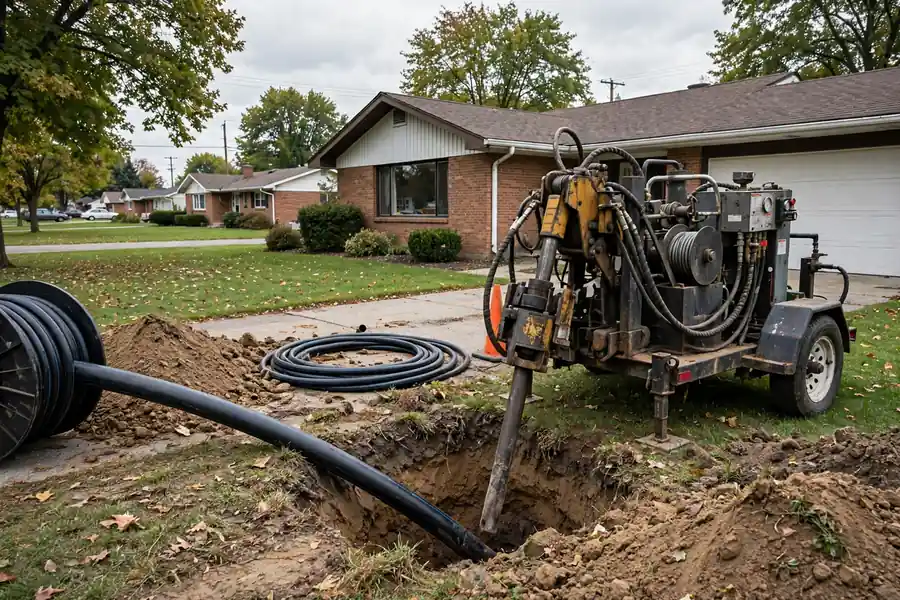
Pipe bursting is a replacement method, so it is prescribed for lines that are done being repaired. For 1960s-70s subdivisions in Palatine near downtown Palatine and the Metra station on 1960s-70s clay tile and Orangeburg laterals, these are the signs the lateral has reached that point.
Orangeburg pipe deforming or blistering
Bituminous fiber pipe from the 60s-70s does not crack — it deforms, blisters inward, and eventually pancakes. For 1960s-70s subdivisions near downtown Palatine and the Metra station in Palatine with Orangeburg among their 1960s-70s clay tile and Orangeburg laterals, bursting is the clean exit: the old pipe splits easily and HDPE takes its place.
The lateral runs under something you love
Mature trees, a new driveway, an expensive patio — 1960s-70s subdivisions near downtown Palatine and the Metra station in Palatine often have 1960s-70s clay tile and Orangeburg laterals running under exactly the feature open-cut would destroy. Bursting was designed for this conflict: the surface feature survives, the pipe gets replaced.
A belly that keeps collecting debris
A low spot in the lateral holds water and everything in it, and no cleaning changes the grade. If your Palatine line near downtown Palatine and the Metra station has a belly the camera keeps finding in 1960s-70s clay tile and Orangeburg laterals, bursting installs a correctly graded HDPE replacement — the only fix that addresses the slope.
Cast iron scaling down to a trickle
Old cast-iron house sewers corrode from the inside until the diameter is a fraction of original — the camera shows a rough, narrowing tunnel. Where 1960s-70s clay tile and Orangeburg laterals in Palatine near downtown Palatine and the Metra station have scaled past cleaning, bursting pulls a full-diameter HDPE line through the old shell.
Repeated backups despite regular cleaning
A lateral that is jetted on schedule and still backs up is telling you cleaning is not the problem — the pipe is. Palatine homes near downtown Palatine and the Metra station on aging 1960s-70s clay tile and Orangeburg laterals reach a point where each cleaning buys less time; bursting buys decades.
Multiple cracks or breaks on camera
A camera survey showing fractures at several points along your Palatine lateral near downtown Palatine and the Metra station means spot repairs would chase failures down the line. Bursting replaces the whole run of 1960s-70s clay tile and Orangeburg laterals in one pull — the economics flip once breaks are plural.
Roots return within a year of cutting
When root masses grow back through the same joints season after season, the 1960s-70s clay tile and Orangeburg laterals are too compromised to defend. Palatine homeowners near downtown Palatine and the Metra station in this cycle spend more on repeated cuttings than a single bursting job — and still own the old pipe.
A previous spot repair failed
One patched section holding while the rest of the 1960s-70s clay tile and Orangeburg laterals continues to deteriorate is the classic prelude to full replacement. Palatine homeowners near downtown Palatine and the Metra station who have already paid for a spot repair know the line's trajectory — bursting finishes the job the patch started.