Sewer Line Repair · Buffalo Grove, IL

Pipe Bursting in Strathmore, IL

Trenchless sewer replacement in Strathmore, IL 60089: two small pits, one powerful pull, and 1968-88 homes, some without basements on Arlington Heights Road north of Checker Road get a new lateral without the trench.

  • Camera-Verified Diagnosis
  • Trenchless Options
  • Day & Night Service
Pipe Bursting in Strathmore, IL

In short: If your Strathmore lateral is cracked, root-invaded, or collapsed, this page explains trenchless bursting for 60089. The first step when you call (833) 713-2101 is always verifying the line's condition on camera — bursting needs a path to follow.

Replacing Your Strathmore Sewer Line Without the Trench

There is a particular heartbreak in watching an excavator tear mature tree roots apart to reach a sewer line — especially when the line could have been replaced without touching them. Pipe bursting exists for exactly that situation. A cone-shaped bursting head is pulled through your old clay tile laterals, some with shallow no-basement routing in Strathmore, fracturing it outward while trailing a brand-new seamless HDPE pipe into the exact same path. The lawn on Arlington Heights Road north of Checker Road stays a lawn; the driveway stays a driveway.

The method suits Strathmore's housing stock remarkably well. Strathmore Grove 1968-1988 (mostly 1970s), west of Buffalo Grove Rd south of Aptakisic Rd on Arlington Heights Road north of Checker Road typically sit on clay tile laterals, some with shallow no-basement routing — materials that burst cleanly because they are brittle. Clay tile shatters, Orangeburg splits, cast iron fractures; the bursting head does not care which, as long as the camera shows a continuous path with enough integrity to guide the pull. Two pits — one at the house, one at the street — are the only excavation your 60089 property sees.

Signs Your Strathmore Lateral Is Ready for Replacement

The camera is the final judge, but these symptoms are strong evidence. If your Strathmore lateral on Arlington Heights Road north of Checker Road shows them, ask specifically whether pipe bursting fits your clay tile laterals, some with shallow no-basement routing.

Orangeburg pipe deforming or blistering

Bituminous fiber pipe from the 60s-70s does not crack — it deforms, blisters inward, and eventually pancakes. For 1968-88 homes, some without basements on Arlington Heights Road north of Checker Road in Strathmore with Orangeburg among their clay tile laterals, some with shallow no-basement routing, bursting is the clean exit: the old pipe splits easily and HDPE takes its place.

Roots return within a year of cutting

When root masses grow back through the same joints season after season, the clay tile laterals, some with shallow no-basement routing are too compromised to defend. Strathmore homeowners on Arlington Heights Road north of Checker Road in this cycle spend more on repeated cuttings than a single bursting job — and still own the old pipe.

Repeated backups despite regular cleaning

A lateral that is jetted on schedule and still backs up is telling you cleaning is not the problem — the pipe is. Strathmore homes on Arlington Heights Road north of Checker Road on aging clay tile laterals, some with shallow no-basement routing reach a point where each cleaning buys less time; bursting buys decades.

Multiple cracks or breaks on camera

A camera survey showing fractures at several points along your Strathmore lateral on Arlington Heights Road north of Checker Road means spot repairs would chase failures down the line. Bursting replaces the whole run of clay tile laterals, some with shallow no-basement routing in one pull — the economics flip once breaks are plural.

A previous spot repair failed

One patched section holding while the rest of the clay tile laterals, some with shallow no-basement routing continues to deteriorate is the classic prelude to full replacement. Strathmore homeowners on Arlington Heights Road north of Checker Road who have already paid for a spot repair know the line's trajectory — bursting finishes the job the patch started.

Cast iron scaling down to a trickle

Old cast-iron house sewers corrode from the inside until the diameter is a fraction of original — the camera shows a rough, narrowing tunnel. Where clay tile laterals, some with shallow no-basement routing in Strathmore on Arlington Heights Road north of Checker Road have scaled past cleaning, bursting pulls a full-diameter HDPE line through the old shell.

The lateral runs under something you love

Mature trees, a new driveway, an expensive patio — 1968-88 homes, some without basements on Arlington Heights Road north of Checker Road in Strathmore often have clay tile laterals, some with shallow no-basement routing running under exactly the feature open-cut would destroy. Bursting was designed for this conflict: the surface feature survives, the pipe gets replaced.

A belly that keeps collecting debris

A low spot in the lateral holds water and everything in it, and no cleaning changes the grade. If your Strathmore line on Arlington Heights Road north of Checker Road has a belly the camera keeps finding in clay tile laterals, some with shallow no-basement routing, bursting installs a correctly graded HDPE replacement — the only fix that addresses the slope.

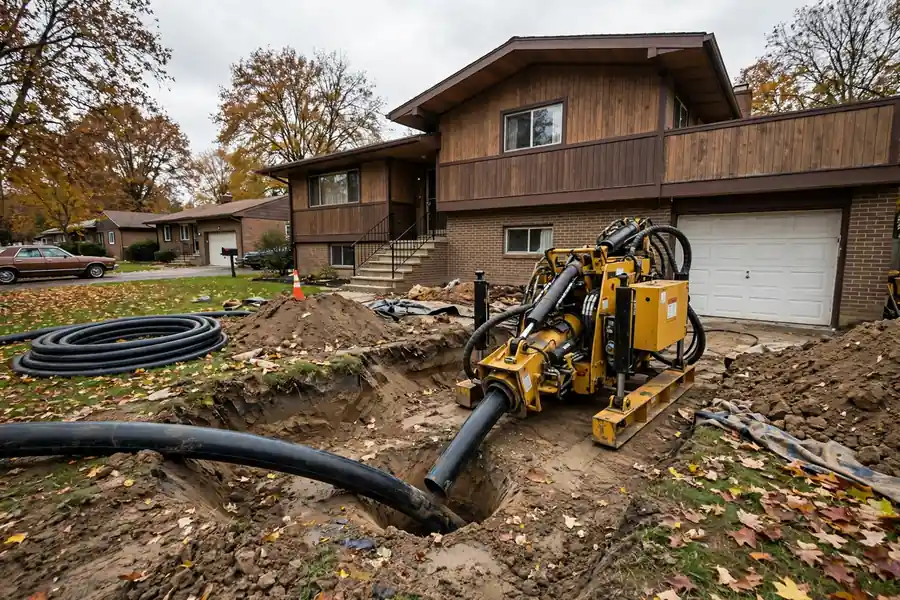
How Pipe Bursting Works, Step by Underground Step

Candidacy comes first, and it is decided on camera. The technician inspects your Strathmore lateral on Arlington Heights Road north of Checker Road end to end, confirming the clay tile laterals, some with shallow no-basement routing form a continuous path the bursting head can follow. Collapsed voids with no pipe to guide the head, or extreme bellies, get flagged — sometimes a small spot repair first makes the line burstable. You see the footage and the verdict together.

Next the crew locates and marks the line's exact path and depth across your 60089 property, then digs two pits: an entry pit at the house end and an exit pit at the street or main connection. For 1968-88 homes, some without basements on Arlington Heights Road north of Checker Road, that is the total excavation — everything else happens underground. Utilities along the route are located and cleared before any pulling begins.

The pull is the centerpiece. A steel cable is threaded through the old clay tile laterals, some with shallow no-basement routing, attached to the bursting head, with the new HDPE pipe fused into one continuous length behind it. The hydraulic rig draws the assembly through foot by foot: the head fractures the old pipe outward into the surrounding soil while the HDPE slides into the enlarged cavity. Technicians at both pits monitor tension so the new line beds evenly.

Connections and proof close the job. The new HDPE is tied into your house drain at the entry pit and the city main at the exit pit — the two joints in the entire run. Everything between is one continuous, seamless pipe. Strathmore homeowners on Arlington Heights Road north of Checker Road watch it on the final camera pass: joint-free HDPE where clay tile laterals, some with shallow no-basement routing used to be, from foundation to street.

Strathmore's Sewer Conditions — and How They Change This Service

Area Facts

ZIP code
60089
Housing stock
Strathmore Grove 1968-1988 (mostly 1970s), west of Buffalo Grove Rd south of Aptakisic Rd
Typical sewer lines
Clay tile era
Soil
Glacial till clay
Key local factor
Strathmore's no-basement and crawl-space models are the differentiator: shallow sewer routing with less frost protection and tighter repair access than full-basement neighbors.

Crawl-space access that changes repair methods is the reason Strathmore homeowners choose bursting over open-cut. With Strathmore Grove 1968-1988 (mostly 1970s), west of Buffalo Grove Rd south of Aptakisic Rd in 60089, the surface features worth protecting — established landscaping, driveways, patios — sit directly above the lateral's path on Arlington Heights Road north of Checker Road. Two pits versus one long trench is not a close call when the yard took decades to grow.

The clay tile laterals, some with shallow no-basement routing under Strathmore are why bursting fits here so well. Shallow no-basement sewer routing with less frost cover — and brittle materials like clay tile and Orangeburg are exactly what a bursting head wants: they fracture cleanly instead of resisting. The camera survey on your 1968-88 homes, some without basements on Arlington Heights Road north of Checker Road confirms candidacy in one visit, and most Strathmore lines of this era pass.

Freeze-thaw on shallow slab-model sewers (less frost cover) In Strathmore, Glacial till clay on Arlington Heights Road north of Checker Road actually helps the method: glacial till holds the expanded cavity open while the HDPE seats, and the new fused joints ignore the freeze-thaw movement that cracked the old clay tile laterals, some with shallow no-basement routing. Bursting here is not just less disruptive — in these soils, it is the technically right call for end-of-life clay and Orangeburg.

The Bursting Process From Camera to Final Inspection

Step 1: Camera inspection and candidacy check

Call (833) 713-2101 and a technician cameras your Strathmore lateral on Arlington Heights Road north of Checker Road end to end, confirming your clay tile laterals, some with shallow no-basement routing can be burst. You get a straight answer — candidate or not — with the footage to back it.

Step 2: Locate, mark, and plan the pits

The line's path and depth are marked across your property, utilities are located, and the two pit positions are set — entry at the house, exit at the street. For 1968-88 homes, some without basements on Arlington Heights Road north of Checker Road, the plan shows exactly what gets disturbed: two pits, nothing more.

Step 3: Dig entry and exit pits

Small, shored pits go in at both ends of your Strathmore lateral on Arlington Heights Road north of Checker Road. Spoil is staged on tarps, plantings along the pit edges are protected, and the rest of your yard stays untouched.

Step 4: The bursting pull

Cable through the old clay tile laterals, some with shallow no-basement routing, bursting head on, new HDPE fused behind it — the rig pulls the assembly through, fracturing the old line outward and seating the new pipe in its place. Your Strathmore property on Arlington Heights Road north of Checker Road feels some vibration; the surface sees almost nothing.

Step 5: Connect both ends

The new HDPE is connected to your house drain inside the entry pit and to the city main at the exit pit — the two joints in the entire run. Everything between is one continuous, seamless pipe serving your 1968-88 homes, some without basements on Arlington Heights Road north of Checker Road.

Step 6: Verify, backfill, restore

A final camera pass documents the new line, both pits are backfilled in compacted lifts, and the surface is restored. You keep the before-and-after footage of your Strathmore lateral on Arlington Heights Road north of Checker Road — proof of a new line from foundation to street.

FAQs

Frequently Asked Questions

Is pipe bursting better than pipe lining for my Strathmore line?

They solve different problems. Lining seals a structurally sound but leaky line and slightly reduces diameter; bursting replaces a structurally failed line at full (or larger) diameter. For clay tile laterals, some with shallow no-basement routing in Strathmore on Arlington Heights Road north of Checker Road that are cracked, deformed, or collapsed, bursting is the replacement — lining is the repair.

How much of my yard gets dug up on Arlington Heights Road north of Checker Road?

Two pits: one at the house end of the lateral, one at the street. For 1968-88 homes, some without basements in Strathmore on Arlington Heights Road north of Checker Road, that is the entire excavation — the lawn, driveway, and plantings between the pits are never opened. Compare that with open-cut trenching, which opens the whole route.

How long does a pipe bursting job take in Strathmore?

Most residential bursting jobs on 1968-88 homes, some without basements lots on Arlington Heights Road north of Checker Road complete the pull in a day once pits are dug — the calendar time is mostly the camera inspection, utility locates, and scheduling. Your crew gives you the sequence in writing before work starts.

Can the new pipe be larger than the old one?

Often yes — upsizing is one of bursting's advantages. The bursting head expands the cavity as it fractures your old clay tile laterals, some with shallow no-basement routing, so the HDPE that follows can match or exceed the original diameter. For Strathmore homes on Arlington Heights Road north of Checker Road adding bathrooms or fixtures, that extra capacity matters.

What is HDPE and why is it better than clay tile laterals, some with shallow no-basement routing?

High-density polyethylene: a flexible, seamless plastic fused into one continuous length with no joints for roots to enter. Compared with the segmented clay tile laterals, some with shallow no-basement routing under 1968-88 homes, some without basements on Arlington Heights Road north of Checker Road in Strathmore, HDPE does not crack at joints, does not corrode, and shrugs off the soil movement that destroyed the old line.

Does bursting damage nearby utility lines?

The crew locates gas, electric, water, and telecom along the route before pulling, and the bursting head's expansion is controlled and localized. In 60089, where Strathmore Grove 1968-1988 (mostly 1970s), west of Buffalo Grove Rd south of Aptakisic Rd lots on Arlington Heights Road north of Checker Road have decades of buried infrastructure, those locates are non-negotiable — no pull starts until every crossing is marked.

Will pipe bursting work on my clay tile laterals, some with shallow no-basement routing in Strathmore?

If the camera shows a continuous path — even a badly cracked one — usually yes. Clay tile, Orangeburg, and cast iron all burst cleanly because they are brittle. What disqualifies a line is a fully collapsed void with no pipe left to guide the head, or a severe belly; in Strathmore on Arlington Heights Road north of Checker Road, the inspection gives you that answer before any commitment.

What happens to the old pipe?

It stays where it is, fractured outward into the surrounding soil — which is why the method needs no removal trench. The fragments of your old clay tile laterals, some with shallow no-basement routing in Strathmore on Arlington Heights Road north of Checker Road become bedding around the new HDPE, harmless underground.

Get Your Strathmore Sewer Line Back on Track

Open-cut had a good century. Your Strathmore lateral on Arlington Heights Road north of Checker Road deserves the method that replaced it: two pits, one pull, and seamless HDPE where clay tile laterals, some with shallow no-basement routing used to fail. Call (833) 713-2101 any time — the camera inspection comes first, and the honest answer comes with it.

Sewer Line Problems Don’t Wait. Neither Should You.

Call now and reach a local sewer line specialist serving Buffalo Grove, IL and nearby northwest suburbs — 24/7.

(833) 713-2101

Free to call · No obligation · 24/7 emergency line

Serving Strathmore, IL 60089

Call Now · (833) 713-2101