
Sewer Leak Detection in Old Buffalo Grove, IL
From weeping joints to cracked sections, Old Buffalo Grove homeowners in historic downtown Buffalo Grove get the exact leak location in their original 60-year-old clay tile laterals — not a torn-up yard searching for it.
- Camera-verified work
- Trenchless options
- Serving 60089
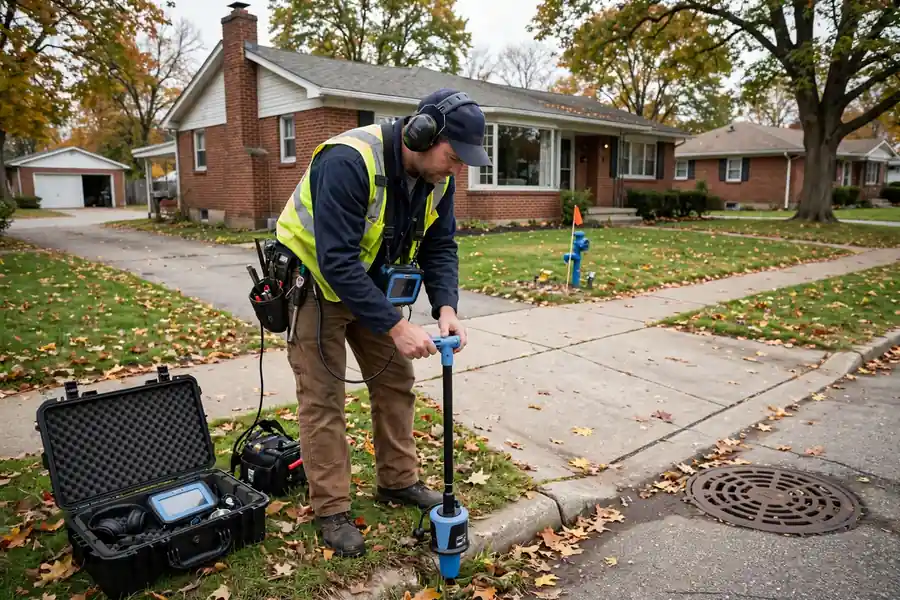
In short: If wastewater is escaping your Old Buffalo Grove lateral somewhere between the house and the street, this page explains leak detection for 60089: how we find the break in original 60-year-old clay tile laterals under 1958-70 postwar ranches. The first step when you call (833) 713-2101 is always a symptom review before any equipment comes out.
What sewer leak detection means for Old Buffalo Grove homes
Leaks follow the weak points, and in Old Buffalo Grove the weak points are well known. 60-plus-year-old clay tile at the highest collapse risk — each of those is a classic leak origin in original 60-year-old clay tile laterals, and each leaves a signature: infiltration staining on the camera, a damp halo in the soil, a sound profile the acoustic gear recognizes. 1958-70 postwar ranches in historic downtown Buffalo Grove benefit from technicians who have traced these exact failures before, because pattern recognition shortens the search.
Finding the leak is only half the job; proving it is the other half. Every detection visit ends with documentation — camera footage of the failed section of original 60-year-old clay tile laterals, surface markings showing the leak's position and depth, and a written summary. Old Buffalo Grove homeowners in historic downtown Buffalo Grove use that package to authorize a sectional repair or lining with confidence, and 1958-70 postwar ranches buyers use it as leverage, because a located leak is a priced leak.
Signs your Old Buffalo Grove home needs sewer leak detection
Sewer leaks speak in secondary symptoms — the leak itself stays buried. In Old Buffalo Grove, where 1958-70 postwar ranches sit on original 60-year-old clay tile laterals, these are the surface clues in historic downtown Buffalo Grove that wastewater is escaping somewhere along the lateral.
A soggy patch that never dries
One area of the yard stays wet long after rain stops — often along the lateral's path to the street. In Old Buffalo Grove in historic downtown Buffalo Grove, that persistent dampness over original 60-year-old clay tile laterals serving 1958-70 postwar ranches is wastewater keeping the soil saturated, and detection equipment traces it back to the failed joint.
Persistent sewer odors outdoors
A healthy lateral is sealed; a leaking one vents sewer gas into the soil and up through it. Around 1958-70 postwar ranches in Old Buffalo Grove in historic downtown Buffalo Grove, outdoor odors that intensify in warm weather often trace to a cracked section of original 60-year-old clay tile laterals that detection pinpoints within feet.
A sudden sinkhole or depression
Small surface depressions over the lateral's path mean soil has been washing into a broken original 60-year-old clay tile laterals for a while. In Old Buffalo Grove in historic downtown Buffalo Grove, 1958-70 postwar ranches owners who spot one should treat it as urgent — detection locates the breach so repair starts before the void grows.
Foundation dampness near the lateral entry
Where the lateral penetrates the foundation wall is a natural stress point, and original 60-year-old clay tile laterals in Old Buffalo Grove in historic downtown Buffalo Grove can weep right at that penetration. 1958-70 postwar ranches with dampness blooming on the basement wall where the sewer exits have a leak that detection confirms in one visit.
Rodents or insects near the line's path
A leaking lateral is a water source, and pests find water. 1958-70 postwar ranches in Old Buffalo Grove in historic downtown Buffalo Grove sometimes notice increased pest activity along the original 60-year-old clay tile laterals route before they notice anything plumbing-related — another secondary symptom that detection work traces to its source.
Gurgling paired with wet spots
Either symptom alone has innocent explanations; together they describe a original 60-year-old clay tile laterals that is both obstructed and breached. For 1958-70 postwar ranches in Old Buffalo Grove in historic downtown Buffalo Grove, that combination sends detection equipment out — the camera finds the blockage while acoustic gear finds the leak in the same run.
How sewer leak detection works
Detection starts with the symptom map. You walk the technician through what you have noticed at your Old Buffalo Grove home — where the wet spot sits, when the odor peaks, which fixtures gurgle — and that history aims the equipment at the right section of original 60-year-old clay tile laterals serving your 1958-70 postwar ranches. in historic downtown Buffalo Grove, the lateral's likely path is already half-known before a sensor comes out.
Acoustic listening comes next. Sensitive ground microphones and correlators listen along the original 60-year-old clay tile laterals route for the distinct sound signature of water escaping — or, in gravity sewers, the subtler turbulence where flow exits through a crack. On 1958-70 postwar ranches laterals in Old Buffalo Grove in historic downtown Buffalo Grove, the gear narrows the leak to a zone often just a few feet wide, without turning a single spade of soil.
The camera confirms what the ears found. A video inspection of the suspect section of original 60-year-old clay tile laterals shows the actual defect — the separated joint, the longitudinal crack, the root mass drinking at the leak — and the sonde marks its exact depth and surface position. For Old Buffalo Grove homeowners in historic downtown Buffalo Grove, this is the moment a suspicion becomes a located, measurable failure in their 1958-70 postwar ranches lateral.
Dye or smoke testing closes the loop where needed. Harmless dye flushed through fixtures appears at the leak point and proves the connection; smoke pumped through the line escapes at the breach and marks it visibly. Each method cross-checks the others, so the repair plan for your original 60-year-old clay tile laterals in Old Buffalo Grove rests on converging evidence, not a single reading.
How Old Buffalo Grove changes the sewer leak detection plan
60-plus-year-old clay tile at the highest collapse risk tells the acoustic gear where to listen first in Old Buffalo Grove. Leak detection is not a blind sweep of the whole property — it starts at the known weak points of your original 60-year-old clay tile laterals and works outward, which is why 1958-70 postwar ranches laterals in historic downtown Buffalo Grove get located faster and with less surface disruption.
Short ranch laterals that make pipe bursting fast is the reason detection exists as a separate service here. When excavation is costly or constrained, you cannot afford exploratory digging — the leak in original 60-year-old clay tile laterals under 1958-70 postwar ranches in Old Buffalo Grove in historic downtown Buffalo Grove has to be found before the first shovel, and the detection visit is what makes the repair a single small excavation instead of a search.
Local ground conditions write the leak's signature. Glacial till clay; 60 years of root growth from original plantings. in historic downtown Buffalo Grove — saturated clays carry sound differently than dry fill, and Six decades of freeze-thaw on clay tile joints; spring infiltration through cracked joints. means infiltration and exfiltration trade places with the seasons. Technicians who read original 60-year-old clay tile laterals in 60089 account for that: a wet-weather leak that vanishes in dry months still gets found, because the camera sees the crack the acoustics only hear when water moves.
Area Facts
- ZIP Code
- 60089
- Housing stock
- 1958-1970: Al Frank's original development for WWII/Korean War veterans (~1,000 sq ft ranches; Dolly Madison model 864 sq ft 3bd/1ba); village incorporated 1958 with 164 residents, population 11,000 by 1970.
- Common pipe materials
- The oldest sewer stock in the village: original clay tile laterals at 60+ years, cast-iron house sewers, possible Orangeburg in late-60s infill. Collapse risk highest here.
- Soil
- Glacial till clay; 60 years of root growth from original plantings.
What happens when you call
Describe the symptoms
Call (833) 713-2101 and tell us what you are seeing around your Old Buffalo Grove home — wet spots, odors, settling, lush grass. That picture tells the technician which section of original 60-year-old clay tile laterals to aim the equipment at when they reach your 1958-70 postwar ranches.
Surface survey and listening
Acoustic sensors sweep the likely route of your original 60-year-old clay tile laterals across the Old Buffalo Grove property in historic downtown Buffalo Grove, listening for the signature of escaping water. 1958-70 postwar ranches lots get a full pass — the gear hears what eyes cannot see.
Camera confirmation
A camera run through the suspect section shows the actual breach in your original 60-year-old clay tile laterals — the joint, crack, or root entry — and marks its depth and position. Old Buffalo Grove homeowners in historic downtown Buffalo Grove watch the defect appear on the monitor of their 1958-70 postwar ranches lateral.
Dye or smoke verification
Where the evidence needs a second witness, harmless dye or smoke traces the path from fixture to breach, proving the leak's source in your original 60-year-old clay tile laterals beyond doubt for your Old Buffalo Grove 1958-70 postwar ranches.
Mark and document
The leak's surface position and depth are marked on your Old Buffalo Grove property in historic downtown Buffalo Grove, and you receive the camera footage plus a written summary of the failed section of original 60-year-old clay tile laterals — the package your 1958-70 postwar ranches repair will be priced from.
Targeted repair plan
With the leak located, the fix becomes a single planned excavation or trenchless repair — not a search. Your technician lays out the options for the failed section of original 60-year-old clay tile laterals serving 1958-70 postwar ranches in Old Buffalo Grove, and you choose with the evidence in hand.
Frequently Asked Questions
What is the difference between leak detection and a camera inspection?
A camera inspection surveys the whole lateral; leak detection hunts one specific failure using acoustics plus camera plus verification. For 1958-70 postwar ranches in Old Buffalo Grove with original 60-year-old clay tile laterals in historic downtown Buffalo Grove, detection is the right call when you already have leak symptoms — wet spots, odors, settling — and need the source, not a general survey.
Can you detect a leak if my drains still work fine?
Yes — most leaks are found exactly then. A original 60-year-old clay tile laterals can weep wastewater into the soil for months while fixtures drain normally, which is why Old Buffalo Grove homeowners in historic downtown Buffalo Grove call about wet spots and odors rather than backups. Detection catches what drainage symptoms miss in 1958-70 postwar ranches lines.
How accurate is the leak location?
The methods cross-check each other: acoustics narrow the zone, the camera's sonde marks depth and position, and dye or smoke confirms the path. On original 60-year-old clay tile laterals under 1958-70 postwar ranches in Old Buffalo Grove in historic downtown Buffalo Grove, that convergence puts the repair crew on a small, well-defined dig area — not a trench of hope.
What causes the leaks you find in Old Buffalo Grove original 60-year-old clay tile laterals?
The local greatest hits: 60-plus-year-old clay tile at the highest collapse risk. Each fails in its own way — joints separate as ground moves, cracks propagate from stress, roots wedge openings wider — and detection reads which one your 1958-70 postwar ranches lateral in historic downtown Buffalo Grove is showing.
How do you find a sewer leak without digging up my Old Buffalo Grove yard?
By listening and looking before touching a shovel. Acoustic sensors narrow the search along your original 60-year-old clay tile laterals, the camera shows the actual breach, and dye or smoke confirms it — 1958-70 postwar ranches in Old Buffalo Grove in historic downtown Buffalo Grove get a marked location, and digging only starts after the leak is proven.
Will leak detection work with short ranch laterals that make pipe bursting fast?
It was designed for exactly that situation. Because every method works from the surface or from inside the original 60-year-old clay tile laterals, 1958-70 postwar ranches in Old Buffalo Grove in historic downtown Buffalo Grove get a located leak with zero exploratory digging — the whole point is proving the spot before anyone excavates.
60-plus-year-old clay tile at the highest collapse risk will keep weeping whether you look at it or not — the only question is whether you find it on your terms. Old Buffalo Grove homeowners in historic downtown Buffalo Grove who call about original 60-year-old clay tile laterals leaks early get a small, defined repair on their 1958-70 postwar ranches; those who wait get the leak plus everything it undermined. Call (833) 713-2101 and let the equipment do the searching.
Related services in Old Buffalo Grove
Pipe Lining in Old Buffalo Grove, IL
A new pipe inside the old one for 1958-70 postwar ranches in Old Buffalo Grove: cracked, root-invaded laterals renewed from within.
Learn moreSewer Camera Inspection in Old Buffalo Grove, IL
Video inspection that maps original 60-year-old clay tile laterals in Old Buffalo Grove — cracks, roots, and offsets recorded.
Learn moreSewer Line Problems Don’t Wait. Neither Should You.
Call now and reach a local sewer line specialist serving Buffalo Grove, IL and nearby northwest suburbs — 24/7.
(833) 713-2101Free to call · No obligation · 24/7 emergency line
Serving Old Buffalo Grove, IL 60089