
Sewer Line Installation in Deerfield, IL
Septic-to-sewer conversions and new laterals in Deerfield: careful excavation, correct grade, and clean connections for clay tile and Orangeburg laterals under dense tree canopy-era homes.
- 24/7 emergency line
- Serving Deerfield 60015
- Free to call · No obligation
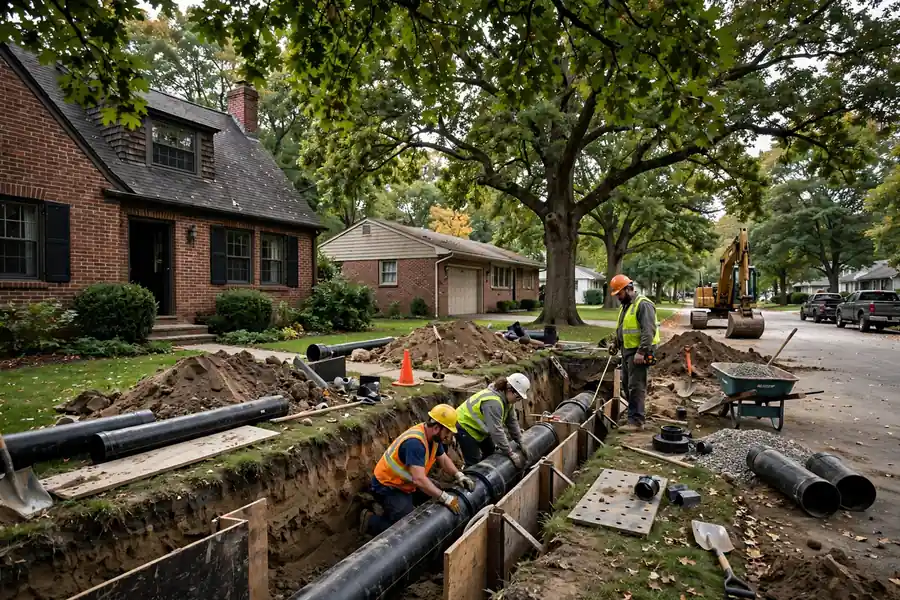
In short: Sewer line installation in Deerfield, IL 60015 means a new underground line built to carry your Deerfield home's wastewater to the municipal sewer — for 1950s-70s brick Capes, ranches, and split-levels east of Waukegan Avenue. Call (833) 713-2101 to start with a site evaluation, where we map the route, check depths, and explain permits before any digging.
Sewer Line Installation in Deerfield: What to Know
Most Deerfield homeowners east of Waukegan Avenue think about sewer installation exactly twice: when they build and when they convert. New construction on 1950s-70s brick Capes, ranches, and split-levels lots needs a lateral from day one, sized for the home's fixtures and laid with a consistent downhill grade to the street. Septic-to-sewer conversions — common where clay tile and Orangeburg laterals under dense tree canopy meet municipal expansion — need the old system properly abandoned and a new line trenched, bedded, and connected.
In Deerfield, what separates a good installation from a future headache is invisible once the trench is closed: bedding material that supports the pipe evenly, joints that are fully seated, slope verified with a level at every section, and backfill compacted in lifts so the ground does not settle into a dip over the line. Deerfield installations east of Waukegan Avenue follow that sequence on every job, because the only thing worse than digging once is digging twice.
Signs You Need Sewer Line Installation in Deerfield
In Deerfield, knowing whether you need installation versus repair starts with recognizing the scenario. In Deerfield, where 1950s-70s brick Capes, ranches, and split-levels sit on clay tile and Orangeburg laterals under dense tree canopy, these are the clearest cases for putting a new line in the ground.
A failed or undersized old line
When clay tile and Orangeburg laterals under dense tree canopy under Deerfield homes have collapsed beyond repair — or were never sized for the house above them — replacement-by-installation is the honest fix. A new line is engineered for the actual fixture load of your 1950s-70s brick Capes, ranches, and split-levels.
Separating combined or improper connections
Some older 1950s-70s brick Capes, ranches, and split-levels in Deerfield still route stormwater or sump discharge into the sanitary lateral east of Waukegan Avenue — a setup modern code does not allow. Installation separates the flows with a dedicated, correctly sized sanitary line.
Chronic backups the old line can't shake
If clay tile and Orangeburg laterals under dense tree canopy serving your Deerfield home have been jetted and repaired and still back up, the pipe itself is the problem — bellies, separations, or root damage along the whole run. A new installation ends the cycle instead of extending it.
Failed inspection on a property transfer
Pre-sale camera inspections in Deerfield east of Waukegan Avenue sometimes condemn a lateral outright. Installing new often clears the way to a clean inspection report and a closed sale for 1950s-70s brick Capes, ranches, and split-levels owners.
A plumbing addition or ADU
In Deerfield, adding a bathroom, kitchen, or accessory dwelling unit can push the existing lateral beyond its capacity. In Deerfield, where 1950s-70s brick Capes, ranches, and split-levels run on clay tile and Orangeburg laterals under dense tree canopy, a second or upsized line is often cleaner than overloading the old one.
Extending service to a detached structure
In Deerfield, a detached garage with a bathroom or a backyard studio on a Deerfield lot needs its own connection. New laterals for outbuildings on 1950s-70s brick Capes, ranches, and split-levels properties east of Waukegan Avenue are trenched, graded, and tied into the main house line or the street connection.
How Sewer Line Installation Works in Deerfield
In Deerfield, a proper installation begins at the surface with a plan. The crew walks the Deerfield lot with the homeowner, tracing the route from the foundation penetration to the street connection across 1950s-70s brick Capes, ranches, and split-levels yards east of Waukegan Avenue. Utility locates mark every gas, electric, and telecom line, and the trench path is adjusted to miss them. Depths are set so the pipe sits below the local frost line with a steady downhill grade — typically around a quarter inch per foot — from house to main.
In Deerfield, connections happen at both ends: inside, the new line ties into the home's drainage stack through the foundation wall with a properly sealed penetration; outside, it meets the city main at the tap or wye with an approved fitting. In Deerfield east of Waukegan Avenue, the municipal inspector then checks the open trench — pipe material, grade, bedding, and connections — before any backfill is allowed. Only after the line passes do crews backfill in compacted lifts and restore the surface.
In Deerfield, testing closes the job before the yard is restored. The new lateral is checked for leaks and proper flow — often with water testing and a final camera pass that records the clean, correctly graded line for your records. For Deerfield homeowners, that footage plus the inspection sign-off is the paperwork that proves the 1950s-70s brick Capes, ranches, and split-levels lateral was built right, and it is worth keeping with the house files.
What Makes Sewer Line Installation Different in Deerfield
Area Facts
- Housing stock
- 1950s-70s brick Capes, ranches, and split-levels
- Sewer laterals
- clay tile and Orangeburg laterals under dense tree canopy
- Soil
- fine glacial till with somewhat-poor drainage
- ZIP served
- 60015
New clay tile and Orangeburg laterals under dense tree canopy in Deerfield go below frost depth because fine glacial till with somewhat-poor drainage east of Waukegan Avenue heaves every winter. Every Sewer Line Installation trench here is bedded for that soil, not for generic ground.
In Deerfield, installation planning starts with long shallow ranch laterals under dense tree canopy. That reality changes the route on the drawing board: longer runs need intermediate cleanouts for future access, and the trench path has to thread between mature root zones, existing utilities, and property setbacks east of Waukegan Avenue. Crews serving 60015 map all of it before the first bucket of soil moves.
In Deerfield, decades-old landscaping that trenchless methods spare is the second thing every Deerfield installation accounts for. On 1950s-70s brick Capes, ranches, and split-levels lots, restoration is part of the bid, not an afterthought — sod, plantings, and hardscaping disturbed by the trench are planned for from day one. Homeowners east of Waukegan Avenue should expect a written restoration plan alongside the installation plan, because the yard matters as much as the pipe.
Our Sewer Line Installation Process in Deerfield
Site evaluation
We walk your Deerfield lot east of Waukegan Avenue, locate the foundation penetration and the street connection, probe depths, and note every obstacle — trees, driveways, utilities — that the trench must avoid on your 1950s-70s brick Capes, ranches, and split-levels property.
Permits and utility locates
The Deerfield municipal permit is pulled and every buried utility is marked before digging. For Deerfield installations, inspection checkpoints are scheduled so the open trench, connections, and backfill each get their sign-off.
Excavation to grade
The trench is dug along the marked route across your Deerfield lot and its bottom shaped to the designed slope. On 1950s-70s brick Capes, ranches, and split-levels lots in Deerfield, excavated soil is staged to protect lawns and plantings east of Waukegan Avenue.
Pipe laying and jointing
In Deerfield, bedding goes in first, then pipe sections are laid, jointed, and level-checked one by one — the careful middle of the job that decides whether your Deerfield lateral drains by gravity for decades.
Connections and inspection
In Deerfield, the line is tied into the house drainage and the city main, then the Deerfield municipal inspector reviews the open work. Nothing gets buried on a Deerfield installation until it passes.
Backfill, testing, and restoration
The trench on your Deerfield property is backfilled in compacted lifts, the line is tested for flow and leaks, and the surface is restored. You keep the camera footage and inspection records for your 1950s-70s brick Capes, ranches, and split-levels in Deerfield.
In Deerfield, a sewer line installation is a once-in-a-generation project for most Deerfield homeowners — the kind of work where planning matters more than speed. For 1950s-70s brick Capes, ranches, and split-levels east of Waukegan Avenue, starting with a careful site evaluation means the trench takes the smartest route, the grade is right from the first section, and the inspections pass without rework. Call (833) 713-2101 to walk your lot with a specialist and get a written plan before anything is dug.
Sewer Line Installation in nearby areas
More services in Deerfield
Sewer Line Cleaning
Often booked with Sewer Line Installation in Deerfield.
Learn moreSewer Line Replacement
Often booked with Sewer Line Installation in Deerfield.
Learn moreSewer Maintenance
Good with Sewer Line Installation in Deerfield.
Learn moreTree Root Removal
Pairs well with Sewer Line Installation in Deerfield.
Learn moreTrenchless Sewer Repair
Good with Sewer Line Installation in Deerfield.
Learn moreSewer Line Installation in nearby areas
Sewer Line Installation in Mill Creek
Mill Creek 60089 service area.
Learn moreSewer Line Installation in Prospect Heights
Now booking in Prospect Heights 60070.
Learn moreSewer Line Installation in Woodlands of Fiore
Also serving Woodlands of Fiore 60089.
Learn moreSewer Line Installation in Northbrook
Now booking in Northbrook 60062.
Learn moreSewer Line Problems Don’t Wait. Neither Should You.
Call now and reach a local sewer line specialist serving Buffalo Grove, IL and nearby northwest suburbs — 24/7.
(833) 713-2101Free to call · No obligation · 24/7 emergency line
Frequently Asked Questions
Do I need a permit for sewer installation in Deerfield?
Yes — sewer laterals are permitted work in Deerfield, and the permit triggers the inspections that protect you: open-trench review, connection approval, and final sign-off. The crew handling your 1950s-70s brick Capes, ranches, and split-levels installation pulls the permit and schedules each inspection east of Waukegan Avenue, so you do not have to navigate the process yourself.
What happens to my old septic tank or lateral?
In Deerfield, nothing usable is left to cause trouble later. Septic tanks are pumped and properly abandoned; old laterals being replaced are either removed where the trench crosses them or left undisturbed and capped at both ends. On Deerfield lots east of Waukegan Avenue, abandonment follows the same permit and inspection process as the new installation.
How long does a sewer line installation take in Deerfield?
Most residential installations on 1950s-70s brick Capes, ranches, and split-levels lots in Deerfield are completed within a few working days of excavation — the calendar time depends mostly on permit issuance and inspection scheduling east of Waukegan Avenue, not the digging itself. Your crew gives you a written sequence before work starts so you know what happens on each day.
What pipe material is used for new installations?
In Deerfield, modern installations use PVC or similar approved materials — smooth-walled, jointed with gasketed or solvent-welded connections, and rated for underground service. For Deerfield homes replacing clay tile and Orangeburg laterals under dense tree canopy, the new line is a generational upgrade in both material and joint integrity.
How deep will the new line be buried in Deerfield?
In Deerfield, below the local frost line, with depth varying along the run as the grade falls from house to street. On 1950s-70s brick Capes, ranches, and split-levels lots east of Waukegan Avenue, the foundation penetration sets the starting depth and the street connection sets the end — the design connects those two points with a steady, code-compliant slope through your clay tile and Orangeburg laterals under dense tree canopy-era soil conditions.
Will installation tear up my whole yard in Deerfield?
The trench follows one planned route — not the whole yard. On 1950s-70s brick Capes, ranches, and split-levels properties east of Waukegan Avenue, crews stage soil on tarps, protect plantings along the path, and restore the surface afterward. Decades-old landscaping that trenchless methods spare, so the restoration plan is written into the job from the start.
Serving Deerfield, IL 60015