
Tree Root Removal in Arlington Heights, IL
Tree roots love clay tile and Orangeburg laterals. Arlington Heights homeowners near Arlington Park and the Metra UP-NW station get them cut, flushed, and documented — then a plan to keep them out.
- 24/7 emergency line
- Serving Arlington Heights 60004
- Free to call · No obligation
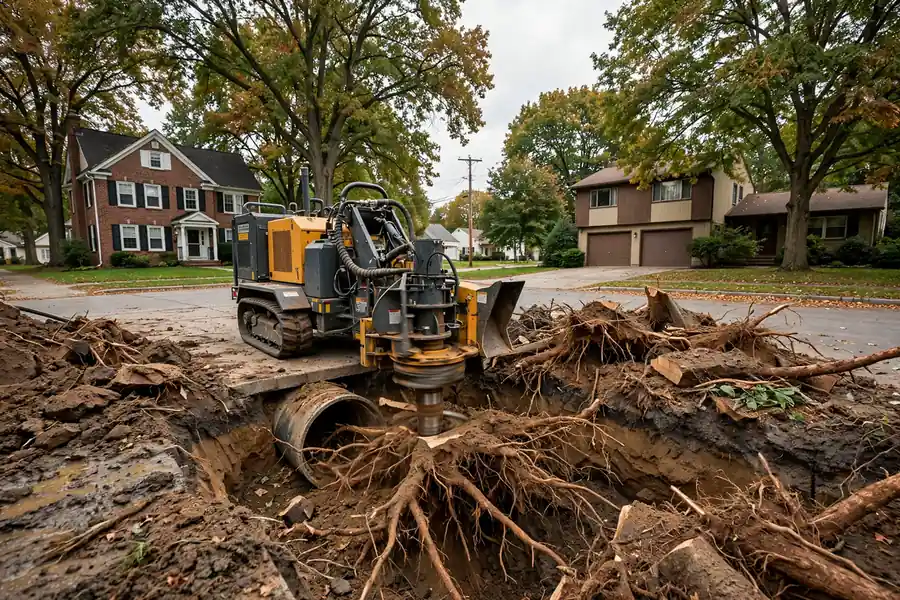
In short: Tree root removal in Arlington Heights, IL 60004 frees clay tile and Orangeburg laterals from the root masses that cause recurring backups in 1970s colonials, split-levels, and ranches. Call (833) 713-2101 and the first step is always a camera look inside the line to map every root entry point before the cutter goes in.
Tree Root Removal in Arlington Heights: What to Know
Ask any Arlington Heights homeowner near Arlington Park and the Metra UP-NW station with big trees and clay tile and Orangeburg laterals what their sewer nemesis is, and the answer is roots. The pattern is unmistakable: drains slow every spring as growth surges, a cleaning buys a few good months, then the gurgles return like clockwork. Each cycle the roots come back thicker, because cutting without addressing the entry points is pruning — and pruned roots grow back stronger.
In Arlington Heights, professional root removal stops the cycle from repeating. The cutter does not just poke a hole through the mass the way a hand snake does; it mills the full diameter of the pipe back open at every invaded joint. Paired with a camera that maps each entry along your 1970s colonials, split-levels, and ranches lateral, the visit ends with knowledge: exactly where roots get in, how bad each point is, and what it will take — lining, spot repair, or scheduled cutting — to keep them out.
Signs You Need Tree Root Removal in Arlington Heights
In Arlington Heights, root intrusion has a signature — once you know it, you will recognize it in your Arlington Heights home. For 1970s colonials, split-levels, and ranches on clay tile and Orangeburg laterals near Arlington Park and the Metra UP-NW station, these are the telltale signs that roots, not just buildup, are closing the line.
Spring slowdowns after winter's relief
In Arlington Heights, lines that behaved all winter and choke each April are responding to root growth season. For 1970s colonials, split-levels, and ranches in Arlington Heights on clay tile and Orangeburg laterals near Arlington Park and the Metra UP-NW station, the spring slowdown is roots waking up — and the argument for cutting before summer.
Backups that return like clockwork
In Arlington Heights, a line cleared in spring that backs up again by fall is the classic root cycle. In Arlington Heights, clay tile and Orangeburg laterals near Arlington Park and the Metra UP-NW station regrow root masses on a seasonal rhythm — if your 1970s colonials, split-levels, and ranches backups follow the calendar, roots are the prime suspect.
Cleanings that help less each time
In Arlington Heights, the first jetting bought a year; the next bought six months; the last bought weeks. That shrinking return on clay tile and Orangeburg laterals in Arlington Heights near Arlington Park and the Metra UP-NW station means the root masses are winning — time to cut aggressively and plan the lasting fix.
A neighbor's root story on your street
In Arlington Heights, roots do not respect lot lines — the same soil, trees, and pipe era run the whole block. When a Arlington Heights neighbor near Arlington Park and the Metra UP-NW station has clay tile and Orangeburg laterals cleared of roots, 1970s colonials, split-levels, and ranches on the same street should get their own camera look.
The camera shows root masses, not just buildup
In Arlington Heights, there is no mistaking it on the monitor: pale tendrils waving in the flow, then dense mats choking the joints. When Arlington Heights technicians camera clay tile and Orangeburg laterals under 1970s colonials, split-levels, and ranches near Arlington Park and the Metra UP-NW station, root footage is the definitive diagnosis.
Gurgling that gets worse after rain
Rain swells root masses inside clay tile and Orangeburg laterals, tightening the restriction just when flow increases. Arlington Heights homeowners near Arlington Park and the Metra UP-NW station who notice gurgles spike during storms are hearing roots and water compete for the same pipe.
How Tree Root Removal Works in Arlington Heights
In Arlington Heights, cutting is followed by flushing. The hydro-jetter runs the cleared sections of clay tile and Orangeburg laterals, breaking the cut root fragments loose and carrying them downstream to the city main — because root debris left behind becomes the seed of the next clog. For 1970s colonials, split-levels, and ranches in Arlington Heights near Arlington Park and the Metra UP-NW station, this two-step is what separates professional removal from a quick snake: the line is not just opened, it is emptied.
In Arlington Heights, the cutter is matched to the pipe. A flexible shaft carries a rotating head — blades or chains sized just under your pipe's diameter — through the cleanout to the first root mass in your clay tile and Orangeburg laterals. Spinning at high speed, it mills the roots back to bare wall without gouging the pipe itself, working joint by joint down the Arlington Heights lateral under your Arlington Heights 1970s colonials, split-levels, and ranches. Different heads handle different masses: fine tendrils, woody mats, or the full blockages that stop flow entirely.
Root removal starts with mapping, not cutting. The camera travels your clay tile and Orangeburg laterals and the Arlington Heights technician logs every entry point — joint separations, cracks, offsets — with depth and distance from the cleanout. Arlington Heights homeowners near Arlington Park and the Metra UP-NW station see the invasion on the monitor: where the roots are thickest, which joints they favor, and whether the pipe behind the roots is still sound enough to save.
What Makes Tree Root Removal Different in Arlington Heights
Area Facts
- Housing stock
- 1970s colonials, split-levels, and ranches
- Sewer laterals
- clay tile and Orangeburg laterals
- Soil
- silty clay loam that drains somewhat poorly
- ZIP served
- 60004
In Arlington Heights, root work is defined by mature street-tree roots invading clay tile joints. That shapes the cutting plan directly: the camera has to find every entry along the run, because missing one joint on 1970s colonials, split-levels, and ranches laterals near Arlington Park and the Metra UP-NW station just moves the next backup by a few months. Crews serving 60004 cut methodically from the house toward the street so no invaded joint is skipped.
Roots follow water, and in Arlington Heights water follows silty clay loam that drains somewhat poorly near Arlington Park and the Metra UP-NW station. Tree Root Removal rechecks here target the dampest joints first, because that is where Arlington Heights roots return.
Finished basements that rule out messy interior work is why Arlington Heights root removal pairs cutting with a next step. Clearing the roots solves today; the constraint on 1970s colonials, split-levels, and ranches lots means the lasting fix — lining the entries, scheduling seasonal cuts, or treating regrowth — has to fit the property's reality near Arlington Park and the Metra UP-NW station. The Arlington Heights technician lays out those options with the footage in hand, not as an upsell but as the honest sequel to the cutting.
Our Tree Root Removal Process in Arlington Heights
Camera mapping
Every root entry in your clay tile and Orangeburg laterals is located and logged — depth, distance, severity. Your Arlington Heights cutting plan near Arlington Park and the Metra UP-NW station is built on this map, not on guesswork.
Cutter selection
In Arlington Heights, the head is sized to your pipe's diameter and matched to the mass — tendrils, mats, or full blockages in 1970s colonials, split-levels, and ranches laterals get different tooling.
Mechanical root cutting
In Arlington Heights, joint by joint, the spinning cutter mills roots back to bare pipe wall through your existing cleanout — no digging in your Arlington Heights yard near Arlington Park and the Metra UP-NW station.
Hydro-jetter flush
Cut fragments are flushed downstream to the city main so your clay tile and Orangeburg laterals are emptied, not just opened.
Verification camera pass
In Arlington Heights, the camera confirms open joints and free flow — you watch the cleared line on the monitor and see the before-and-after for your 1970s colonials, split-levels, and ranches.
Prevention strategy
Each entry point is graded: treat, schedule, or seal. Your Arlington Heights technician near Arlington Park and the Metra UP-NW station lays out the options for keeping roots out of your clay tile and Orangeburg laterals for good.
In Arlington Heights, cutting the roots is today's win; closing their entries is the long game. Across Arlington Heights, 60004, 1970s colonials, split-levels, and ranches pair professional root removal with lining or scheduled maintenance and stop thinking about their sewer lines entirely. To start with the camera mapping, call (833) 713-2101 any time.
Tree Root Removal in nearby areas
More services in Arlington Heights
Sewer Line Cleaning
Pairs well with Tree Root Removal in Arlington Heights.
Learn moreSewer Line Installation
Pairs well with Tree Root Removal in Arlington Heights.
Learn moreSewer Line Replacement
Good with Tree Root Removal in Arlington Heights.
Learn moreSewer Maintenance
Good with Tree Root Removal in Arlington Heights.
Learn moreTrenchless Sewer Repair
Often booked with Tree Root Removal in Arlington Heights.
Learn moreTree Root Removal in nearby areas
Sewer Line Problems Don’t Wait. Neither Should You.
Call now and reach a local sewer line specialist serving Buffalo Grove, IL and nearby northwest suburbs — 24/7.
(833) 713-2101Free to call · No obligation · 24/7 emergency line
Frequently Asked Questions
Can chemical treatments replace cutting in Arlington Heights?
Treatments manage regrowth; they do not remove masses. On clay tile and Orangeburg laterals in Arlington Heights near Arlington Park and the Metra UP-NW station, the sequence that works is cut first — restoring full diameter — then treat to slow what grows back. Skipping the cutting and only treating is like mowing without ever clearing the brush: the mass stays.
Will root removal damage my tree in Arlington Heights?
In Arlington Heights, no. Cutting removes only the roots that entered the pipe — a tiny fraction of the tree's system. The tree standing in your Arlington Heights yard near Arlington Park and the Metra UP-NW station keeps every other root; in fact, many 1970s colonials, split-levels, and ranches owners are relieved to learn the beloved maple or oak is never touched above ground at all.
How can you tell roots from a collapsed pipe in Arlington Heights?
In Arlington Heights, the camera tells them apart instantly: roots wave and shred; collapses show deformed or missing pipe wall. This distinction matters enormously for 1970s colonials, split-levels, and ranches on clay tile and Orangeburg laterals near Arlington Park and the Metra UP-NW station — roots mean cutting and a plan, collapse means replacement. Arlington Heights technicians never cut first and diagnose later.
How much root can a pipe tolerate in Arlington Heights?
Less than you'd think. Even a partial mat in clay tile and Orangeburg laterals snags paper and slows flow, and Arlington Heights 1970s colonials, split-levels, and ranches near Arlington Park and the Metra UP-NW station learn that the line's tolerance shrinks as the mass grows. The practical rule: if the camera shows roots occupying meaningful diameter, cut — waiting only makes the mass woodier and harder to mill.
What does the prevention plan look like after cutting?
It depends on what the camera found in your clay tile and Orangeburg laterals. Tight cracks might just need scheduled recutting; separated joints usually earn a lining or spot-repair recommendation. Your Arlington Heights technician near Arlington Park and the Metra UP-NW station prices nothing in vague terms — you get the footage, the entry-point map for your 1970s colonials, split-levels, and ranches, and options ranked by durability.
Will the roots grow back after cutting in Arlington Heights?
In Arlington Heights, yes, if the entry points stay open — cutting is pruning, and pruned roots regrow. On clay tile and Orangeburg laterals in Arlington Heights near Arlington Park and the Metra UP-NW station, regrowth typically takes a season or two to matter again. The lasting answer is closing the entries: sectional lining or spot repairs at the invaded joints of your 1970s colonials, split-levels, and ranches lateral, or scheduled cutting on a calendar that stays ahead of the growth.
Serving Arlington Heights, IL 60004