
Tree Roots in Sewer Lines: Prevention That Actually Works
Roots don't attack pipes out of malice — they follow water. Understanding why they invade is the key to prevention that actually holds.
In short: Tree root intrusion in Buffalo Grove, IL happens when roots find moisture at pipe joints — most common in clay tile and cast iron. Prevention that works: smart planting, root barriers, scheduled cutting with foaming treatment, and lining the vulnerable joints. Call (833) 713-2101 for a root assessment.
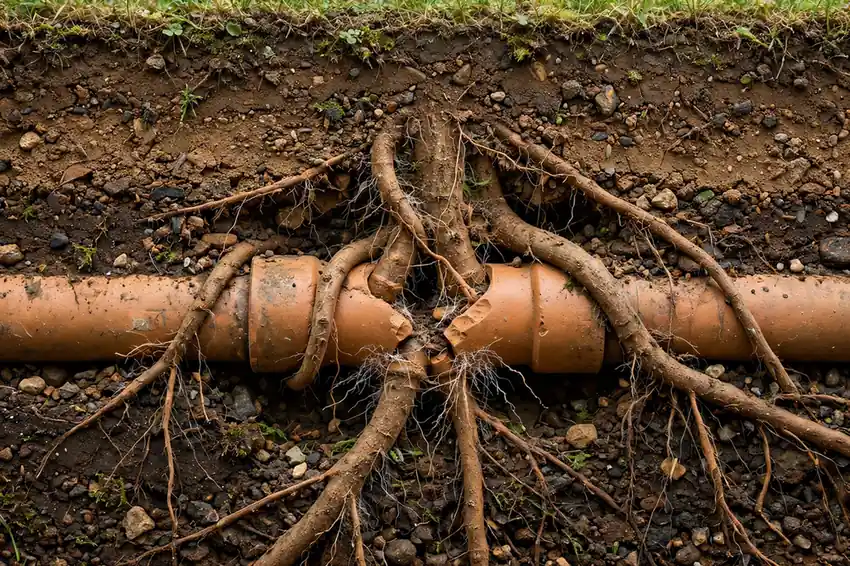
Ask any sewer technician in the northwest suburbs what fills their spring schedule, and the answer is roots. Tree roots are the number one cause of sewer lateral blockages in Buffalo Grove — not because trees are malicious, but because they are brilliantly engineered water-seekers, and a sewer lateral is a year-round underground river of exactly what they want. A single root hair entering a pipe joint through a gap thinner than a credit card can, over a few seasons, become a mat dense enough to stop a sewer line cold.
The good news: root intrusion is one of the most preventable sewer problems, and the prevention toolkit is well proven. The bad news: half of what homeowners try does not work, and some of it makes things worse. This guide separates what actually prevents root intrusion — planting choices, barriers, treatments, mechanical management, and permanent repair — from the folklore.
Why roots target your sewer line
Roots do not 'seek out' pipes; they grow toward moisture and nutrients, and they exploit any opening they encounter. A sewer lateral leaks tiny amounts of water vapor at every joint — clay tile joints, cast-iron hubs, even slightly separated PVC gaskets — and the surrounding soil stays perpetually damp along the pipe's path. Fine root hairs follow that moisture gradient, enter through the joint gap, and then hit the jackpot: constant water, warmth, and nutrients inside the pipe. Growth inside the pipe accelerates because conditions are perfect.
This is why pipe material matters so much. Clay tile laterals with joints every two to three feet offer dozens of entry points; cast-iron hub joints offer fewer but still vulnerable ones; properly joined PVC offers almost none. It is also why mature trees matter: a silver maple 30 feet from your lateral has a root zone that easily reaches it. In Buffalo Grove's older neighborhoods, where 50-year-old clay laterals run beneath 50-year-old maples and oaks, the matchup is essentially designed for intrusion — which makes prevention a maintenance discipline, not a one-time fix.
Prevention layer 1: planting smart
The least expensive prevention happens at the nursery. If you are planting new trees, keep thirsty, aggressive-rooted species — willows, silver maples, elms, poplars — well away from the lateral's path; forty feet is a reasonable minimum for the thirstiest species. Prefer slower-growing, less aggressive species near sewer infrastructure: many oaks, hornbeams, and serviceberries are better neighbors. And know where the lateral runs before you plant anything significant — a camera inspection with locating paints the pipe's path on your lawn, turning a guessing game into a planting plan.
For existing mature trees over the line, removal is rarely necessary or desirable — the tree is an asset, and the pipe can be defended. But do not plant new thirsty species in the same corridor, do not install irrigation that keeps the soil around the lateral perpetually moist (wet soil invites root density), and think of the lateral's path as infrastructure corridor first, garden bed second. Deep-rooted shrubs directly over the line are a milder version of the same mistake.
Prevention layer 2: barriers and treatments
Physical root barriers — rigid panels buried vertically between trees and the lateral — redirect root growth downward and away from the pipe. They work most effectively when installed before roots arrive: during new planting, or when a lateral is replaced and the trench is open anyway. Retrofitting barriers along an existing lateral means trenching parallel to the pipe, which is rarely worth it unless major landscaping is already planned. Barriers redirect; they do not eliminate — roots eventually go around or under, so consider them a delaying tactic, not a cure.
Chemical prevention means foaming root treatments applied through the cleanout — products that fill the pipe with a root-killing foam that contacts roots at the joints without harming the tree itself (the treatment affects only roots inside the pipe). Used on a schedule after mechanical cutting, foaming treatments meaningfully slow regrowth. Used alone on a pipe choked with a root mass, they disappoint — the foam cannot penetrate a dense mat. The effective sequence is always: cut first, treat second, repeat on schedule. Copper sulfate crystals poured down drains, the old folk remedy, are an environmental hazard and largely ineffective; skip them.
Prevention layer 3: mechanical management
For lines with established intrusion, scheduled mechanical root cutting is honest, effective maintenance. A root-cutting head on a cable or jetter shaves the intrusion back to the pipe wall, restoring full flow; done every 12 to 24 months (the interval the camera footage suggests), it keeps a root-prone line functional indefinitely. This is not failure — it is management, the same way mowing manages a lawn. Many Buffalo Grove clay-tile laterals have been managed this way for decades.
The key discipline is the follow-up camera: cutting without inspecting is mowing blind. The footage after cutting shows whether intrusion is stable, worsening, or concentrated at specific joints — and that trend data is what eventually justifies (or postpones) the permanent fix. Professional root removal includes that inspection as standard practice, because the cutting is today's work and the footage is tomorrow's plan. Lines where the same joint reclogs within months despite cutting and treatment are waving a flag: that joint wants a permanent solution.
The permanent fix: eliminating the entry points
All prevention layers manage roots; only repair eliminates their entry points. When a clay lateral's joints are the recurring problem, lining the line — a jointless epoxy liner cured inside the old pipe — removes every joint at once: roots cannot enter a pipe with no openings. Sectional lining targets just the bad joints when the rest of the line is sound. For lines too deteriorated to line, pipe bursting replaces the segmented pipe with continuous, jointless HDPE — the root problem ends permanently because the entries no longer exist.
The economics favor permanence once management gets expensive: compare the annual cost of cutting plus treatments against the one-time cost of lining, and most root-plagued lines cross over within a few years — before counting the avoided emergency backups. Root-prone areas like Palatine, with dense mature canopy over 60s-era clay tile, are where lining transitions from option to obvious. Prevention keeps you in control; permanent repair ends the cycle. Either beats waiting for the next backup to decide for you.
Frequently Asked Questions
Will removing the tree solve my root problem?
Not necessarily, and often not at all. The roots already inside the pipe do not die when the tree is cut — and neighboring trees' roots will exploit the same joints. Tree removal is rarely the answer unless the tree is already slated for removal; defending the pipe (cutting, treatment, lining) addresses the actual problem regardless of which tree sent the roots.
Do root barriers really work?
They redirect roots rather than stopping them, and they work most effectively installed proactively — at planting time or during a lateral replacement when the trench is open. As a retrofit along an existing lateral, they require their own trenching and deliver modest benefit. Think of barriers as one layer in a strategy, not a standalone solution.
Are foaming root treatments safe for my trees and pipes?
Foaming treatments applied correctly affect only the roots inside the pipe, not the tree itself, and are safe for intact pipe materials. They are a maintenance tool — they slow regrowth after cutting — not a repair for structural defects. Avoid copper sulfate and harsh chemical cocktails, which can damage pipes, kill beneficial soil biology, and violate local discharge rules.
How often should roots be cut from a sewer line?
Let the camera set the interval: lines with aggressive intrusion may need annual cutting, moderate cases every two years. The follow-up footage after each cutting shows the regrowth rate, which is the honest basis for scheduling. A line that reclogs within months of cutting is telling you the joints need permanent repair, not more frequent cutting.
Sewer Line Problems Don’t Wait. Neither Should You.
Call now and reach a local sewer line specialist serving Buffalo Grove, IL and nearby northwest suburbs — 24/7.
(833) 713-2101Free to call · No obligation · 24/7 emergency line