
Tree Root Removal in Palatine, IL
Tree roots love 1960s-70s clay tile and Orangeburg laterals. Palatine homeowners near downtown Palatine and the Metra station get them cut, flushed, and documented — then a plan to keep them out.
- 24/7 emergency line
- Serving Palatine 60067
- Free to call · No obligation
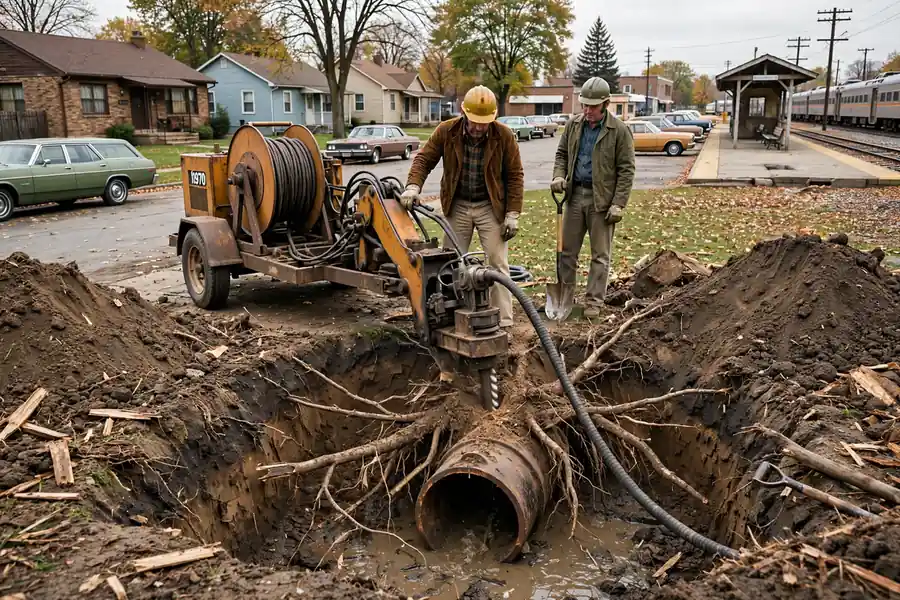
In short: This page covers tree root removal in Palatine, IL 60067: mechanical cutting and hydro-jetting that clears root masses from 1960s-70s clay tile and Orangeburg laterals serving 1960s-70s subdivisions. When you call (833) 713-2101, the first step is a camera inspection — we locate exactly where roots are entering your line near downtown Palatine and the Metra station before cutting anything.
Tree Root Removal in Palatine: What to Know
Ask any Palatine homeowner near downtown Palatine and the Metra station with big trees and 1960s-70s clay tile and Orangeburg laterals what their sewer nemesis is, and the answer is roots. The pattern is unmistakable: drains slow every spring as growth surges, a cleaning buys a few good months, then the gurgles return like clockwork. Each cycle the roots come back thicker, because cutting without addressing the entry points is pruning — and pruned roots grow back stronger.
In Palatine, professional root removal stops the cycle from repeating. The cutter does not just poke a hole through the mass the way a hand snake does; it mills the full diameter of the pipe back open at every invaded joint. Paired with a camera that maps each entry along your 1960s-70s subdivisions lateral, the visit ends with knowledge: exactly where roots get in, how bad each point is, and what it will take — lining, spot repair, or scheduled cutting — to keep them out.
Signs You Need Tree Root Removal in Palatine
In Palatine, root intrusion has a signature — once you know it, you will recognize it in your Palatine home. For 1960s-70s subdivisions on 1960s-70s clay tile and Orangeburg laterals near downtown Palatine and the Metra station, these are the telltale signs that roots, not just buildup, are closing the line.
Cleanings that help less each time
In Palatine, the first jetting bought a year; the next bought six months; the last bought weeks. That shrinking return on 1960s-70s clay tile and Orangeburg laterals in Palatine near downtown Palatine and the Metra station means the root masses are winning — time to cut aggressively and plan the lasting fix.
A neighbor's root story on your street
In Palatine, roots do not respect lot lines — the same soil, trees, and pipe era run the whole block. When a Palatine neighbor near downtown Palatine and the Metra station has 1960s-70s clay tile and Orangeburg laterals cleared of roots, 1960s-70s subdivisions on the same street should get their own camera look.
Gurgling that gets worse after rain
Rain swells root masses inside 1960s-70s clay tile and Orangeburg laterals, tightening the restriction just when flow increases. Palatine homeowners near downtown Palatine and the Metra station who notice gurgles spike during storms are hearing roots and water compete for the same pipe.
Large trees standing over the lateral's path
In Palatine, a mature tree within 20-30 feet of your sewer line is a root-risk fact, not a coincidence. Palatine yards near downtown Palatine and the Metra station with big shade trees over 1960s-70s clay tile and Orangeburg laterals should assume roots are involved until a camera proves otherwise.
Spring slowdowns after winter's relief
In Palatine, lines that behaved all winter and choke each April are responding to root growth season. For 1960s-70s subdivisions in Palatine on 1960s-70s clay tile and Orangeburg laterals near downtown Palatine and the Metra station, the spring slowdown is roots waking up — and the argument for cutting before summer.
The camera shows root masses, not just buildup
In Palatine, there is no mistaking it on the monitor: pale tendrils waving in the flow, then dense mats choking the joints. When Palatine technicians camera 1960s-70s clay tile and Orangeburg laterals under 1960s-70s subdivisions near downtown Palatine and the Metra station, root footage is the definitive diagnosis.
How Tree Root Removal Works in Palatine
In Palatine, the cutter is matched to the pipe. A flexible shaft carries a rotating head — blades or chains sized just under your pipe's diameter — through the cleanout to the first root mass in your 1960s-70s clay tile and Orangeburg laterals. Spinning at high speed, it mills the roots back to bare wall without gouging the pipe itself, working joint by joint down the Palatine lateral under your Palatine 1960s-70s subdivisions. Different heads handle different masses: fine tendrils, woody mats, or the full blockages that stop flow entirely.
Root removal starts with mapping, not cutting. The camera travels your 1960s-70s clay tile and Orangeburg laterals and the Palatine technician logs every entry point — joint separations, cracks, offsets — with depth and distance from the cleanout. Palatine homeowners near downtown Palatine and the Metra station see the invasion on the monitor: where the roots are thickest, which joints they favor, and whether the pipe behind the roots is still sound enough to save.
In Palatine, the camera makes a final pass to verify and to plan. Open joints, clean walls, free flow — you watch the proof on the monitor. The Palatine technician also documents each entry point's condition: tight cracks that a root treatment can hold, versus separated joints that will keep inviting roots back. That assessment turns your Palatine root removal from a single visit into a strategy — scheduled cutting, chemical treatment, or lining the entries shut for good.
What Makes Tree Root Removal Different in Palatine
Area Facts
- Housing stock
- 1960s-70s subdivisions
- Sewer laterals
- 1960s-70s clay tile and Orangeburg laterals
- Soil
- silty clay loam near creek flood zones
- ZIP served
- 60067
Creekside infiltration near the Buffalo Creek headwaters is why Palatine root removal pairs cutting with a next step. Clearing the roots solves today; the constraint on 1960s-70s subdivisions lots means the lasting fix — lining the entries, scheduling seasonal cuts, or treating regrowth — has to fit the property's reality near downtown Palatine and the Metra station. The Palatine technician lays out those options with the footage in hand, not as an upsell but as the honest sequel to the cutting.
Roots follow water, and in Palatine water follows silty clay loam near creek flood zones near downtown Palatine and the Metra station. Tree Root Removal rechecks here target the dampest joints first, because that is where Palatine roots return.
In Palatine, root work is defined by whole subdivisions of clay tile and Orangeburg aging out together. That shapes the cutting plan directly: the camera has to find every entry along the run, because missing one joint on 1960s-70s subdivisions laterals near downtown Palatine and the Metra station just moves the next backup by a few months. Crews serving 60067 cut methodically from the house toward the street so no invaded joint is skipped.
Our Tree Root Removal Process in Palatine
Camera mapping
Every root entry in your 1960s-70s clay tile and Orangeburg laterals is located and logged — depth, distance, severity. Your Palatine cutting plan near downtown Palatine and the Metra station is built on this map, not on guesswork.
Cutter selection
In Palatine, the head is sized to your pipe's diameter and matched to the mass — tendrils, mats, or full blockages in 1960s-70s subdivisions laterals get different tooling.
Mechanical root cutting
In Palatine, joint by joint, the spinning cutter mills roots back to bare pipe wall through your existing cleanout — no digging in your Palatine yard near downtown Palatine and the Metra station.
Hydro-jetter flush
Cut fragments are flushed downstream to the city main so your 1960s-70s clay tile and Orangeburg laterals are emptied, not just opened.
Verification camera pass
In Palatine, the camera confirms open joints and free flow — you watch the cleared line on the monitor and see the before-and-after for your 1960s-70s subdivisions.
Prevention strategy
Each entry point is graded: treat, schedule, or seal. Your Palatine technician near downtown Palatine and the Metra station lays out the options for keeping roots out of your 1960s-70s clay tile and Orangeburg laterals for good.
In Palatine, every root mass in your lateral started as a single hairline root through a single joint. Palatine homeowners near downtown Palatine and the Metra station who act while the invasion is still cuttable save themselves the excavation conversation later. If your 1960s-70s clay tile and Orangeburg laterals are showing the signs, call (833) 713-2101 — the camera will show you precisely what you are dealing with.
Tree Root Removal in nearby areas
More services in Palatine
Sewer Line Cleaning
Pairs well with Tree Root Removal in Palatine.
Learn moreSewer Line Installation
Pairs well with Tree Root Removal in Palatine.
Learn moreSewer Line Replacement
Pairs well with Tree Root Removal in Palatine.
Learn moreSewer Maintenance
Pairs well with Tree Root Removal in Palatine.
Learn moreTrenchless Sewer Repair
Good with Tree Root Removal in Palatine.
Learn moreTree Root Removal in nearby areas
Tree Root Removal in Vernon Hills
Now booking in Vernon Hills 60061.
Learn moreTree Root Removal in Canterbury Fields
Also serving Canterbury Fields 60089.
Learn moreTree Root Removal in Mill Creek
Mill Creek 60089 service area.
Learn moreTree Root Removal in Woodlands of Fiore
Woodlands of Fiore 60089 service area.
Learn moreSewer Line Problems Don’t Wait. Neither Should You.
Call now and reach a local sewer line specialist serving Buffalo Grove, IL and nearby northwest suburbs — 24/7.
(833) 713-2101Free to call · No obligation · 24/7 emergency line
Frequently Asked Questions
How can you tell roots from a collapsed pipe in Palatine?
In Palatine, the camera tells them apart instantly: roots wave and shred; collapses show deformed or missing pipe wall. This distinction matters enormously for 1960s-70s subdivisions on 1960s-70s clay tile and Orangeburg laterals near downtown Palatine and the Metra station — roots mean cutting and a plan, collapse means replacement. Palatine technicians never cut first and diagnose later.
Can chemical treatments replace cutting in Palatine?
Treatments manage regrowth; they do not remove masses. On 1960s-70s clay tile and Orangeburg laterals in Palatine near downtown Palatine and the Metra station, the sequence that works is cut first — restoring full diameter — then treat to slow what grows back. Skipping the cutting and only treating is like mowing without ever clearing the brush: the mass stays.
Will the roots grow back after cutting in Palatine?
In Palatine, yes, if the entry points stay open — cutting is pruning, and pruned roots regrow. On 1960s-70s clay tile and Orangeburg laterals in Palatine near downtown Palatine and the Metra station, regrowth typically takes a season or two to matter again. The lasting answer is closing the entries: sectional lining or spot repairs at the invaded joints of your 1960s-70s subdivisions lateral, or scheduled cutting on a calendar that stays ahead of the growth.
How much root can a pipe tolerate in Palatine?
Less than you'd think. Even a partial mat in 1960s-70s clay tile and Orangeburg laterals snags paper and slows flow, and Palatine 1960s-70s subdivisions near downtown Palatine and the Metra station learn that the line's tolerance shrinks as the mass grows. The practical rule: if the camera shows roots occupying meaningful diameter, cut — waiting only makes the mass woodier and harder to mill.
Is there an ideal season for root cutting in Palatine?
In Palatine, late spring, after the growth surge, is the sweet spot — the year's new roots are in the pipe and worth cutting. For 1960s-70s clay tile and Orangeburg laterals under 1960s-70s subdivisions near downtown Palatine and the Metra station, many Palatine owners pair a spring cutting with a fall camera recheck: cut when growth peaks, verify before winter that the line is clear.
Do I need to dig to remove roots in Palatine?
In Palatine, no — removal is entirely through the cleanout. Cutting, flushing, and camera verification all happen via existing access on your Palatine 1960s-70s subdivisions near downtown Palatine and the Metra station. Digging only enters the picture if you choose the lasting fix of lining or replacing the invaded sections of 1960s-70s clay tile and Orangeburg laterals — and even then, trenchless options usually avoid open excavation.
Serving Palatine, IL 60067