
Sewer Line Replacement in Palatine, IL
Full sewer lateral replacement for 1960s-70s subdivisions in Palatine, 60067 — pipe bursting or open-cut renewal for 1960s-70s clay tile and Orangeburg laterals at the end of their life.
- 24/7 emergency line
- Serving Palatine 60067
- Free to call · No obligation
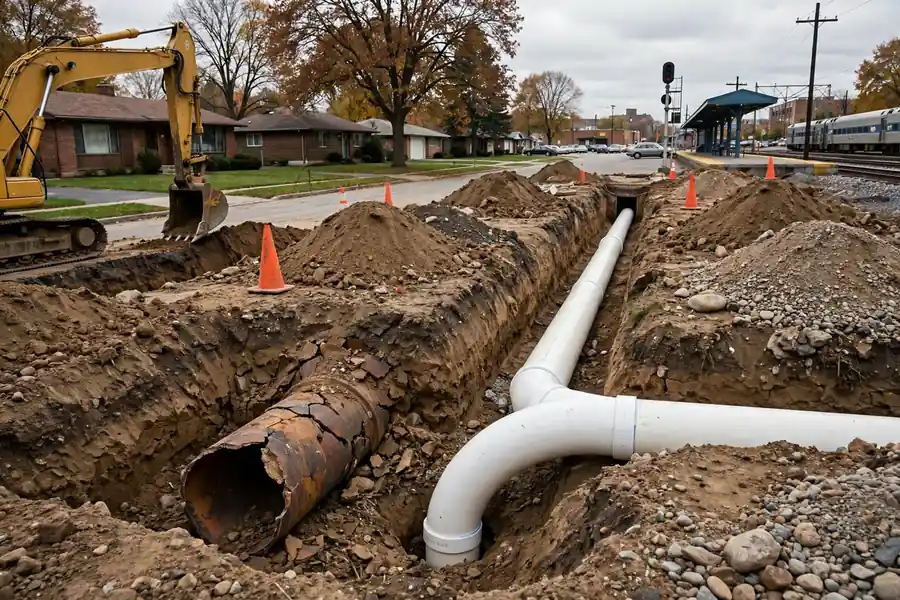
In short: If your Palatine lateral is done — collapsed clay, disintegrated Orangeburg, joints offset beyond sealing — this page explains replacement options for 60067. The first step when you call (833) 713-2101 is a camera inspection of your 1960s-70s clay tile and Orangeburg laterals to confirm the diagnosis before anyone talks methods.
Sewer Line Replacement in Palatine: What to Know
Think of replacement as the reset your Palatine property's plumbing has been waiting for. 1960s-70s subdivisions were connected to 1960s-70s clay tile and Orangeburg laterals decades ago near downtown Palatine and the Metra station, and everything about the new line is an upgrade: continuous pipe with fused or gasketed joints that roots cannot enter, proper bedding that prevents settling, and grade verified by level before backfill. It is the last sewer project the line will need for a very long time.
In Palatine, the decision always starts with evidence. A camera inspection maps every foot of your lateral — where it is sound, where it is failing, and whether the damage is localized enough for a spot repair or extensive enough to justify replacement. Palatine homeowners get that footage and a straight recommendation: repair where repair makes sense, replace where it does not, and the reasons explained in plain language.
Signs You Need Sewer Line Replacement in Palatine
In Palatine, a camera inspection confirms it, but the symptoms usually speak first. In Palatine, where 1960s-70s subdivisions sit on aging 1960s-70s clay tile and Orangeburg laterals, these are the classic end-of-life signals.
The camera shows collapse or missing sections
In Palatine, footage does not lie: flattened Orangeburg, crushed clay tile, or gaps where pipe should be. For 1960s-70s subdivisions in Palatine near downtown Palatine and the Metra station, a camera showing structural failure in 1960s-70s clay tile and Orangeburg laterals is the definitive replacement trigger.
Orangeburg pipe past its service life
In Palatine, bituminous fiber pipe from the 1945-1972 era is living on borrowed time everywhere, including Palatine. Where 1960s-70s subdivisions still run on Orangeburg sections near downtown Palatine and the Metra station, proactive replacement beats waiting for the deformation to become a collapse.
Sewage odors that cleaning never fixes
In Palatine, persistent odor after a thorough cleaning means wastewater is escaping the pipe, not just sitting in it. In Palatine's 1960s-70s clay tile and Orangeburg laterals near downtown Palatine and the Metra station, that points to cracks or separations no jetter can seal.
Multiple bellies holding water
In Palatine, low spots where water ponds instead of flowing collect solids until they dam the line. When camera footage shows several bellies along 1960s-70s clay tile and Orangeburg laterals serving 1960s-70s subdivisions in Palatine, regrading — effectively replacement — is the durable fix.
Repairs that cost nearly as much as replacement
Three spot repairs on 1960s-70s clay tile and Orangeburg laterals can approach the investment of one new lateral — without the warranty of a new line's lifespan. Palatine homeowners near downtown Palatine and the Metra station facing the third repair bill often find replacement is the better math.
A lateral the inspector condemns
Pre-sale or municipal inspections in Palatine near downtown Palatine and the Metra station occasionally fail a lateral outright. When 1960s-70s clay tile and Orangeburg laterals cannot pass, replacement is not optional — it is the path to a compliant, sellable 1960s-70s subdivisions property.
How Sewer Line Replacement Works in Palatine
In Palatine, replacement starts the same way every responsible job does: with a camera. The Palatine technician maps your 1960s-70s clay tile and Orangeburg laterals from cleanout to city main, recording depths, materials, and every defect — and Palatine homeowners near downtown Palatine and the Metra station watch the footage that justifies the recommendation. Only when the video shows damage beyond repair does the conversation turn to methods: pipe bursting or open-cut excavation.
Whichever method fits your Palatine lot, the finish is the same: connections sealed at the house and the city main, the line tested for flow and leaks, municipal inspection of the work, and backfill compacted in lifts with the surface restored. You keep the before-and-after camera footage — proof that the 1960s-70s subdivisions lateral went from failed to new.
In Palatine, open-cut excavation is the traditional option and still the right one in many cases. The crew digs along the Palatine lateral's path, removes the failed 1960s-70s clay tile and Orangeburg laterals, beds the trench, and lays new pipe section by section with grade verified by level. Where bursting cannot run — severe collapses that block the bursting head, or lines needing rerouting — excavation gives Palatine crews full access to build the line exactly right.
What Makes Sewer Line Replacement Different in Palatine
Area Facts
- Housing stock
- 1960s-70s subdivisions
- Sewer laterals
- 1960s-70s clay tile and Orangeburg laterals
- Soil
- silty clay loam near creek flood zones
- ZIP served
- 60067
Replacement crews in Palatine bed new pipe for silty clay loam near creek flood zones near downtown Palatine and the Metra station, not for textbook soil. That is what makes Sewer Line Replacement in Palatine a fifty-year asset instead of a repeat project.
In Palatine, the replacement decision almost always starts with whole subdivisions of clay tile and Orangeburg aging out together. That is why the camera inspection in Palatine is diagnostic, not ceremonial: it has to distinguish a line with a few bad joints — a lining or spot-repair candidate — from a line that is failing along its length. Crews serving 60067 make that call on footage, not assumptions, because the wrong method wastes everyone's money.
In Palatine, creekside infiltration near the Buffalo Creek headwaters decides the method as much as the pipe does. On 1960s-70s subdivisions lots in Palatine, bursting is often the first choice precisely because it avoids the surface damage excavation would cause — but it needs enough intact path to pull through. Where the line is fully collapsed or the route must change near downtown Palatine and the Metra station, open-cut is the honest recommendation, planned with restoration from day one.
Our Sewer Line Replacement Process in Palatine
Camera diagnosis
In Palatine, the full lateral is inspected and recorded. You see exactly which sections of your 1960s-70s clay tile and Orangeburg laterals have failed and which are sound — the evidence your Palatine replacement plan is built on.
Method recommendation
In Palatine, bursting or open-cut — the choice is matched to your pipe's condition, your lot near downtown Palatine and the Metra station, and access. Your 1960s-70s subdivisions get the method that fits, not the one that is easiest to sell.
Permits and utility locates
Municipal permits are pulled and every buried line is marked. Palatine inspections are scheduled so the work is reviewed at the right stages.
Replacement work
In Palatine, the new pipe goes in — burst through the old path or laid in an open trench — with grade checked section by section under your Palatine yard near downtown Palatine and the Metra station.
Connections, testing, inspection
Both ends are sealed and connected, the Palatine line is tested for flow and leaks, and the municipal inspector signs off before backfill.
Backfill and restoration
The trench or pits on your Palatine lot are backfilled in compacted lifts and the surface restored. Your Palatine property near downtown Palatine and the Metra station is left with a new lateral and the footage to prove it.
Palatine homeowners near downtown Palatine and the Metra station do not need a sewer lecture; they need a straight answer about their 1960s-70s clay tile and Orangeburg laterals and a crew that does what the footage calls for. Whether that is bursting a new line through the old path or opening a careful trench, the goal is the same: a lateral your 1960s-70s subdivisions can rely on for decades. Start with the camera — call (833) 713-2101.
Sewer Line Replacement in nearby areas
More services in Palatine
Sewer Line Cleaning
Often booked with Sewer Line Replacement in Palatine.
Learn moreSewer Line Installation
Often booked with Sewer Line Replacement in Palatine.
Learn moreSewer Maintenance
Often booked with Sewer Line Replacement in Palatine.
Learn moreTree Root Removal
Pairs well with Sewer Line Replacement in Palatine.
Learn moreTrenchless Sewer Repair
Good with Sewer Line Replacement in Palatine.
Learn moreSewer Line Replacement in nearby areas
Sewer Line Replacement in Vernon Hills
Vernon Hills 60061 service area.
Learn moreSewer Line Replacement in Canterbury Fields
Also serving Canterbury Fields 60089.
Learn moreSewer Line Replacement in Mill Creek
Now booking in Mill Creek 60089.
Learn moreSewer Line Replacement in Woodlands of Fiore
Woodlands of Fiore 60089 service area.
Learn moreSewer Line Problems Don’t Wait. Neither Should You.
Call now and reach a local sewer line specialist serving Buffalo Grove, IL and nearby northwest suburbs — 24/7.
(833) 713-2101Free to call · No obligation · 24/7 emergency line
Frequently Asked Questions
How long will the new sewer line last in Palatine?
In Palatine, a properly installed modern lateral — continuous pipe, watertight joints, correct grade and bedding for Palatine soil near downtown Palatine and the Metra station — is built to serve for many decades. What ends lines early is poor installation: bad grade, poor bedding, unsealed joints. That is why the inspection checkpoints on your 1960s-70s subdivisions replacement matter as much as the pipe itself.
What is the difference between pipe bursting and pipe lining?
In Palatine, bursting replaces the pipe — breaking the old one apart and pulling a brand-new line into its path. Lining rehabilitates it — curing a resin sleeve inside the existing pipe. For Palatine 1960s-70s clay tile and Orangeburg laterals that are structurally failed, bursting (full replacement) is the answer; for lines that are worn but still shaped, lining can work. The camera footage of your 1960s-70s subdivisions lateral shows which camp yours is in.
Will replacement destroy my yard or driveway in Palatine?
In Palatine, far less than you fear. Pipe bursting needs only two access pits; even open-cut follows a single trench line, not the whole yard. On 1960s-70s subdivisions properties near downtown Palatine and the Metra station, creekside infiltration near the Buffalo Creek headwaters, and restoration is part of the written plan — sod, plantings, and hardscaping put back when the pipe work is done.
How do I know if my Palatine line needs replacement or just repair?
In Palatine, the camera decides. If footage shows one or two bad joints in otherwise sound 1960s-70s clay tile and Orangeburg laterals, a spot repair or sectional lining usually suffices for your 1960s-70s subdivisions. If it shows collapse, widespread offsets, or deformation along most of the run near downtown Palatine and the Metra station, replacement is the durable answer. Any honest Palatine contractor shows you the video and explains which category your line falls into before quoting either option.
Can replacement be done in winter in Palatine?
In Palatine, yes, with adjustments. Frozen ground digs harder and concrete-like soil slows excavation, but Palatine crews work through winter near downtown Palatine and the Metra station by staging the job around thaws and protecting open trenches overnight. The pipe and methods do not care about the calendar — only the Palatine digging does, and that is manageable.
Is pipe bursting possible on 1960s-70s clay tile and Orangeburg laterals in Palatine?
In Palatine, often yes. Bursting handles clay tile and Orangeburg well — the head fractures the old material outward as it pulls the new pipe through. It struggles where the line has fully collapsed into a blocked mass or where whole subdivisions of clay tile and Orangeburg aging out together. Your Palatine technician confirms bursting feasibility from the camera footage near downtown Palatine and the Metra station before recommending it.
Serving Palatine, IL 60067