
Sewer Line Cleaning in Palatine, IL
Slow drains in Palatine? We clean 1960s-70s clay tile and Orangeburg laterals serving 1960s-70s subdivisions near downtown Palatine and the Metra station, restoring full flow with camera-verified hydro-jetting.
- 24/7 emergency line
- Serving Palatine 60067
- Free to call · No obligation
In short: This page covers professional sewer line cleaning in Palatine, IL 60067: hydro-jetting, mechanical augering, and root cutting for 1960s-70s subdivisions. When you call (833) 713-2101, the first step is a quick symptom check, then we schedule a camera inspection to see exactly what is blocking your 1960s-70s clay tile and Orangeburg laterals.
Sewer Line Cleaning in Palatine: What to Know
Nobody in Palatine schedules sewer cleaning for fun — they call when the warning signs pile up near downtown Palatine and the Metra station. 1960s-70s subdivisions with 1960s-70s clay tile and Orangeburg laterals are especially prone to slow accumulation: every shower adds soap film, every dishwasher cycle adds grease, and every spring adds a fresh push of root growth into joints that have been underground for decades. Cleaning removes all of it in a single visit.
In Palatine, what makes professional cleaning different from a store-bought drain snake is verification. After the jetter or auger passes through your 1960s-70s clay tile and Orangeburg laterals, the Palatine technician runs a camera down the same line and shows you the result — clean walls, open joints, water flowing freely. Palatine homeowners get proof the job worked, not just a promise, and a clear picture of what shape the line is in for the years ahead.
Signs You Need Sewer Line Cleaning in Palatine
Sewer trouble in Palatine rarely announces itself with a single dramatic backup. More often it builds through small symptoms that 1960s-70s subdivisions owners near downtown Palatine and the Metra station learn to live with — until the line closes enough to force the issue. If you recognize several of these signs in your 1960s-70s clay tile and Orangeburg laterals, cleaning is usually the right first step before anything more invasive.
Toilets gurgle or bubble
In Palatine, gurgling happens when air gets trapped by a partial blockage and forces its way back through the toilet trap. Palatine homeowners near downtown Palatine and the Metra station often hear it first in a basement or first-floor bathroom — a sign that wastewater is struggling past buildup in the 1960s-70s clay tile and Orangeburg laterals.
Drain flies that never go away
In Palatine, tiny drain flies breed in the organic film coating dirty pipes. If they persist around your Palatine sinks despite cleaning the drains you can see, the breeding ground is deeper — inside 1960s-70s clay tile and Orangeburg laterals where only professional jetting reaches.
The same drain clogs again and again
In Palatine, a clog that returns weeks after snaking was never fully removed — the snake punched a hole through the blockage and the rest stayed behind. In Palatine's 1960s-70s clay tile and Orangeburg laterals, recurring clogs usually mean scale or root regrowth that only a full-diameter cleaning addresses.
Several drains slow down at once
In Palatine, when the kitchen sink, a bathroom sink, and the tub all drain slowly, the restriction is usually in the main lateral — not in a single trap. In Palatine, 1960s-70s clay tile and Orangeburg laterals narrow gradually as grease and scale coat the walls, so multi-fixture slowness is the classic early warning that cleaning is due.
Basement floor drain burps or overflows
Floor drains in 1960s-70s subdivisions connect straight to the Palatine lateral, so air or water pushing up through one means the line downstream is blocked. For Palatine homes near downtown Palatine and the Metra station with 1960s-70s clay tile and Orangeburg laterals, a burping floor drain is the last warning before a full backup — call before it becomes one.
Water backs up in the tub or shower
The tub or shower is the lowest drain in most 1960s-70s subdivisions, so it shows lateral trouble first. When flushing a toilet pushes water up into the tub, the main line serving your Palatine home near downtown Palatine and the Metra station is significantly restricted — cleaning should not wait.
How Sewer Line Cleaning Works in Palatine
Where roots have claimed sections of 1960s-70s clay tile and Orangeburg laterals, the Palatine technician switches to mechanical cutting. A flexible cable with a rotating cutter head — sized to the pipe diameter — feeds through the cleanout and shreds root masses at the joints, followed by a jetter flush that carries the cuttings away. For Palatine homeowners near downtown Palatine and the Metra station, this combination clears lines that a snake alone could never fully open, because it removes the roots instead of just poking through them.
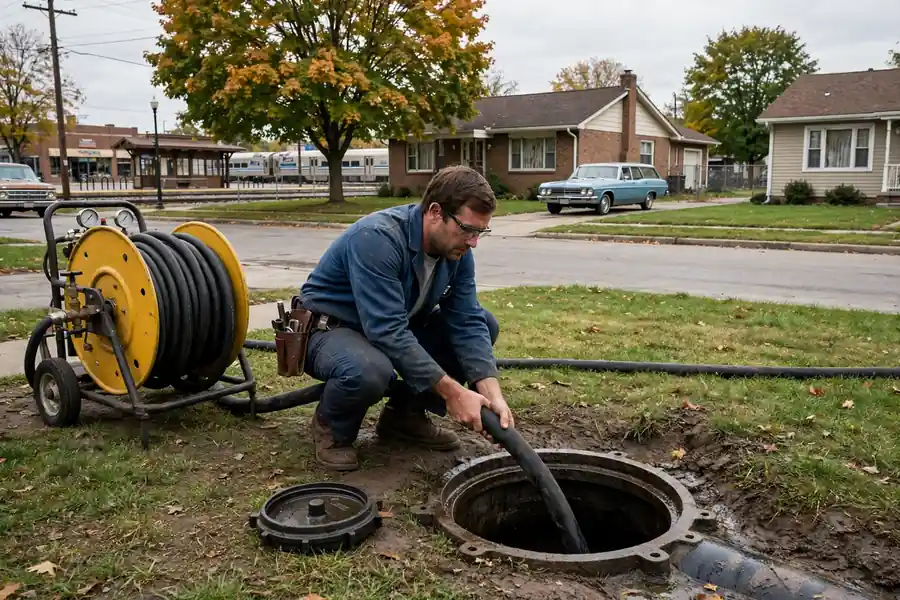
Hydro-jetting is the workhorse for Palatine sewer lines. A hose with a specialized nozzle threads into the pipe and blasts water at thousands of pounds of pressure in every direction — forward to break through the blockage, backward to scour the walls and pull the hose along. On 1960s-70s clay tile and Orangeburg laterals under 1960s-70s subdivisions near downtown Palatine and the Metra station, a jetter pass strips grease and scale back to bare pipe wall and flushes the debris out to the city main in one continuous operation.
Access is through cleanouts, and 1960s-70s subdivisions in Palatine almost always have one — sometimes two. If a cleanout is buried or missing, the Palatine technician can pull a toilet or access the line through a basement floor drain to reach the 1960s-70s clay tile and Orangeburg laterals. After cleaning, the camera goes back in for a verification pass: you watch the water run clear and see the full diameter restored, which is also when any cracks, offsets, or bellies worth monitoring get documented for the future.
What Makes Sewer Line Cleaning Different in Palatine
Area Facts
- Housing stock
- 1960s-70s subdivisions
- Sewer laterals
- 1960s-70s clay tile and Orangeburg laterals
- Soil
- silty clay loam near creek flood zones
- ZIP served
- 60067
The 1960s-70s clay tile and Orangeburg laterals under Palatine define how cleaning is done here. Whole subdivisions of clay tile and Orangeburg aging out together means the camera inspection matters more than the jetter: the Palatine technician maps exactly where roots or scale concentrate so the cleaning targets those joints instead of blindly scouring the whole run. Palatine homeowners near downtown Palatine and the Metra station get a line that is not just clean but documented, joint by joint.
In Palatine, silty clay loam near creek flood zones near downtown Palatine and the Metra station keeps groundwater near 1960s-70s clay tile and Orangeburg laterals. Sewer Line Cleaning visits here end with a flow check, because a clean Palatine line should move stormwater, not hold it.
In Palatine, creekside infiltration near the Buffalo Creek headwaters shapes the logistics of every visit. Because 1960s-70s subdivisions in Palatine come with that constraint, cleaning crews plan access before they arrive — confirming cleanout locations, scheduling around occupants where needed, and choosing methods that keep the property undisturbed. It is routine work for teams that serve 60067 every week, but it is planned work, not improvised.
Our Sewer Line Cleaning Process in Palatine
Describe the symptoms
In Palatine, call (833) 713-2101 and tell us what you are seeing in your Palatine home — which drains are slow, whether toilets gurgle, any odors or backups. Those details tell the Palatine technician what to expect inside your 1960s-70s clay tile and Orangeburg laterals before the truck rolls.
Camera inspection and locate
The Palatine technician feeds a camera through the cleanout and records the full run of your 1960s-70s clay tile and Orangeburg laterals, marking depths and distances. Palatine homeowners near downtown Palatine and the Metra station watch the monitor and see the blockage themselves — no guesswork about what needs cleaning.
Choose the cleaning method
Grease and scale in Palatine lines call for hydro-jetting; root masses call for mechanical cutting followed by jetting. The choice is matched to what the camera found in your Palatine line — 1960s-70s subdivisions with 1960s-70s clay tile and Orangeburg laterals often need the combination.
Clear the line
Through the cleanout, the Palatine technician works the full length of your Palatine lateral — jetter passes to scour walls, cutter passes to shred roots — flushing everything downstream to the city main. No digging, no interior mess in your Palatine home.
Verify with a second camera pass
The camera goes back into your Palatine line to confirm full-diameter flow and clean walls. You see the after picture on the monitor, and the Palatine technician notes any cracks or offsets in your 1960s-70s clay tile and Orangeburg laterals worth watching — useful history for your 1960s-70s subdivisions.
Prevention plan
In Palatine, based on what the line looked like, you get a plain-English plan: how often 1960s-70s clay tile and Orangeburg laterals serving 1960s-70s subdivisions in Palatine near downtown Palatine and the Metra station should be rechecked, what to keep out of drains, and whether root treatment or a maintenance schedule makes sense.
Most Palatine homeowners near downtown Palatine and the Metra station only learn the state of their 1960s-70s clay tile and Orangeburg laterals when something goes wrong. A cleaning visit flips that around: you get the full picture while everything still works, plus a clear line that drains the way it should. If it has been years since anyone looked inside your lateral — or if the drains are already slowing — call (833) 713-2101 and start with the camera inspection.
Sewer Line Cleaning in nearby areas
More services in Palatine
Sewer Line Installation
Good with Sewer Line Cleaning in Palatine.
Learn moreSewer Line Replacement
Good with Sewer Line Cleaning in Palatine.
Learn moreSewer Maintenance
Pairs well with Sewer Line Cleaning in Palatine.
Learn moreTree Root Removal
Pairs well with Sewer Line Cleaning in Palatine.
Learn moreTrenchless Sewer Repair
Pairs well with Sewer Line Cleaning in Palatine.
Learn moreSewer Line Cleaning in nearby areas
Sewer Line Cleaning in Vernon Hills
Vernon Hills 60061 service area.
Learn moreSewer Line Cleaning in Canterbury Fields
Now booking in Canterbury Fields 60089.
Learn moreSewer Line Cleaning in Mill Creek
Also serving Mill Creek 60089.
Learn moreSewer Line Cleaning in Woodlands of Fiore
Now booking in Woodlands of Fiore 60089.
Learn moreSewer Line Problems Don’t Wait. Neither Should You.
Call now and reach a local sewer line specialist serving Buffalo Grove, IL and nearby northwest suburbs — 24/7.
(833) 713-2101Free to call · No obligation · 24/7 emergency line
Frequently Asked Questions
What is the difference between snaking and hydro-jetting?
In Palatine, a snake punches a hole through a blockage; a jetter scours the full interior diameter of the pipe. For Palatine homes with 1960s-70s clay tile and Orangeburg laterals near downtown Palatine and the Metra station, snaking restores flow temporarily while hydro-jetting removes the grease, scale, and root hairs the snake left behind — which is why jetted lines stay clear far longer between visits.
Will hydro-jetting damage the older pipes in Palatine?
Not when it is matched to the pipe. 1960s-70s clay tile and Orangeburg laterals in Palatine get pressure and nozzle choices suited to their age and condition — the Palatine technician reads the camera first and dials the approach accordingly. Brittle sections with visible cracks get a gentler pass or a different method entirely. The goal is removing buildup from 1960s-70s subdivisions lines, never harming the pipe itself.
Can roots be removed without digging up my Palatine yard?
In Palatine, yes — that is exactly what mechanical root cutting plus hydro-jetting does. The cutter shreds root masses inside your 1960s-70s clay tile and Orangeburg laterals through the existing cleanout, and the jetter flushes the debris out, all with no excavation in your Palatine yard near downtown Palatine and the Metra station. If the camera shows roots entering through broken joints, the lasting fix is sealing those entries with lining — but the removal itself needs no digging.
Do I need to be home during the cleaning in Palatine?
In Palatine, it helps but is not always required. If the cleanout is accessible from outside your 1960s-70s subdivisions, the Palatine technician can often complete the camera inspection and cleaning in Palatine near downtown Palatine and the Metra station with just a phone walkthrough. Interior access — basement or crawl-space cleanouts — does need someone present. Either way you get the before-and-after camera footage to review for your Palatine home.
How long does a sewer cleaning visit take?
Most Palatine cleaning visits are completed in a single appointment — camera inspection, cleaning, and verification together. Heavily root-bound sections of 1960s-70s clay tile and Orangeburg laterals or lines that need both cutting and jetting can extend the visit, and your technician will tell you what to expect after the first camera look at your 1960s-70s subdivisions.
What if cleaning doesn't solve the problem?
In Palatine, then the camera has done its second job: showing why. If the inspection reveals collapsed sections, major offsets, or bellies holding water in your 1960s-70s clay tile and Orangeburg laterals, cleaning was still the right first step — it exposed the real issue in your Palatine home near downtown Palatine and the Metra station. From there the conversation turns to targeted repair or replacement options, and you already have the footage to make an informed decision.
Serving Palatine, IL 60067