
Pipe Lining in Arlington Heights, IL
From root-invaded joints to corroded cast iron, pipe lining gives Arlington Heights homeowners near Arlington Park and the Metra UP-NW station a renewed lateral inside their clay tile and Orangeburg laterals — installed through small access points.
- Camera-verified work
- Trenchless options
- Serving 60004
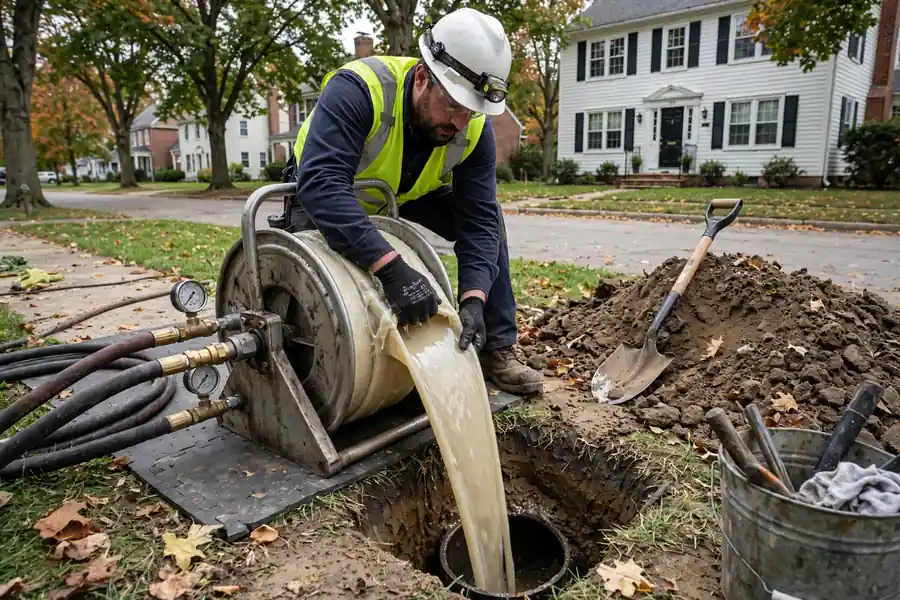
In short: If the clay tile and Orangeburg laterals under your Arlington Heights home are cracked, root-invaded, or corroded, this page explains pipe lining for 60004: how a cured-in-place liner creates a pipe-within-a-pipe for 1970s colonials, split-levels, and ranches. The first step when you call (833) 713-2101 is a camera inspection to verify the line can be lined.
What pipe lining means for Arlington Heights homes
A sewer lateral fails from the inside out, and in Arlington Heights that process has been running for decades. 1970s colonials, split-levels, and ranches here sit on clay tile and Orangeburg laterals, and every year of service adds another layer of trouble: fine roots find the joints, cast iron scales and pits, clay tile shifts a fraction of an inch at a time. Homeowners near Arlington Park and the Metra UP-NW station usually notice the outside symptoms first — slow drains, gurgling, the occasional backup — while the real damage stays buried.
Pipe lining answers that damage without the trench that traditional replacement demands. A technician saturates a felt liner with epoxy resin, inverts it into the old clay tile and Orangeburg laterals, and cures it into a hard, seamless pipe inside the old one. For 1970s colonials, split-levels, and ranches in Arlington Heights, that means a renewed lateral created through small access points instead of an open cut across the yard — and the new inner surface resists roots and scale far better than the pipe it now lines.
Signs your Arlington Heights home needs pipe lining
Knowing the difference between a line that needs cleaning and a line that needs lining saves Arlington Heights homeowners real aggravation. 1970s colonials, split-levels, and ranches on clay tile and Orangeburg laterals near Arlington Park and the Metra UP-NW station show the same progression: buildup symptoms first, then structural symptoms as joints open and roots thicken. These are the structural ones — the point where a new inner pipe earns its keep.
Recurring root blockages after every cleaning
When roots return within months of a cutting, they are entering through separated joints or cracks — not just brushing the pipe. In Arlington Heights's clay tile and Orangeburg laterals, that pattern near Arlington Park and the Metra UP-NW station means the openings are permanent, and each regrowth cycle widens them. Lining seals every joint at once, which is why it ends the root-cleaning treadmill for 1970s colonials, split-levels, and ranches.
Aging pipe you want to future-proof
clay tile and Orangeburg laterals in Arlington Heights do not get younger, and 1970s colonials, split-levels, and ranches owners near Arlington Park and the Metra UP-NW station sometimes choose lining before failure rather than after — during a remodel, before listing the home, or simply to stop scheduling their life around the lateral. Renewing the pipe on your timetable beats renewing it on the pipe's.
Offset joints that catch debris
When clay tile and Orangeburg laterals sections shift at the joints, the resulting lip snags wipes, paper, and solids on every flush. Video inspections of 1970s colonials, split-levels, and ranches laterals in Arlington Heights near Arlington Park and the Metra UP-NW station frequently catch these small offsets before they become big blockages. A liner spans the offset and restores a continuous bore.
Frequent backups despite a clear line
Some Arlington Heights backups are not blockages at all — they are rough, pitted clay tile and Orangeburg laterals walls grabbing every solid that passes. When 1970s colonials, split-levels, and ranches near Arlington Park and the Metra UP-NW station back up even after jetting, the interior surface itself is the problem. Lining replaces that rough surface with slick resin that wastewater slides through.
Scale and corrosion narrowing cast iron
Cast-iron sections in Arlington Heights's 1970s colonials, split-levels, and ranches rust from the inside, and the scale buildup can close off a surprising share of the diameter. near Arlington Park and the Metra UP-NW station, homeowners hear the diagnosis as 'your pipe is closing in on itself.' A liner gives that corroded clay tile and Orangeburg laterals section a smooth epoxy interior with the full diameter back.
Bellying or channeling visible on video
Where clay tile and Orangeburg laterals have settled, wastewater carves a channel along the bottom and solids collect in the low spots. In Arlington Heights near Arlington Park and the Metra UP-NW station, video of 1970s colonials, split-levels, and ranches laterals sometimes shows that telltale wavy waterline. Lining restores a smooth, uniform interior so flow carries solids through instead of parking them.
How pipe lining works
Every lining job in Arlington Heights starts with proof, not assumptions. A camera travels the full length of your clay tile and Orangeburg laterals, recording cracks, offsets, root entry points, and the pipe's internal diameter at each section. The technician measures distances and depths so the liner can be cut to the exact run serving your 1970s colonials, split-levels, and ranches — lining only what needs it, from cleanout to city tap or between two access points near Arlington Park and the Metra UP-NW station.
Preparation decides how well the liner bonds. The line is cleaned to bare wall — hydro-jetting strips grease and scale, mechanical cutters remove root masses at the joints — because resin adheres to clean clay tile and Orangeburg laterals, not to buildup. In Arlington Heights near Arlington Park and the Metra UP-NW station, this cleaning pass also confirms there are no collapsed sections that would block the liner; lining needs a continuous path, and the camera verifies it before resin is ever mixed.
Installation is the quiet part. The felt liner, saturated with two-part epoxy, is inverted into the clay tile and Orangeburg laterals with air or water pressure so the resin-coated side presses against the old wall, or pulled into place and expanded — the method matched to your 1970s colonials, split-levels, and ranches lateral's diameter and bends. Once positioned, it is cured: heat, steam, or ambient cure hardens the resin into a rigid, jointless pipe inside the old one, typically within a single workday near Arlington Park and the Metra UP-NW station.
The job closes with the same tool it opened with. A post-installation camera run shows the smooth new interior of your lined clay tile and Orangeburg laterals, verifies full diameter at every section, and documents the renewed lateral for your Arlington Heights home's records. Connections at branch lines are reopened robotically from inside where needed, so fixtures throughout your 1970s colonials, split-levels, and ranches drain into the new pipe exactly as they did into the old.
How Arlington Heights changes the pipe lining plan
Mature street-tree roots invading clay tile joints is the first thing a lining plan for Arlington Heights has to answer. That failure mode decides where the liner starts and stops, which access points the crew uses, and whether sectional lining at the most damaged joints beats a full-length run. Arlington Heights homeowners near Arlington Park and the Metra UP-NW station get a plan drawn around their actual clay tile and Orangeburg laterals, not a generic package.
Finished basements that rule out messy interior work is why trenchless methods win the argument here before work even starts. On 1970s colonials, split-levels, and ranches lots in Arlington Heights near Arlington Park and the Metra UP-NW station, the math is simple: two small access points versus a trench across everything the owners value. Lining was practically designed for properties where excavation is the expensive part of the job.
The ground itself has a vote. Glacial till, silty clay loam (Markham/Elliott series); somewhat-poor drainage. Buffalo Creek tributaries run through the village. near Arlington Park and the Metra UP-NW station, and NW Chicago suburbs: ~32 in annual precip, ~28 in snowfall, avg winter low ~19F, summer high ~84F. Freeze-thaw heave; spring urban flooding. — freeze-thaw works every joint of clay tile and Orangeburg laterals a little looser each winter, which is exactly the slow separation that liners are built to bridge. A cured liner moves with minor ground movement instead of opening new gaps, so 1970s colonials, split-levels, and ranches in 60004 get a renewal matched to local conditions.
Area Facts
- ZIP Code
- 60004
- Housing stock
- Median construction year 1974; 22.7% built 1970-79, 21.7% 1960-69, 17.8% 1980-89; downtown district median 1959. Colonials, split-levels and ranches on mature-tree lots.
- Common pipe materials
- Clay tile laterals in the pre-1970 core; Orangeburg (bituminous fiber, 1945-1972) in 60s-70s tracts; cast-iron interior stacks. PVC only on post-1980 infill.
- Soil
- Glacial till, silty clay loam (Markham/Elliott series); somewhat-poor drainage. Buffalo Creek tributaries run through the village.
What happens when you call
Describe the symptoms
Call (833) 713-2101 and tell us what your Arlington Heights home is doing — repeat clogs, gurgling, odors, or a camera report you already have. Those details tell us whether your clay tile and Orangeburg laterals sound like lining candidates before anyone visits your 1970s colonials, split-levels, and ranches.
Camera inspection and measurement
A technician runs a camera through your clay tile and Orangeburg laterals and records the full run serving your 1970s colonials, split-levels, and ranches near Arlington Park and the Metra UP-NW station — cracks, offsets, diameters, and distances. You watch the monitor and see exactly what the liner would cover, and the measurements size the liner to your line.
Cleaning to bare wall
Hydro-jetting and mechanical cutting strip grease, scale, and roots from the clay tile and Orangeburg laterals so the resin bonds to clean wall. Arlington Heights lines near Arlington Park and the Metra UP-NW station get verified clear and continuous — a collapsed section found here would reroute the plan to a different repair.
Liner installation and cure
The resin-saturated liner is inverted or pulled into your clay tile and Orangeburg laterals through small access points and cured into a hard, jointless inner pipe. Your Arlington Heights yard near Arlington Park and the Metra UP-NW station stays intact — no trench, no heavy equipment tearing across the lawn of your 1970s colonials, split-levels, and ranches.
Reopen connections and verify
Branch connections are reopened from inside where needed, then a final camera pass documents the smooth new interior of your lined lateral. You keep the before-and-after footage for your 1970s colonials, split-levels, and ranches in Arlington Heights — proof of what was renewed.
Aftercare guidance
You get plain guidance for the renewed line: what the new epoxy interior shrugs off, what still deserves care, and when clay tile and Orangeburg laterals serving 1970s colonials, split-levels, and ranches in Arlington Heights near Arlington Park and the Metra UP-NW station should get their next camera check. The liner needs no special maintenance — just normal, sensible drain habits.
Frequently Asked Questions
Does the liner reduce the pipe's diameter?
Slightly — the new wall has real thickness — but flow usually improves anyway. The slick epoxy interior of a lined clay tile and Orangeburg laterals carries wastewater more efficiently than the rough, scaled wall it replaced, so Arlington Heights homeowners near Arlington Park and the Metra UP-NW station typically see better drainage from their 1970s colonials, split-levels, and ranches laterals after lining, not worse.
Can pipe lining fix the clay tile and Orangeburg laterals problems common in Arlington Heights?
Where the issue is cracks, separated joints, root entry, or interior corrosion — the pattern behind mature street-tree roots invading clay tile joints — lining is built for exactly that. It bridges the damage with a continuous new wall. What it cannot fix is a fully collapsed section with no path for the liner, which is why the camera inspection of your 1970s colonials, split-levels, and ranches lateral near Arlington Park and the Metra UP-NW station comes first.
What happens to the old pipe during lining?
It stays right where it is and becomes the form for the new pipe. Your clay tile and Orangeburg laterals remain buried under your Arlington Heights property near Arlington Park and the Metra UP-NW station; the liner simply creates a new structural pipe inside them. Nothing is hauled away, which is part of why 1970s colonials, split-levels, and ranches owners choose lining over dig-and-replace.
Will lining work with finished basements that rule out messy interior work?
That constraint is precisely why lining is recommended here. Because the work runs through small access points, 1970s colonials, split-levels, and ranches in Arlington Heights near Arlington Park and the Metra UP-NW station avoid the excavation that traditional replacement would force. The crew plans access around the constraint instead of through it.
How do I know my Arlington Heights lateral is a lining candidate?
The camera decides. If your clay tile and Orangeburg laterals hold their basic shape — cracks, offsets, and root entries but no full collapse — lining is usually on the table for 1970s colonials, split-levels, and ranches near Arlington Park and the Metra UP-NW station. Lines with major bellies holding standing water or sections crushed flat need a different repair, and the video makes that call unambiguous.
What maintenance does a lined pipe need?
Normal, sensible drain habits — the same guidance that protects any lateral. Keep grease, wipes, and harsh chemicals out of the drains of your 1970s colonials, split-levels, and ranches in Arlington Heights, and schedule a camera check on the interval your technician recommends for your clay tile and Orangeburg laterals. The epoxy interior itself needs no special treatment.
Mature street-tree roots invading clay tile joints will not fix itself, and every season it waits, the openings get a little wider. Arlington Heights homeowners near Arlington Park and the Metra UP-NW station who line their clay tile and Orangeburg laterals now trade a small, trenchless project for the excavation they were heading toward. If your 1970s colonials, split-levels, and ranches lateral is showing the signs above, call (833) 713-2101 — the first step is looking inside, and everything after that follows the evidence.
Related services in Arlington Heights
Sewer Camera Inspection in Arlington Heights, IL
Video inspection that maps clay tile and Orangeburg laterals in Arlington Heights — cracks, roots, and offsets recorded.
Learn moreSewer Leak Detection in Arlington Heights, IL
Pinpoint leak detection for clay tile and Orangeburg laterals in Arlington Heights — acoustic, camera, and dye methods.
Learn moreSewer Line Problems Don’t Wait. Neither Should You.
Call now and reach a local sewer line specialist serving Buffalo Grove, IL and nearby northwest suburbs — 24/7.
(833) 713-2101Free to call · No obligation · 24/7 emergency line
Serving Arlington Heights, IL 60004