
Sewer Leak Detection in Arlington Heights, IL
Sewer leaks hide until they don't. We trace them in clay tile and Orangeburg laterals under 1970s colonials, split-levels, and ranches in Arlington Heights, 60004, using acoustic listening, camera, and dye verification.
- Camera-verified work
- Trenchless options
- Serving 60004
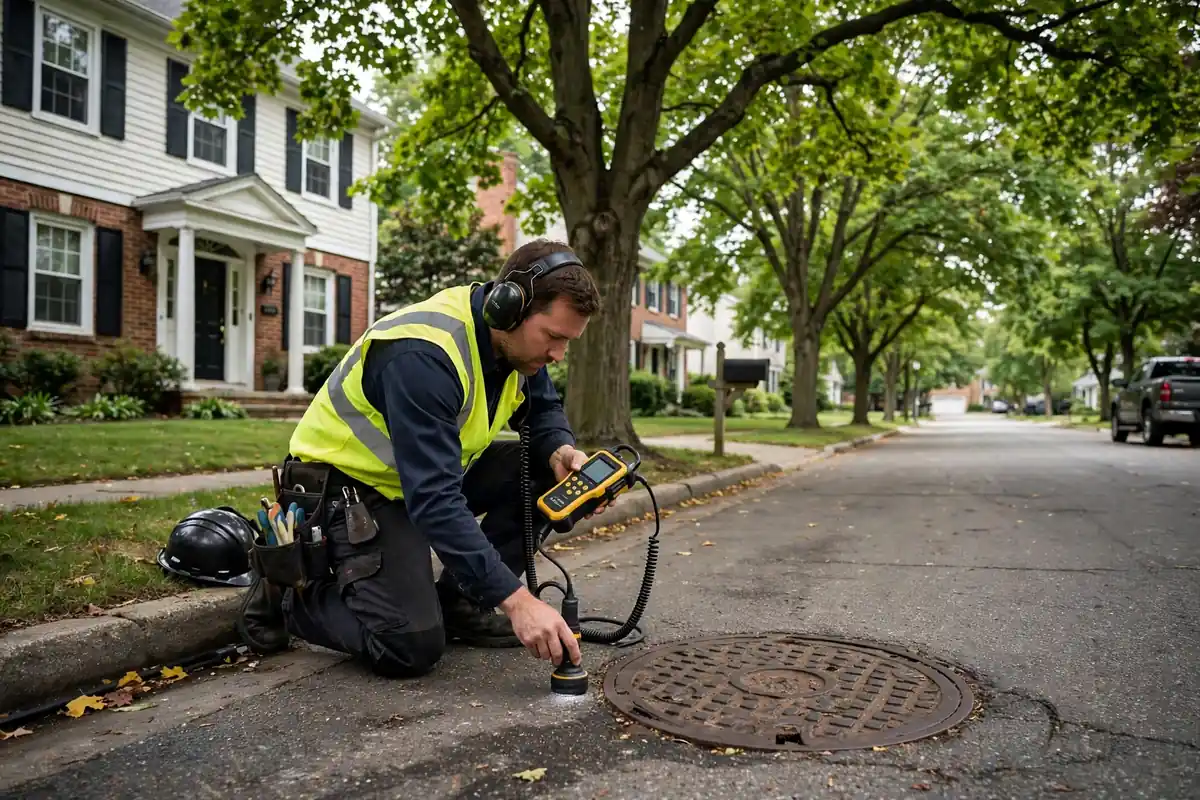
In short: This page covers sewer leak detection in Arlington Heights, IL 60004: acoustic listening, camera inspection, and dye testing that pinpoint where clay tile and Orangeburg laterals leak under 1970s colonials, split-levels, and ranches. When you call (833) 713-2101, the first step is describing the symptoms — wet spots, odors, or settling — then we trace the leak to its source.
What sewer leak detection means for Arlington Heights homes
Waiting on a suspected leak is the expensive option. Wastewater keeps moving through the failed section of clay tile and Orangeburg laterals every day, and in Arlington Heights's soils near Arlington Park and the Metra UP-NW station it keeps softening ground, feeding roots, and widening the opening. 1970s colonials, split-levels, and ranches that get the leak located early repair a joint; 1970s colonials, split-levels, and ranches that wait repair a joint plus whatever the water undermined in the meantime.
The detection visit itself is non-invasive by design. Acoustic sensors sit on the surface, the camera travels inside your clay tile and Orangeburg laterals, and dye testing runs through existing fixtures — no digging happens until the leak's location is proven and a repair plan is approved. For Arlington Heights properties near Arlington Park and the Metra UP-NW station, that sequence protects lawns, driveways, and patios from ever becoming part of the diagnosis.
Signs your Arlington Heights home needs sewer leak detection
Most Arlington Heights leak calls start with something the homeowner can see or smell, not with a plumbing failure. 1970s colonials, split-levels, and ranches on clay tile and Orangeburg laterals near Arlington Park and the Metra UP-NW station show the same handful of surface evidence when a joint or section starts weeping — learn them and you catch leaks while they are still small.
Foundation dampness near the lateral entry
Where the lateral penetrates the foundation wall is a natural stress point, and clay tile and Orangeburg laterals in Arlington Heights near Arlington Park and the Metra UP-NW station can weep right at that penetration. 1970s colonials, split-levels, and ranches with dampness blooming on the basement wall where the sewer exits have a leak that detection confirms in one visit.
A sudden sinkhole or depression
Small surface depressions over the lateral's path mean soil has been washing into a broken clay tile and Orangeburg laterals for a while. In Arlington Heights near Arlington Park and the Metra UP-NW station, 1970s colonials, split-levels, and ranches owners who spot one should treat it as urgent — detection locates the breach so repair starts before the void grows.
A soggy patch that never dries
One area of the yard stays wet long after rain stops — often along the lateral's path to the street. In Arlington Heights near Arlington Park and the Metra UP-NW station, that persistent dampness over clay tile and Orangeburg laterals serving 1970s colonials, split-levels, and ranches is wastewater keeping the soil saturated, and detection equipment traces it back to the failed joint.
Gurgling paired with wet spots
Either symptom alone has innocent explanations; together they describe a clay tile and Orangeburg laterals that is both obstructed and breached. For 1970s colonials, split-levels, and ranches in Arlington Heights near Arlington Park and the Metra UP-NW station, that combination sends detection equipment out — the camera finds the blockage while acoustic gear finds the leak in the same run.
A stripe of unusually lush grass
Wastewater is fertilizer. When Arlington Heights homeowners near Arlington Park and the Metra UP-NW station notice one vivid green band crossing an otherwise ordinary lawn, leak detection on their clay tile and Orangeburg laterals typically finds the weeping joint directly beneath it — the grass has been marking the leak site all along for their 1970s colonials, split-levels, and ranches.
Rodents or insects near the line's path
A leaking lateral is a water source, and pests find water. 1970s colonials, split-levels, and ranches in Arlington Heights near Arlington Park and the Metra UP-NW station sometimes notice increased pest activity along the clay tile and Orangeburg laterals route before they notice anything plumbing-related — another secondary symptom that detection work traces to its source.
How sewer leak detection works
Detection starts with the symptom map. You walk the technician through what you have noticed at your Arlington Heights home — where the wet spot sits, when the odor peaks, which fixtures gurgle — and that history aims the equipment at the right section of clay tile and Orangeburg laterals serving your 1970s colonials, split-levels, and ranches. near Arlington Park and the Metra UP-NW station, the lateral's likely path is already half-known before a sensor comes out.
Acoustic listening comes next. Sensitive ground microphones and correlators listen along the clay tile and Orangeburg laterals route for the distinct sound signature of water escaping — or, in gravity sewers, the subtler turbulence where flow exits through a crack. On 1970s colonials, split-levels, and ranches laterals in Arlington Heights near Arlington Park and the Metra UP-NW station, the gear narrows the leak to a zone often just a few feet wide, without turning a single spade of soil.
The camera confirms what the ears found. A video inspection of the suspect section of clay tile and Orangeburg laterals shows the actual defect — the separated joint, the longitudinal crack, the root mass drinking at the leak — and the sonde marks its exact depth and surface position. For Arlington Heights homeowners near Arlington Park and the Metra UP-NW station, this is the moment a suspicion becomes a located, measurable failure in their 1970s colonials, split-levels, and ranches lateral.
Dye or smoke testing closes the loop where needed. Harmless dye flushed through fixtures appears at the leak point and proves the connection; smoke pumped through the line escapes at the breach and marks it visibly. Each method cross-checks the others, so the repair plan for your clay tile and Orangeburg laterals in Arlington Heights rests on converging evidence, not a single reading.
How Arlington Heights changes the sewer leak detection plan
Mature street-tree roots invading clay tile joints tells the acoustic gear where to listen first in Arlington Heights. Leak detection is not a blind sweep of the whole property — it starts at the known weak points of your clay tile and Orangeburg laterals and works outward, which is why 1970s colonials, split-levels, and ranches laterals near Arlington Park and the Metra UP-NW station get located faster and with less surface disruption.
Finished basements that rule out messy interior work is the reason detection exists as a separate service here. When excavation is costly or constrained, you cannot afford exploratory digging — the leak in clay tile and Orangeburg laterals under 1970s colonials, split-levels, and ranches in Arlington Heights near Arlington Park and the Metra UP-NW station has to be found before the first shovel, and the detection visit is what makes the repair a single small excavation instead of a search.
Local ground conditions write the leak's signature. Glacial till, silty clay loam (Markham/Elliott series); somewhat-poor drainage. Buffalo Creek tributaries run through the village. near Arlington Park and the Metra UP-NW station — saturated clays carry sound differently than dry fill, and NW Chicago suburbs: ~32 in annual precip, ~28 in snowfall, avg winter low ~19F, summer high ~84F. Freeze-thaw heave; spring urban flooding. means infiltration and exfiltration trade places with the seasons. Technicians who read clay tile and Orangeburg laterals in 60004 account for that: a wet-weather leak that vanishes in dry months still gets found, because the camera sees the crack the acoustics only hear when water moves.
Area Facts
- ZIP Code
- 60004
- Housing stock
- Median construction year 1974; 22.7% built 1970-79, 21.7% 1960-69, 17.8% 1980-89; downtown district median 1959. Colonials, split-levels and ranches on mature-tree lots.
- Common pipe materials
- Clay tile laterals in the pre-1970 core; Orangeburg (bituminous fiber, 1945-1972) in 60s-70s tracts; cast-iron interior stacks. PVC only on post-1980 infill.
- Soil
- Glacial till, silty clay loam (Markham/Elliott series); somewhat-poor drainage. Buffalo Creek tributaries run through the village.
What happens when you call
Describe the symptoms
Call (833) 713-2101 and tell us what you are seeing around your Arlington Heights home — wet spots, odors, settling, lush grass. That picture tells the technician which section of clay tile and Orangeburg laterals to aim the equipment at when they reach your 1970s colonials, split-levels, and ranches.
Surface survey and listening
Acoustic sensors sweep the likely route of your clay tile and Orangeburg laterals across the Arlington Heights property near Arlington Park and the Metra UP-NW station, listening for the signature of escaping water. 1970s colonials, split-levels, and ranches lots get a full pass — the gear hears what eyes cannot see.
Camera confirmation
A camera run through the suspect section shows the actual breach in your clay tile and Orangeburg laterals — the joint, crack, or root entry — and marks its depth and position. Arlington Heights homeowners near Arlington Park and the Metra UP-NW station watch the defect appear on the monitor of their 1970s colonials, split-levels, and ranches lateral.
Dye or smoke verification
Where the evidence needs a second witness, harmless dye or smoke traces the path from fixture to breach, proving the leak's source in your clay tile and Orangeburg laterals beyond doubt for your Arlington Heights 1970s colonials, split-levels, and ranches.
Mark and document
The leak's surface position and depth are marked on your Arlington Heights property near Arlington Park and the Metra UP-NW station, and you receive the camera footage plus a written summary of the failed section of clay tile and Orangeburg laterals — the package your 1970s colonials, split-levels, and ranches repair will be priced from.
Targeted repair plan
With the leak located, the fix becomes a single planned excavation or trenchless repair — not a search. Your technician lays out the options for the failed section of clay tile and Orangeburg laterals serving 1970s colonials, split-levels, and ranches in Arlington Heights, and you choose with the evidence in hand.
Frequently Asked Questions
Can you detect a leak if my drains still work fine?
Yes — most leaks are found exactly then. A clay tile and Orangeburg laterals can weep wastewater into the soil for months while fixtures drain normally, which is why Arlington Heights homeowners near Arlington Park and the Metra UP-NW station call about wet spots and odors rather than backups. Detection catches what drainage symptoms miss in 1970s colonials, split-levels, and ranches lines.
Will leak detection work with finished basements that rule out messy interior work?
It was designed for exactly that situation. Because every method works from the surface or from inside the clay tile and Orangeburg laterals, 1970s colonials, split-levels, and ranches in Arlington Heights near Arlington Park and the Metra UP-NW station get a located leak with zero exploratory digging — the whole point is proving the spot before anyone excavates.
How accurate is the leak location?
The methods cross-check each other: acoustics narrow the zone, the camera's sonde marks depth and position, and dye or smoke confirms the path. On clay tile and Orangeburg laterals under 1970s colonials, split-levels, and ranches in Arlington Heights near Arlington Park and the Metra UP-NW station, that convergence puts the repair crew on a small, well-defined dig area — not a trench of hope.
What happens after you find the leak?
You get the marked location, the footage, and a written summary — then a targeted repair plan for that section of clay tile and Orangeburg laterals: sectional repair, lining, or spot excavation, matched to what the evidence showed at your 1970s colonials, split-levels, and ranches in Arlington Heights near Arlington Park and the Metra UP-NW station. You approve the fix; the search is already over.
How do you find a sewer leak without digging up my Arlington Heights yard?
By listening and looking before touching a shovel. Acoustic sensors narrow the search along your clay tile and Orangeburg laterals, the camera shows the actual breach, and dye or smoke confirms it — 1970s colonials, split-levels, and ranches in Arlington Heights near Arlington Park and the Metra UP-NW station get a marked location, and digging only starts after the leak is proven.
What causes the leaks you find in Arlington Heights clay tile and Orangeburg laterals?
The local greatest hits: mature street-tree roots invading clay tile joints. Each fails in its own way — joints separate as ground moves, cracks propagate from stress, roots wedge openings wider — and detection reads which one your 1970s colonials, split-levels, and ranches lateral near Arlington Park and the Metra UP-NW station is showing.
Mature street-tree roots invading clay tile joints will keep weeping whether you look at it or not — the only question is whether you find it on your terms. Arlington Heights homeowners near Arlington Park and the Metra UP-NW station who call about clay tile and Orangeburg laterals leaks early get a small, defined repair on their 1970s colonials, split-levels, and ranches; those who wait get the leak plus everything it undermined. Call (833) 713-2101 and let the equipment do the searching.
Related services in Arlington Heights
Pipe Lining in Arlington Heights, IL
Trenchless CIPP lining that renews clay tile and Orangeburg laterals in Arlington Heights — no trench across your yard.
Learn moreSewer Camera Inspection in Arlington Heights, IL
See inside the lateral serving 1970s colonials, split-levels, and ranches in Arlington Heights before authorizing any repair.
Learn moreSewer Line Problems Don’t Wait. Neither Should You.
Call now and reach a local sewer line specialist serving Buffalo Grove, IL and nearby northwest suburbs — 24/7.
(833) 713-2101Free to call · No obligation · 24/7 emergency line
Serving Arlington Heights, IL 60004