
Pipe Lining in Highland Grove, IL
Trenchless pipe lining for 1978-86 split-levels and two-stories in Highland Grove, 60089 — a resin-saturated liner cures inside your existing clay-tile-to-PVC transition joints, forming a seamless new pipe with no trench across your yard.
- Camera-verified work
- Trenchless options
- Serving 60089
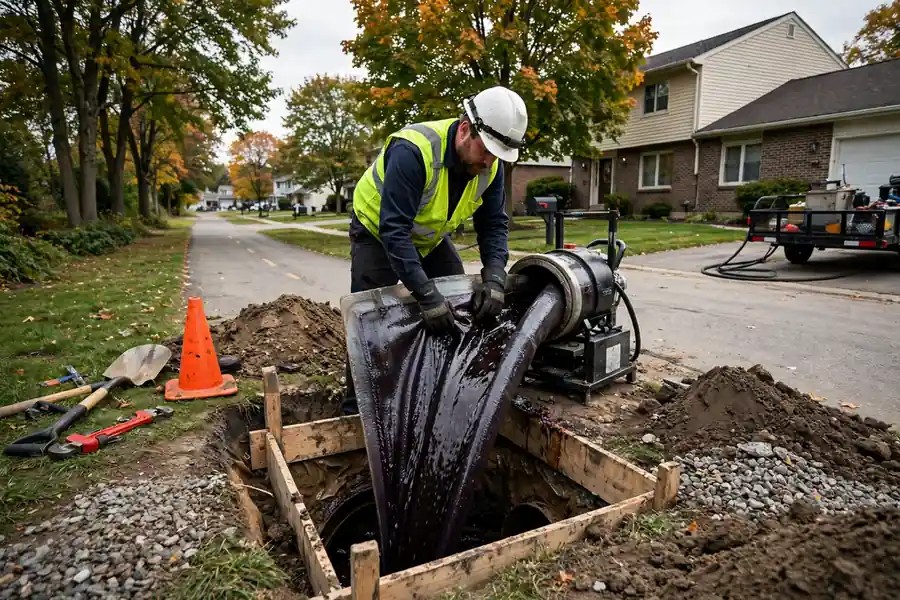
In short: If the clay-tile-to-PVC transition joints under your Highland Grove home are cracked, root-invaded, or corroded, this page explains pipe lining for 60089: how a cured-in-place liner creates a pipe-within-a-pipe for 1978-86 split-levels and two-stories. The first step when you call (833) 713-2101 is a camera inspection to verify the line can be lined.
What pipe lining means for Highland Grove homes
Not every damaged lateral needs a trench, and in Highland Grove most don't. The clay-tile-to-PVC transition joints serving 1978-86 split-levels and two-stories here typically fail at discrete points — a root-invaded joint, a cracked section, a corroded stretch of cast iron — while the rest of the run stays structurally sound. The 1978-86 clay-to-PVC transition joint where roots enter is exactly the failure pattern that lining was designed for: the liner bridges the bad spots and leaves the good pipe doing its job.
The installation itself stays deliberately low-impact. A crew arrives with liner, resin, and inversion equipment — no excavator, no trench shoring, no piles of soil on the lawn. For 1978-86 split-levels and two-stories in 60089, the work runs through a cleanout or a small access pit, and the property near Tripp School and the neighborhood bike paths looks the same that evening as it did that morning. It is the right-sized fix for lines that are damaged but not destroyed.
Signs your Highland Grove home needs pipe lining
Knowing the difference between a line that needs cleaning and a line that needs lining saves Highland Grove homeowners real aggravation. 1978-86 split-levels and two-stories on clay-tile-to-PVC transition joints near Tripp School and the neighborhood bike paths show the same progression: buildup symptoms first, then structural symptoms as joints open and roots thicken. These are the structural ones — the point where a new inner pipe earns its keep.
Frequent backups despite a clear line
Some Highland Grove backups are not blockages at all — they are rough, pitted clay-tile-to-PVC transition joints walls grabbing every solid that passes. When 1978-86 split-levels and two-stories near Tripp School and the neighborhood bike paths back up even after jetting, the interior surface itself is the problem. Lining replaces that rough surface with slick resin that wastewater slides through.
Recurring root blockages after every cleaning
When roots return within months of a cutting, they are entering through separated joints or cracks — not just brushing the pipe. In Highland Grove's clay-tile-to-PVC transition joints, that pattern near Tripp School and the neighborhood bike paths means the openings are permanent, and each regrowth cycle widens them. Lining seals every joint at once, which is why it ends the root-cleaning treadmill for 1978-86 split-levels and two-stories.
You want to avoid tearing up the yard
Finished basements with dual sump pumps — and a traditional replacement trench would run straight through it. For 1978-86 split-levels and two-stories in Highland Grove near Tripp School and the neighborhood bike paths, lining is often chosen as much for what it preserves as for what it fixes: the liner installs through small access points while lawns, plantings, and pavement stay exactly where they are.
Aging pipe you want to future-proof
clay-tile-to-PVC transition joints in Highland Grove do not get younger, and 1978-86 split-levels and two-stories owners near Tripp School and the neighborhood bike paths sometimes choose lining before failure rather than after — during a remodel, before listing the home, or simply to stop scheduling their life around the lateral. Renewing the pipe on your timetable beats renewing it on the pipe's.
Offset joints that catch debris
When clay-tile-to-PVC transition joints sections shift at the joints, the resulting lip snags wipes, paper, and solids on every flush. Video inspections of 1978-86 split-levels and two-stories laterals in Highland Grove near Tripp School and the neighborhood bike paths frequently catch these small offsets before they become big blockages. A liner spans the offset and restores a continuous bore.
Scale and corrosion narrowing cast iron
Cast-iron sections in Highland Grove's 1978-86 split-levels and two-stories rust from the inside, and the scale buildup can close off a surprising share of the diameter. near Tripp School and the neighborhood bike paths, homeowners hear the diagnosis as 'your pipe is closing in on itself.' A liner gives that corroded clay-tile-to-PVC transition joints section a smooth epoxy interior with the full diameter back.
How pipe lining works
Every lining job in Highland Grove starts with proof, not assumptions. A camera travels the full length of your clay-tile-to-PVC transition joints, recording cracks, offsets, root entry points, and the pipe's internal diameter at each section. The technician measures distances and depths so the liner can be cut to the exact run serving your 1978-86 split-levels and two-stories — lining only what needs it, from cleanout to city tap or between two access points near Tripp School and the neighborhood bike paths.
Preparation decides how well the liner bonds. The line is cleaned to bare wall — hydro-jetting strips grease and scale, mechanical cutters remove root masses at the joints — because resin adheres to clean clay-tile-to-PVC transition joints, not to buildup. In Highland Grove near Tripp School and the neighborhood bike paths, this cleaning pass also confirms there are no collapsed sections that would block the liner; lining needs a continuous path, and the camera verifies it before resin is ever mixed.
Installation is the quiet part. The felt liner, saturated with two-part epoxy, is inverted into the clay-tile-to-PVC transition joints with air or water pressure so the resin-coated side presses against the old wall, or pulled into place and expanded — the method matched to your 1978-86 split-levels and two-stories lateral's diameter and bends. Once positioned, it is cured: heat, steam, or ambient cure hardens the resin into a rigid, jointless pipe inside the old one, typically within a single workday near Tripp School and the neighborhood bike paths.
The job closes with the same tool it opened with. A post-installation camera run shows the smooth new interior of your lined clay-tile-to-PVC transition joints, verifies full diameter at every section, and documents the renewed lateral for your Highland Grove home's records. Connections at branch lines are reopened robotically from inside where needed, so fixtures throughout your 1978-86 split-levels and two-stories drain into the new pipe exactly as they did into the old.
How Highland Grove changes the pipe lining plan
The 1978-86 clay-to-PVC transition joint where roots enter is the first thing a lining plan for Highland Grove has to answer. That failure mode decides where the liner starts and stops, which access points the crew uses, and whether sectional lining at the most damaged joints beats a full-length run. Highland Grove homeowners near Tripp School and the neighborhood bike paths get a plan drawn around their actual clay-tile-to-PVC transition joints, not a generic package.
Finished basements with dual sump pumps is why trenchless methods win the argument here before work even starts. On 1978-86 split-levels and two-stories lots in Highland Grove near Tripp School and the neighborhood bike paths, the math is simple: two small access points versus a trench across everything the owners value. Lining was practically designed for properties where excavation is the expensive part of the job.
The ground itself has a vote. Silty clay loam till; somewhat-poor drainage; sump discharge saturates side yards. near Tripp School and the neighborhood bike paths, and Freeze-thaw heave works the clay-tile/PVC joint every winter; spring melt loads the sumps. — freeze-thaw works every joint of clay-tile-to-PVC transition joints a little looser each winter, which is exactly the slow separation that liners are built to bridge. A cured liner moves with minor ground movement instead of opening new gaps, so 1978-86 split-levels and two-stories in 60089 get a renewal matched to local conditions.
Area Facts
- ZIP Code
- 60089
- Housing stock
- Split-levels and 2-stories built 1978-1986 (listings 1978, 1980, 1984, 1986; some 1990s infill); near Tripp school; parks and bike paths.
- Common pipe materials
- Transition era: clay tile street laterals meeting PVC/ABS house sewers; dissimilar-material joints = prime root-entry points; cast-iron interior stacks aging out.
- Soil
- Silty clay loam till; somewhat-poor drainage; sump discharge saturates side yards.
What happens when you call
Describe the symptoms
Call (833) 713-2101 and tell us what your Highland Grove home is doing — repeat clogs, gurgling, odors, or a camera report you already have. Those details tell us whether your clay-tile-to-PVC transition joints sound like lining candidates before anyone visits your 1978-86 split-levels and two-stories.
Camera inspection and measurement
A technician runs a camera through your clay-tile-to-PVC transition joints and records the full run serving your 1978-86 split-levels and two-stories near Tripp School and the neighborhood bike paths — cracks, offsets, diameters, and distances. You watch the monitor and see exactly what the liner would cover, and the measurements size the liner to your line.
Cleaning to bare wall
Hydro-jetting and mechanical cutting strip grease, scale, and roots from the clay-tile-to-PVC transition joints so the resin bonds to clean wall. Highland Grove lines near Tripp School and the neighborhood bike paths get verified clear and continuous — a collapsed section found here would reroute the plan to a different repair.
Liner installation and cure
The resin-saturated liner is inverted or pulled into your clay-tile-to-PVC transition joints through small access points and cured into a hard, jointless inner pipe. Your Highland Grove yard near Tripp School and the neighborhood bike paths stays intact — no trench, no heavy equipment tearing across the lawn of your 1978-86 split-levels and two-stories.
Reopen connections and verify
Branch connections are reopened from inside where needed, then a final camera pass documents the smooth new interior of your lined lateral. You keep the before-and-after footage for your 1978-86 split-levels and two-stories in Highland Grove — proof of what was renewed.
Aftercare guidance
You get plain guidance for the renewed line: what the new epoxy interior shrugs off, what still deserves care, and when clay-tile-to-PVC transition joints serving 1978-86 split-levels and two-stories in Highland Grove near Tripp School and the neighborhood bike paths should get their next camera check. The liner needs no special maintenance — just normal, sensible drain habits.
Frequently Asked Questions
Can pipe lining fix the clay-tile-to-PVC transition joints problems common in Highland Grove?
Where the issue is cracks, separated joints, root entry, or interior corrosion — the pattern behind the 1978-86 clay-to-PVC transition joint where roots enter — lining is built for exactly that. It bridges the damage with a continuous new wall. What it cannot fix is a fully collapsed section with no path for the liner, which is why the camera inspection of your 1978-86 split-levels and two-stories lateral near Tripp School and the neighborhood bike paths comes first.
How do I know my Highland Grove lateral is a lining candidate?
The camera decides. If your clay-tile-to-PVC transition joints hold their basic shape — cracks, offsets, and root entries but no full collapse — lining is usually on the table for 1978-86 split-levels and two-stories near Tripp School and the neighborhood bike paths. Lines with major bellies holding standing water or sections crushed flat need a different repair, and the video makes that call unambiguous.
Do I need to be home during the installation?
For most of the work, no — installation happens outside through access points. You will want to be reachable when the crew needs water access or a final walkthrough at your Highland Grove 1978-86 split-levels and two-stories. The cured liner needs no supervision while it hardens.
Will lining work with finished basements with dual sump pumps?
That constraint is precisely why lining is recommended here. Because the work runs through small access points, 1978-86 split-levels and two-stories in Highland Grove near Tripp School and the neighborhood bike paths avoid the excavation that traditional replacement would force. The crew plans access around the constraint instead of through it.
Does the liner reduce the pipe's diameter?
Slightly — the new wall has real thickness — but flow usually improves anyway. The slick epoxy interior of a lined clay-tile-to-PVC transition joints carries wastewater more efficiently than the rough, scaled wall it replaced, so Highland Grove homeowners near Tripp School and the neighborhood bike paths typically see better drainage from their 1978-86 split-levels and two-stories laterals after lining, not worse.
What happens to the old pipe during lining?
It stays right where it is and becomes the form for the new pipe. Your clay-tile-to-PVC transition joints remain buried under your Highland Grove property near Tripp School and the neighborhood bike paths; the liner simply creates a new structural pipe inside them. Nothing is hauled away, which is part of why 1978-86 split-levels and two-stories owners choose lining over dig-and-replace.
The 1978-86 clay-to-PVC transition joint where roots enter will not fix itself, and every season it waits, the openings get a little wider. Highland Grove homeowners near Tripp School and the neighborhood bike paths who line their clay-tile-to-PVC transition joints now trade a small, trenchless project for the excavation they were heading toward. If your 1978-86 split-levels and two-stories lateral is showing the signs above, call (833) 713-2101 — the first step is looking inside, and everything after that follows the evidence.
Related services in Highland Grove
Sewer Camera Inspection in Highland Grove, IL
See inside the lateral serving 1978-86 split-levels and two-stories in Highland Grove before authorizing any repair.
Learn moreSewer Leak Detection in Highland Grove, IL
Find the exact failure point under 1978-86 split-levels and two-stories in Highland Grove before any digging starts.
Learn moreSewer Line Problems Don’t Wait. Neither Should You.
Call now and reach a local sewer line specialist serving Buffalo Grove, IL and nearby northwest suburbs — 24/7.
(833) 713-2101Free to call · No obligation · 24/7 emergency line
Serving Highland Grove, IL 60089