
Sewer Line Installation in Rolling Hills, IL
New sewer laterals for mid-to-late-90s two-stories in Rolling Hills, 60089 — designed with proper slope, installed to code, and inspected before backfill.
- 24/7 emergency line
- Serving Rolling Hills 60089
- Free to call · No obligation
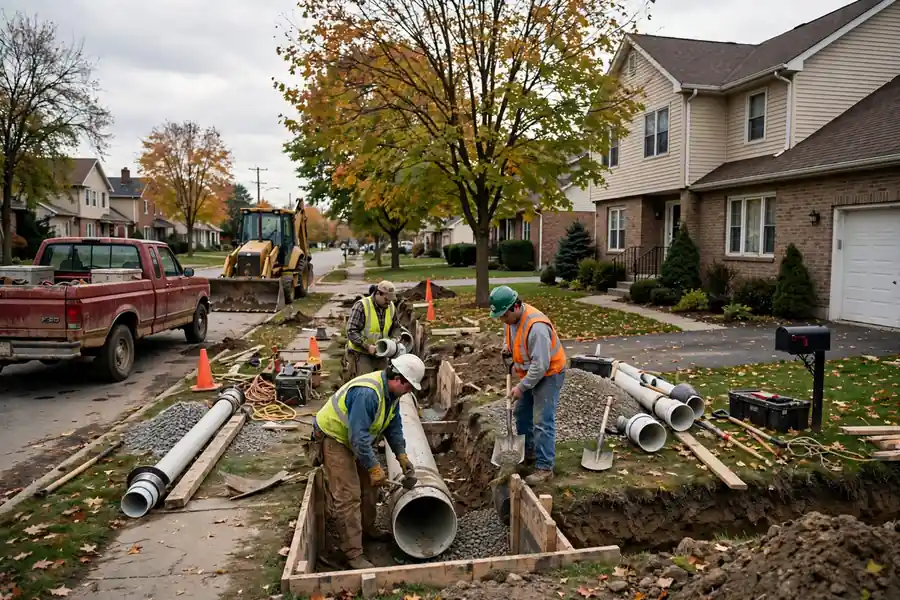
In short: Sewer line installation in Rolling Hills, IL 60089 means a new underground line built to carry your Rolling Hills home's wastewater to the municipal sewer — for mid-to-late-90s two-stories on Aptakisic Road west of Buffalo Grove Road. Call (833) 713-2101 to start with a site evaluation, where we map the route, check depths, and explain permits before any digging.
Sewer Line Installation in Rolling Hills: What to Know
Most Rolling Hills homeowners on Aptakisic Road west of Buffalo Grove Road think about sewer installation exactly twice: when they build and when they convert. New construction on mid-to-late-90s two-stories lots needs a lateral from day one, sized for the home's fixtures and laid with a consistent downhill grade to the street. Septic-to-sewer conversions — common where 1990s PVC laterals meet municipal expansion — need the old system properly abandoned and a new line trenched, bedded, and connected.
In Rolling Hills, what separates a good installation from a future headache is invisible once the trench is closed: bedding material that supports the pipe evenly, joints that are fully seated, slope verified with a level at every section, and backfill compacted in lifts so the ground does not settle into a dip over the line. Rolling Hills installations on Aptakisic Road west of Buffalo Grove Road follow that sequence on every job, because the only thing worse than digging once is digging twice.
Signs You Need Sewer Line Installation in Rolling Hills
In Rolling Hills, nobody installs a new sewer line on a whim — there is always a trigger. For mid-to-late-90s two-stories in Rolling Hills on Aptakisic Road west of Buffalo Grove Road, these are the situations that call for a brand-new lateral rather than a repair to the 1990s PVC laterals already in the ground.
Extending service to a detached structure
In Rolling Hills, a detached garage with a bathroom or a backyard studio on a Rolling Hills lot needs its own connection. New laterals for outbuildings on mid-to-late-90s two-stories properties on Aptakisic Road west of Buffalo Grove Road are trenched, graded, and tied into the main house line or the street connection.
Converting from septic to sewer
Where municipal sewer has reached Rolling Hills streets on Aptakisic Road west of Buffalo Grove Road, mid-to-late-90s two-stories on septic can connect — and in many cases must. Installation means trenching the new lateral, properly abandoning the tank, and connecting to the city main.
Chronic backups the old line can't shake
If 1990s PVC laterals serving your Rolling Hills home have been jetted and repaired and still back up, the pipe itself is the problem — bellies, separations, or root damage along the whole run. A new installation ends the cycle instead of extending it.
A plumbing addition or ADU
In Rolling Hills, adding a bathroom, kitchen, or accessory dwelling unit can push the existing lateral beyond its capacity. In Rolling Hills, where mid-to-late-90s two-stories run on 1990s PVC laterals, a second or upsized line is often cleaner than overloading the old one.
New construction on your lot
A new home or coach house on a Rolling Hills lot needs its own lateral from the foundation to the street. For mid-to-late-90s two-stories parcels on Aptakisic Road west of Buffalo Grove Road, the installation is coordinated with the build schedule so the line is in, inspected, and buried before framing closes off access.
Failed inspection on a property transfer
Pre-sale camera inspections in Rolling Hills on Aptakisic Road west of Buffalo Grove Road sometimes condemn a lateral outright. Installing new often clears the way to a clean inspection report and a closed sale for mid-to-late-90s two-stories owners.
How Sewer Line Installation Works in Rolling Hills
In Rolling Hills, excavation follows the plan, and the trench bottom is shaped as carefully as the pipe that will lie in it. A bed of compacted granular material cradles each section of pipe so 1990s PVC laterals-era connections at the foundation meet a line that will not sag between supports. Sections are joined one at a time, each joint fully seated and each section checked with a level before the next goes in — because grade errors buried today become bellies that hold water for decades.
In Rolling Hills, testing closes the job before the yard is restored. The new lateral is checked for leaks and proper flow — often with water testing and a final camera pass that records the clean, correctly graded line for your records. For Rolling Hills homeowners, that footage plus the inspection sign-off is the paperwork that proves the mid-to-late-90s two-stories lateral was built right, and it is worth keeping with the house files.
In Rolling Hills, a proper installation begins at the surface with a plan. The crew walks the Rolling Hills lot with the homeowner, tracing the route from the foundation penetration to the street connection across mid-to-late-90s two-stories yards on Aptakisic Road west of Buffalo Grove Road. Utility locates mark every gas, electric, and telecom line, and the trench path is adjusted to miss them. Depths are set so the pipe sits below the local frost line with a steady downhill grade — typically around a quarter inch per foot — from house to main.
What Makes Sewer Line Installation Different in Rolling Hills
Area Facts
- Housing stock
- mid-to-late-90s two-stories
- Sewer laterals
- 1990s PVC laterals
- Soil
- clay till with somewhat-poor drainage
- ZIP served
- 60089
New 1990s PVC laterals in Rolling Hills go below frost depth because clay till with somewhat-poor drainage on Aptakisic Road west of Buffalo Grove Road heaves every winter. Every Sewer Line Installation trench here is bedded for that soil, not for generic ground.
In Rolling Hills, tight 0.29-acre side yards with limited excavation room is the second thing every Rolling Hills installation accounts for. On mid-to-late-90s two-stories lots, restoration is part of the bid, not an afterthought — sod, plantings, and hardscaping disturbed by the trench are planned for from day one. Homeowners on Aptakisic Road west of Buffalo Grove Road should expect a written restoration plan alongside the installation plan, because the yard matters as much as the pipe.
In Rolling Hills, installation planning starts with foundation-penetration settlement on 90s PVC. That reality changes the route on the drawing board: longer runs need intermediate cleanouts for future access, and the trench path has to thread between mature root zones, existing utilities, and property setbacks on Aptakisic Road west of Buffalo Grove Road. Crews serving 60089 map all of it before the first bucket of soil moves.
Our Sewer Line Installation Process in Rolling Hills
Site evaluation
We walk your Rolling Hills lot on Aptakisic Road west of Buffalo Grove Road, locate the foundation penetration and the street connection, probe depths, and note every obstacle — trees, driveways, utilities — that the trench must avoid on your mid-to-late-90s two-stories property.
Permits and utility locates
The Rolling Hills municipal permit is pulled and every buried utility is marked before digging. For Rolling Hills installations, inspection checkpoints are scheduled so the open trench, connections, and backfill each get their sign-off.
Excavation to grade
The trench is dug along the marked route across your Rolling Hills lot and its bottom shaped to the designed slope. On mid-to-late-90s two-stories lots in Rolling Hills, excavated soil is staged to protect lawns and plantings on Aptakisic Road west of Buffalo Grove Road.
Pipe laying and jointing
In Rolling Hills, bedding goes in first, then pipe sections are laid, jointed, and level-checked one by one — the careful middle of the job that decides whether your Rolling Hills lateral drains by gravity for decades.
Connections and inspection
In Rolling Hills, the line is tied into the house drainage and the city main, then the Rolling Hills municipal inspector reviews the open work. Nothing gets buried on a Rolling Hills installation until it passes.
Backfill, testing, and restoration
The trench on your Rolling Hills property is backfilled in compacted lifts, the line is tested for flow and leaks, and the surface is restored. You keep the camera footage and inspection records for your mid-to-late-90s two-stories in Rolling Hills.
In Rolling Hills, a sewer line installed correctly the first time costs less over its life than one that needs rework. Across Rolling Hills, 60089, mid-to-late-90s two-stories get new laterals engineered for their soil, their depth, and their fixture load — then inspected and documented so the next owner inherits proof, not questions. To begin with a site evaluation, call (833) 713-2101 any time.
Sewer Line Installation in nearby areas
More services in Rolling Hills
Sewer Line Cleaning
Good with Sewer Line Installation in Rolling Hills.
Learn moreSewer Line Replacement
Pairs well with Sewer Line Installation in Rolling Hills.
Learn moreSewer Maintenance
Good with Sewer Line Installation in Rolling Hills.
Learn moreTree Root Removal
Often booked with Sewer Line Installation in Rolling Hills.
Learn moreTrenchless Sewer Repair
Pairs well with Sewer Line Installation in Rolling Hills.
Learn moreSewer Line Installation in nearby areas
Sewer Line Installation in Woodlands of Fiore
Also serving Woodlands of Fiore 60089.
Learn moreSewer Line Installation in Hidden Lake Village
Hidden Lake Village 60089 service area.
Learn moreSewer Line Installation in Northbrook
Northbrook 60062 service area.
Learn moreSewer Line Installation in Arlington Heights
Also serving Arlington Heights 60004.
Learn moreSewer Line Problems Don’t Wait. Neither Should You.
Call now and reach a local sewer line specialist serving Buffalo Grove, IL and nearby northwest suburbs — 24/7.
(833) 713-2101Free to call · No obligation · 24/7 emergency line
Frequently Asked Questions
How long does a sewer line installation take in Rolling Hills?
Most residential installations on mid-to-late-90s two-stories lots in Rolling Hills are completed within a few working days of excavation — the calendar time depends mostly on permit issuance and inspection scheduling on Aptakisic Road west of Buffalo Grove Road, not the digging itself. Your crew gives you a written sequence before work starts so you know what happens on each day.
How deep will the new line be buried in Rolling Hills?
In Rolling Hills, below the local frost line, with depth varying along the run as the grade falls from house to street. On mid-to-late-90s two-stories lots on Aptakisic Road west of Buffalo Grove Road, the foundation penetration sets the starting depth and the street connection sets the end — the design connects those two points with a steady, code-compliant slope through your 1990s PVC laterals-era soil conditions.
What pipe material is used for new installations?
In Rolling Hills, modern installations use PVC or similar approved materials — smooth-walled, jointed with gasketed or solvent-welded connections, and rated for underground service. For Rolling Hills homes replacing 1990s PVC laterals, the new line is a generational upgrade in both material and joint integrity.
What happens to my old septic tank or lateral?
In Rolling Hills, nothing usable is left to cause trouble later. Septic tanks are pumped and properly abandoned; old laterals being replaced are either removed where the trench crosses them or left undisturbed and capped at both ends. On Rolling Hills lots on Aptakisic Road west of Buffalo Grove Road, abandonment follows the same permit and inspection process as the new installation.
Can you convert my Rolling Hills septic system to city sewer?
In the parts of Rolling Hills on Aptakisic Road west of Buffalo Grove Road where municipal sewer is available, yes. The job has two halves: installing the new lateral from your mid-to-late-90s two-stories to the city main, and properly abandoning the septic tank per local requirements — pumped, then crushed or filled so it cannot collapse later. Both halves are permitted and inspected.
Will installation tear up my whole yard in Rolling Hills?
The trench follows one planned route — not the whole yard. On mid-to-late-90s two-stories properties on Aptakisic Road west of Buffalo Grove Road, crews stage soil on tarps, protect plantings along the path, and restore the surface afterward. Tight 0.29-acre side yards with limited excavation room, so the restoration plan is written into the job from the start.
Serving Rolling Hills, IL 60089