
Trenchless Sewer Repair in Rolling Hills, IL
Repair your Rolling Hills lateral without the trench: cured-in-place lining and pipe bursting for 1990s PVC laterals on Aptakisic Road west of Buffalo Grove Road.
- 24/7 emergency line
- Serving Rolling Hills 60089
- Free to call · No obligation
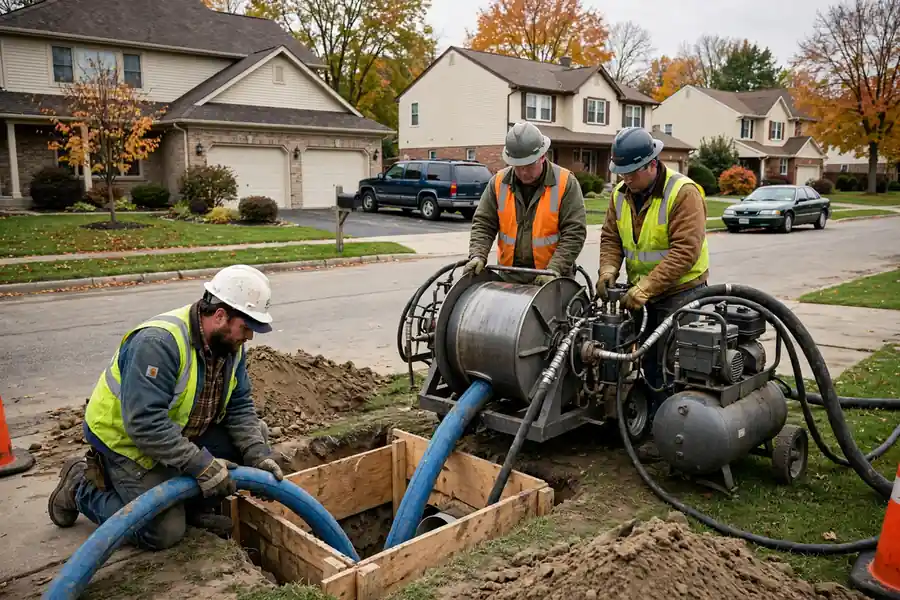
In short: Trenchless sewer repair in Rolling Hills, IL 60089 fixes 1990s PVC laterals from the inside out or pulls new pipe through the old path — no trench across your yard. Call (833) 713-2101 to start with a camera inspection of your mid-to-late-90s two-stories lateral; the footage determines whether trenchless is the right fit.
Trenchless Sewer Repair in Rolling Hills: What to Know
The neighborhood of Rolling Hills has embraced trenchless for a simple reason: the math favors it. mid-to-late-90s two-stories on Aptakisic Road west of Buffalo Grove Road with 1990s PVC laterals often face a choice between a trench that tears up thousands of dollars of landscaping and a trenchless renewal that leaves it standing. When the camera shows a line that is a good candidate — worn but passable — lining or bursting delivers a new-pipe result at a fraction of the surface disruption.
In Rolling Hills, what the finished job looks like underground is the real story. A cured liner is a seamless, corrosion-proof pipe with no joints for roots to find; a burst replacement is a continuous modern line on the proven path of the old one. Either way, Rolling Hills homeowners get decades of service from 1990s PVC laterals that were failing — verified by the post-job camera footage that comes with every trenchless project.
Signs You Need Trenchless Sewer Repair in Rolling Hills
In Rolling Hills, trenchless methods fix specific kinds of damage — knowing whether your line qualifies starts with recognizing the pattern. For mid-to-late-90s two-stories in Rolling Hills with 1990s PVC laterals on Aptakisic Road west of Buffalo Grove Road, these are the signs that trenchless repair is likely the right conversation.
Cracks and fractures along the barrel
In Rolling Hills, longitudinal cracks and fractures that leak but have not collapsed are exactly what CIPP was designed for. In Rolling Hills's 1990s PVC laterals on Aptakisic Road west of Buffalo Grove Road, lining bridges the damage with a structural new pipe inside the old.
A lateral under a driveway or addition
Structures built over 1990s PVC laterals make open-cut excavation destructive or impossible. Trenchless methods reach mid-to-late-90s two-stories laterals in Rolling Hills on Aptakisic Road west of Buffalo Grove Road from small pits at either end — the structure above never moves.
A failing line under expensive landscaping
When 1990s PVC laterals run beneath patios, mature plantings, or driveways at mid-to-late-90s two-stories on Aptakisic Road west of Buffalo Grove Road, excavation's collateral damage dwarfs the pipe work. Trenchless repair exists precisely for Rolling Hills situations like this.
HOA common areas that can't be torn up
Shared 1990s PVC laterals under parking lots and common lawns at mid-to-late-90s two-stories on Aptakisic Road west of Buffalo Grove Road cannot be trenched without disrupting everyone. Lining renews Rolling Hills building sewers with the pavement intact.
Recurring backups from joint offsets
In Rolling Hills, offsets that snag waste but have not collapsed the line respond well to lining's smooth continuous interior. For Rolling Hills 1990s PVC laterals on Aptakisic Road west of Buffalo Grove Road, a liner turns a snag-prone jointed line into one seamless run.
Orangeburg or clay tile worn thin but passable
Deformed-but-open 1990s PVC laterals are bursting candidates: the head can still travel the path, fracturing the weak old material outward. Rolling Hills mid-to-late-90s two-stories on Aptakisic Road west of Buffalo Grove Road with tired-but-passable lines get a full replacement with minimal digging.
How Trenchless Sewer Repair Works in Rolling Hills
In Rolling Hills, for pipe lining, the crew inverts or pulls a felt sleeve saturated with epoxy resin into the cleaned 1990s PVC laterals, positioning it exactly over the damaged sections of your mid-to-late-90s two-stories lateral. The sleeve is then inflated to press against the old pipe walls and cured — with hot water, steam, or UV light — until the resin hardens into a rigid, jointless new pipe inside the old one. When the inflation bladder comes out, Rolling Hills homeowners are left with a smooth structural liner that roots cannot penetrate and water flows through freely.
Every trenchless project in Rolling Hills begins with preparation: the line is camera-inspected, then thoroughly cleaned. Lining and bursting both need a clear, open path — roots cut, scale jetted, debris flushed from your 1990s PVC laterals. Rolling Hills technicians on Aptakisic Road west of Buffalo Grove Road treat this prep as half the job, because a liner curing against leftover debris or a bursting head fighting a root mass is a compromised result before it starts.
In Rolling Hills, for pipe bursting, two small pits are excavated at either end of the failed run. A powerful winch pulls the bursting head through the old 1990s PVC laterals, fracturing it outward into the surrounding soil while a new continuous pipe — typically HDPE or PVC — follows directly behind into the same bore. Under mid-to-late-90s two-stories in Rolling Hills on Aptakisic Road west of Buffalo Grove Road, the new line takes the proven path of the old one with only the two pits disturbing the surface.
What Makes Trenchless Sewer Repair Different in Rolling Hills
Area Facts
- Housing stock
- mid-to-late-90s two-stories
- Sewer laterals
- 1990s PVC laterals
- Soil
- clay till with somewhat-poor drainage
- ZIP served
- 60089
In Rolling Hills, trenchless candidacy is decided by foundation-penetration settlement on 90s PVC. The camera inspection has to answer one question precisely: is this 1990s PVC laterals worn-but-passable, or damaged beyond what lining and bursting can handle? Crews serving 60089 make that determination on measured footage on Aptakisic Road west of Buffalo Grove Road — because recommending trenchless where it cannot work is worse than recommending excavation honestly.
In Rolling Hills, tight 0.29-acre side yards with limited excavation room is the reason trenchless sells itself in Rolling Hills. On mid-to-late-90s two-stories lots, the surface above the Rolling Hills lateral is often worth more than the pipe work below it — and trenchless is the only method that renews 1990s PVC laterals without choosing between the two. Homeowners on Aptakisic Road west of Buffalo Grove Road get the engineering discussion in plain terms: what lining can seal, what bursting can replace, and where the limits are.
Trenchless Sewer Repair in Rolling Hills starts with a cover-depth check, because clay till with somewhat-poor drainage on Aptakisic Road west of Buffalo Grove Road decides whether bursting can fracture safely. The Rolling Hills ground is part of the engineering, not the backdrop.
Our Trenchless Sewer Repair Process in Rolling Hills
Camera inspection and cleaning
Your 1990s PVC laterals are inspected, measured, and cleaned — the footage determines whether lining, bursting, or excavation fits your Rolling Hills lateral on Aptakisic Road west of Buffalo Grove Road.
Method selection
Lining for worn-but-sound Rolling Hills pipe, bursting for failed-but-passable runs. The recommendation for your mid-to-late-90s two-stories is explained with the footage, not asserted.
Access pits or liner setup
In Rolling Hills, two small pits for bursting, or cleanout access for lining — planned to spare the Rolling Hills yard on Aptakisic Road west of Buffalo Grove Road as much as physically possible.
Liner installation or pipe bursting
In Rolling Hills, the sleeve is inverted, inflated, and cured — or the bursting head pulls new pipe through the old path of your 1990s PVC laterals.
Reinstatement and testing
In Rolling Hills, branch connections are reopened, the renewed line is camera-verified end to end and flow-tested on your Rolling Hills mid-to-late-90s two-stories.
Surface restoration
Pits are backfilled and surfaces restored — the Rolling Hills property on Aptakisic Road west of Buffalo Grove Road looks like a sewer project barely happened.
In Rolling Hills, trenchless repair is the art of fixing the pipe while sparing everything above it. For mid-to-late-90s two-stories in Rolling Hills on Aptakisic Road west of Buffalo Grove Road, that means 1990s PVC laterals renewed to a jointless, root-proof condition — verified on camera — while the yard, the driveway, and the landscaping carry on untouched. Call (833) 713-2101 to find out if your line is a candidate.
Trenchless Sewer Repair in nearby areas
More services in Rolling Hills
Sewer Line Cleaning
Often booked with Trenchless Sewer Repair in Rolling Hills.
Learn moreSewer Line Installation
Good with Trenchless Sewer Repair in Rolling Hills.
Learn moreSewer Line Replacement
Pairs well with Trenchless Sewer Repair in Rolling Hills.
Learn moreSewer Maintenance
Good with Trenchless Sewer Repair in Rolling Hills.
Learn moreTree Root Removal
Good with Trenchless Sewer Repair in Rolling Hills.
Learn moreTrenchless Sewer Repair in nearby areas
Trenchless Sewer Repair in Woodlands of Fiore
Also serving Woodlands of Fiore 60089.
Learn moreTrenchless Sewer Repair in Hidden Lake Village
Also serving Hidden Lake Village 60089.
Learn moreTrenchless Sewer Repair in Northbrook
Also serving Northbrook 60062.
Learn moreTrenchless Sewer Repair in Arlington Heights
Now booking in Arlington Heights 60004.
Learn moreSewer Line Problems Don’t Wait. Neither Should You.
Call now and reach a local sewer line specialist serving Buffalo Grove, IL and nearby northwest suburbs — 24/7.
(833) 713-2101Free to call · No obligation · 24/7 emergency line
Frequently Asked Questions
What can't trenchless fix in Rolling Hills?
In Rolling Hills, honest limits: fully collapsed sections the equipment cannot pass, bellies so deep that water ponds regardless of the liner, and laterals that must be rerouted for grade. When Rolling Hills camera footage on Aptakisic Road west of Buffalo Grove Road shows any of these in your 1990s PVC laterals, the recommendation is excavation — and a good contractor tells you that before selling you anything.
Will trenchless work under my driveway in Rolling Hills?
In Rolling Hills, that is a natural fit for this kind of work. Lining and bursting both travel the existing path of your 1990s PVC laterals — under driveways, patios, and additions at mid-to-late-90s two-stories on Aptakisic Road west of Buffalo Grove Road — without disturbing the surface above. If open-cut would mean demolishing concrete in Rolling Hills, trenchless usually wins the comparison.
Is trenchless repair permitted and inspected in Rolling Hills?
In Rolling Hills, yes — trenchless work is permitted work, with inspections like any sewer project. Your Rolling Hills contractor pulls the permit, and the finished lining or bursting on your mid-to-late-90s two-stories on Aptakisic Road west of Buffalo Grove Road is camera-documented for the record. Keep that footage with the house files; it is the proof the renewal was done right.
Which is better for Rolling Hills homes: lining or bursting?
They solve different problems. Lining rehabilitates 1990s PVC laterals that are damaged but structurally coherent — sealing cracks and joints from inside. Bursting replaces pipe that has failed outright. For mid-to-late-90s two-stories in Rolling Hills on Aptakisic Road west of Buffalo Grove Road, the camera footage picks the method: lining where the old pipe can host the sleeve, bursting where it cannot.
Does lining reduce the pipe's diameter in Rolling Hills?
In Rolling Hills, slightly — the sleeve has thickness — but the smooth resin interior flows better than the rough old 1990s PVC laterals it lines. Net effect on mid-to-late-90s two-stories laterals in Rolling Hills on Aptakisic Road west of Buffalo Grove Road: equal or better flow capacity despite the small diameter trade, verified by post-installation camera and flow testing.
Is my Rolling Hills line a candidate for trenchless repair?
If the camera shows 1990s PVC laterals that are worn, cracked, or root-invaded but still holding their general shape, usually yes. Full collapses, severe bellies holding water, or lines needing rerouting are the common disqualifiers in Rolling Hills. Your Rolling Hills technician on Aptakisic Road west of Buffalo Grove Road gives you the candidacy answer from footage of your specific mid-to-late-90s two-stories lateral — not from a sales script.
Serving Rolling Hills, IL 60089