
Sewer Line Replacement in Prospect Heights, IL
Full sewer lateral replacement for 1970s homes and condo blocks in Prospect Heights, 60070 — pipe bursting or open-cut renewal for 1970s cast-iron and clay tile systems at the end of their life.
- 24/7 emergency line
- Serving Prospect Heights 60070
- Free to call · No obligation
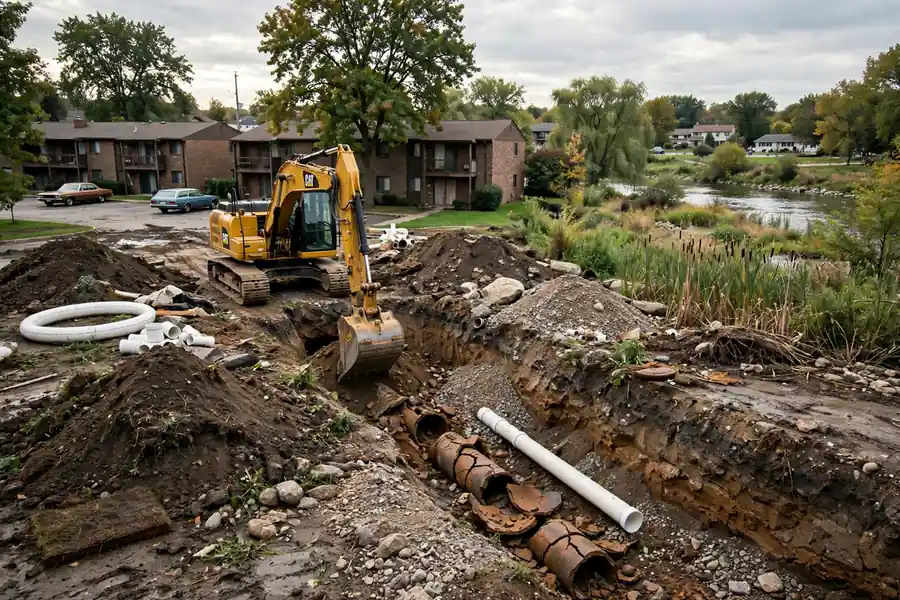
In short: This page covers sewer line replacement in Prospect Heights, IL 60070: full lateral renewal for 1970s homes and condo blocks whose 1970s cast-iron and clay tile systems are collapsed, badly offset, or simply worn out. When you call (833) 713-2101, the first step is a camera inspection that shows whether replacement — by pipe bursting or open-cut excavation — is truly needed.
Sewer Line Replacement in Prospect Heights: What to Know
In Prospect Heights, nobody wants to hear that their sewer line needs replacing, and in Prospect Heights the recommendation is never made lightly. 1970s homes and condo blocks with 1970s cast-iron and clay tile systems along Milwaukee Avenue usually reach this point after a clear chain of evidence: recurring backups that cleaning only pauses, camera footage showing collapse or severe offsets, and repair estimates that add up to a large fraction of replacement. When the pipe itself is the problem, replacing it is the fix.
In Prospect Heights, the good news is that replacement today is not the ordeal it was a generation ago. Pipe bursting lets crews pull a new line through the old one's path with only small access pits — no trench across the whole yard. Where bursting does not fit, open-cut excavation replaces the line section by section with full inspection at every stage. Either way, Prospect Heights homeowners end up with a documented, inspected lateral instead of a mystery.
Signs You Need Sewer Line Replacement in Prospect Heights
In Prospect Heights, replacement is the answer when the pipe itself is finished — not blocked, not dirty, but structurally done. For 1970s homes and condo blocks in Prospect Heights on 1970s cast-iron and clay tile systems along Milwaukee Avenue, these are the signs that point past cleaning and repair toward a new lateral.
The camera shows collapse or missing sections
In Prospect Heights, footage does not lie: flattened Orangeburg, crushed clay tile, or gaps where pipe should be. For 1970s homes and condo blocks in Prospect Heights along Milwaukee Avenue, a camera showing structural failure in 1970s cast-iron and clay tile systems is the definitive replacement trigger.
A lateral the inspector condemns
Pre-sale or municipal inspections in Prospect Heights along Milwaukee Avenue occasionally fail a lateral outright. When 1970s cast-iron and clay tile systems cannot pass, replacement is not optional — it is the path to a compliant, sellable 1970s homes and condo blocks property.
Multiple bellies holding water
In Prospect Heights, low spots where water ponds instead of flowing collect solids until they dam the line. When camera footage shows several bellies along 1970s cast-iron and clay tile systems serving 1970s homes and condo blocks in Prospect Heights, regrading — effectively replacement — is the durable fix.
Backups return weeks after every cleaning
In Prospect Heights, when hydro-jetting buys only a few weeks of relief in your Prospect Heights home, the blockage is not buildup — it is damage. 1970s cast-iron and clay tile systems with collapsed sections or severe offsets re-clog almost immediately along Milwaukee Avenue, because the pipe shape itself traps waste.
Sewage odors that cleaning never fixes
In Prospect Heights, persistent odor after a thorough cleaning means wastewater is escaping the pipe, not just sitting in it. In Prospect Heights's 1970s cast-iron and clay tile systems along Milwaukee Avenue, that points to cracks or separations no jetter can seal.
Orangeburg pipe past its service life
In Prospect Heights, bituminous fiber pipe from the 1945-1972 era is living on borrowed time everywhere, including Prospect Heights. Where 1970s homes and condo blocks still run on Orangeburg sections along Milwaukee Avenue, proactive replacement beats waiting for the deformation to become a collapse.
How Sewer Line Replacement Works in Prospect Heights
In Prospect Heights, open-cut excavation is the traditional option and still the right one in many cases. The crew digs along the Prospect Heights lateral's path, removes the failed 1970s cast-iron and clay tile systems, beds the trench, and lays new pipe section by section with grade verified by level. Where bursting cannot run — severe collapses that block the bursting head, or lines needing rerouting — excavation gives Prospect Heights crews full access to build the line exactly right.
In Prospect Heights, pipe bursting is the trenchless option. Two small pits are dug — one at each end of the failed section — and a bursting head is pulled through the old 1970s cast-iron and clay tile systems, fracturing it outward while towing a new continuous pipe into the same path. For 1970s homes and condo blocks in Prospect Heights, the appeal is obvious along Milwaukee Avenue: the new line follows the proven route with minimal surface disruption, and the seamless new pipe has no joints for roots to exploit.
In Prospect Heights, replacement starts the same way every responsible job does: with a camera. The Prospect Heights technician maps your 1970s cast-iron and clay tile systems from cleanout to city main, recording depths, materials, and every defect — and Prospect Heights homeowners along Milwaukee Avenue watch the footage that justifies the recommendation. Only when the video shows damage beyond repair does the conversation turn to methods: pipe bursting or open-cut excavation.
What Makes Sewer Line Replacement Different in Prospect Heights
Area Facts
- Housing stock
- 1970s homes and condo blocks
- Sewer laterals
- 1970s cast-iron and clay tile systems
- Soil
- glacial till with high water-table pockets
- ZIP served
- 60070
Replacement crews in Prospect Heights bed new pipe for glacial till with high water-table pockets along Milwaukee Avenue, not for textbook soil. That is what makes Sewer Line Replacement in Prospect Heights a fifty-year asset instead of a repeat project.
In Prospect Heights, the replacement decision almost always starts with groundwater infiltration that mimics blockages. That is why the camera inspection in Prospect Heights is diagnostic, not ceremonial: it has to distinguish a line with a few bad joints — a lining or spot-repair candidate — from a line that is failing along its length. Crews serving 60070 make that call on footage, not assumptions, because the wrong method wastes everyone's money.
In Prospect Heights, 1970s condo-block shared sewers managed by HOAs decides the method as much as the pipe does. On 1970s homes and condo blocks lots in Prospect Heights, bursting is often the first choice precisely because it avoids the surface damage excavation would cause — but it needs enough intact path to pull through. Where the line is fully collapsed or the route must change along Milwaukee Avenue, open-cut is the honest recommendation, planned with restoration from day one.
Our Sewer Line Replacement Process in Prospect Heights
Camera diagnosis
In Prospect Heights, the full lateral is inspected and recorded. You see exactly which sections of your 1970s cast-iron and clay tile systems have failed and which are sound — the evidence your Prospect Heights replacement plan is built on.
Method recommendation
In Prospect Heights, bursting or open-cut — the choice is matched to your pipe's condition, your lot along Milwaukee Avenue, and access. Your 1970s homes and condo blocks get the method that fits, not the one that is easiest to sell.
Permits and utility locates
Municipal permits are pulled and every buried line is marked. Prospect Heights inspections are scheduled so the work is reviewed at the right stages.
Replacement work
In Prospect Heights, the new pipe goes in — burst through the old path or laid in an open trench — with grade checked section by section under your Prospect Heights yard along Milwaukee Avenue.
Connections, testing, inspection
Both ends are sealed and connected, the Prospect Heights line is tested for flow and leaks, and the municipal inspector signs off before backfill.
Backfill and restoration
The trench or pits on your Prospect Heights lot are backfilled in compacted lifts and the surface restored. Your Prospect Heights property along Milwaukee Avenue is left with a new lateral and the footage to prove it.
Prospect Heights homeowners along Milwaukee Avenue do not need a sewer lecture; they need a straight answer about their 1970s cast-iron and clay tile systems and a crew that does what the footage calls for. Whether that is bursting a new line through the old path or opening a careful trench, the goal is the same: a lateral your 1970s homes and condo blocks can rely on for decades. Start with the camera — call (833) 713-2101.
Sewer Line Replacement in nearby areas
More services in Prospect Heights
Sewer Line Cleaning
Pairs well with Sewer Line Replacement in Prospect Heights.
Learn moreSewer Line Installation
Often booked with Sewer Line Replacement in Prospect Heights.
Learn moreSewer Maintenance
Good with Sewer Line Replacement in Prospect Heights.
Learn moreTree Root Removal
Good with Sewer Line Replacement in Prospect Heights.
Learn moreTrenchless Sewer Repair
Good with Sewer Line Replacement in Prospect Heights.
Learn moreSewer Line Replacement in nearby areas
Sewer Line Replacement in Wheeling
Also serving Wheeling 60090.
Learn moreSewer Line Replacement in Deerfield
Deerfield 60015 service area.
Learn moreSewer Line Replacement in Mundelein
Now booking in Mundelein 60060.
Learn moreSewer Line Replacement in Woodstone
Now booking in Woodstone 60089.
Learn moreSewer Line Problems Don’t Wait. Neither Should You.
Call now and reach a local sewer line specialist serving Buffalo Grove, IL and nearby northwest suburbs — 24/7.
(833) 713-2101Free to call · No obligation · 24/7 emergency line
Frequently Asked Questions
Is pipe bursting possible on 1970s cast-iron and clay tile systems in Prospect Heights?
In Prospect Heights, often yes. Bursting handles clay tile and Orangeburg well — the head fractures the old material outward as it pulls the new pipe through. It struggles where the line has fully collapsed into a blocked mass or where groundwater infiltration that mimics blockages. Your Prospect Heights technician confirms bursting feasibility from the camera footage along Milwaukee Avenue before recommending it.
How do I know if my Prospect Heights line needs replacement or just repair?
In Prospect Heights, the camera decides. If footage shows one or two bad joints in otherwise sound 1970s cast-iron and clay tile systems, a spot repair or sectional lining usually suffices for your 1970s homes and condo blocks. If it shows collapse, widespread offsets, or deformation along most of the run along Milwaukee Avenue, replacement is the durable answer. Any honest Prospect Heights contractor shows you the video and explains which category your line falls into before quoting either option.
Will my landscaping survive a replacement in Prospect Heights?
In Prospect Heights, with planning, most of it. Bursting disturbs only the two pit locations; open-cut disturbs the trench line, and crews on 1970s homes and condo blocks lots along Milwaukee Avenue stage soil on tarps and protect plantings outside the path. 1970s condo-block shared sewers managed by HOAs — which is exactly why the method choice and the restoration plan are discussed before work starts, not after.
How long will the new sewer line last in Prospect Heights?
In Prospect Heights, a properly installed modern lateral — continuous pipe, watertight joints, correct grade and bedding for Prospect Heights soil along Milwaukee Avenue — is built to serve for many decades. What ends lines early is poor installation: bad grade, poor bedding, unsealed joints. That is why the inspection checkpoints on your 1970s homes and condo blocks replacement matter as much as the pipe itself.
Can replacement be done in winter in Prospect Heights?
In Prospect Heights, yes, with adjustments. Frozen ground digs harder and concrete-like soil slows excavation, but Prospect Heights crews work through winter along Milwaukee Avenue by staging the job around thaws and protecting open trenches overnight. The pipe and methods do not care about the calendar — only the Prospect Heights digging does, and that is manageable.
Do I need to be home during the replacement?
Not for most of it. The work happens outside your Prospect Heights home along Milwaukee Avenue; you will want to be reachable for the inspector's visit and the brief water shutoff at final connection. Many 1970s homes and condo blocks owners go about their day and check in by phone, then review the final camera footage together with the crew.
Serving Prospect Heights, IL 60070