
Trenchless Sewer Repair in Prospect Heights, IL
Trenchless pipe lining and bursting for 1970s homes and condo blocks in Prospect Heights, 60070 — renewing 1970s cast-iron and clay tile systems through small access points instead of open trenches.
- 24/7 emergency line
- Serving Prospect Heights 60070
- Free to call · No obligation
In short: This page covers trenchless sewer repair in Prospect Heights, IL 60070: pipe lining (CIPP) and pipe bursting that renew 1970s cast-iron and clay tile systems serving 1970s homes and condo blocks with minimal digging. When you call (833) 713-2101, the first step is a camera inspection — trenchless methods need a clear picture of your line along Milwaukee Avenue before we recommend lining or bursting.
Trenchless Sewer Repair in Prospect Heights: What to Know
In Prospect Heights, trenchless sewer repair is exactly what it sounds like: fixing the pipe without the trench. Instead of digging up the Prospect Heights lateral serving your 1970s homes and condo blocks in Prospect Heights, technicians work through small access points — renewing 1970s cast-iron and clay tile systems from the inside with a cured-in-place liner, or fracturing the old pipe outward while pulling a new one through behind it. along Milwaukee Avenue, the difference is measured in intact lawns and driveways.
In Prospect Heights, the two methods cover different damage. Pipe lining (CIPP) installs a resin-saturated sleeve inside the existing line and cures it into a smooth, jointless new pipe within the old one — ideal for 1970s cast-iron and clay tile systems that are worn, cracked, or root-invaded but still holding their shape. Pipe bursting replaces the line entirely, breaking the old 1970s cast-iron and clay tile systems apart as a new continuous pipe takes its path — the answer when the old line is too far gone to line.
Signs You Need Trenchless Sewer Repair in Prospect Heights
Not every failing lateral is a trenchless candidate, but many are. Prospect Heights homeowners along Milwaukee Avenue seeing these symptoms in their 1970s cast-iron and clay tile systems should ask about lining and bursting before assuming excavation.
A lateral under a driveway or addition
Structures built over 1970s cast-iron and clay tile systems make open-cut excavation destructive or impossible. Trenchless methods reach 1970s homes and condo blocks laterals in Prospect Heights along Milwaukee Avenue from small pits at either end — the structure above never moves.
Cracks and fractures along the barrel
In Prospect Heights, longitudinal cracks and fractures that leak but have not collapsed are exactly what CIPP was designed for. In Prospect Heights's 1970s cast-iron and clay tile systems along Milwaukee Avenue, lining bridges the damage with a structural new pipe inside the old.
Recurring backups from joint offsets
In Prospect Heights, offsets that snag waste but have not collapsed the line respond well to lining's smooth continuous interior. For Prospect Heights 1970s cast-iron and clay tile systems along Milwaukee Avenue, a liner turns a snag-prone jointed line into one seamless run.
Orangeburg or clay tile worn thin but passable
Deformed-but-open 1970s cast-iron and clay tile systems are bursting candidates: the head can still travel the path, fracturing the weak old material outward. Prospect Heights 1970s homes and condo blocks along Milwaukee Avenue with tired-but-passable lines get a full replacement with minimal digging.
HOA common areas that can't be torn up
Shared 1970s cast-iron and clay tile systems under parking lots and common lawns at 1970s homes and condo blocks along Milwaukee Avenue cannot be trenched without disrupting everyone. Lining renews Prospect Heights building sewers with the pavement intact.
A failing line under expensive landscaping
When 1970s cast-iron and clay tile systems run beneath patios, mature plantings, or driveways at 1970s homes and condo blocks along Milwaukee Avenue, excavation's collateral damage dwarfs the pipe work. Trenchless repair exists precisely for Prospect Heights situations like this.
How Trenchless Sewer Repair Works in Prospect Heights
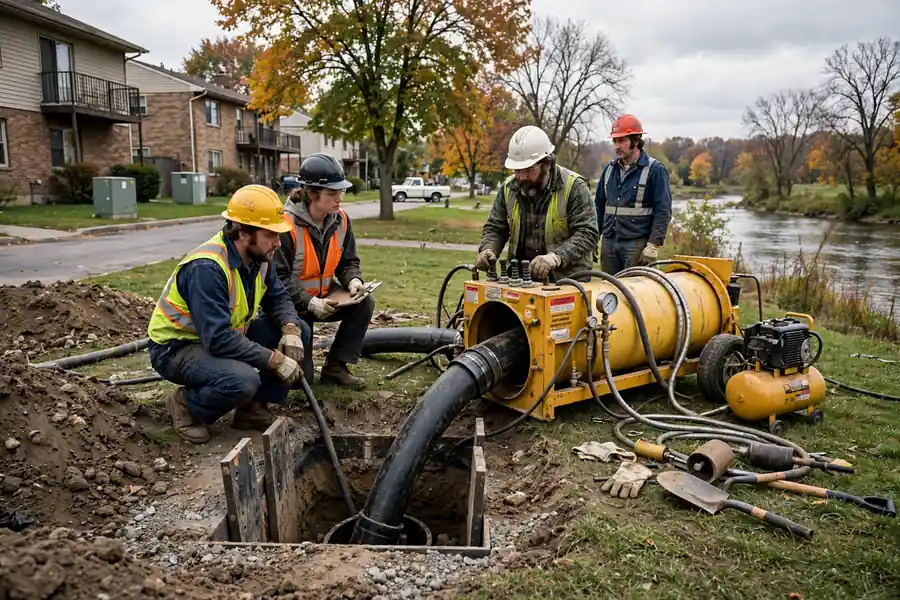
In Prospect Heights, for pipe bursting, two small pits are excavated at either end of the failed run. A powerful winch pulls the bursting head through the old 1970s cast-iron and clay tile systems, fracturing it outward into the surrounding soil while a new continuous pipe — typically HDPE or PVC — follows directly behind into the same bore. Under 1970s homes and condo blocks in Prospect Heights along Milwaukee Avenue, the new line takes the proven path of the old one with only the two pits disturbing the surface.
In Prospect Heights, both methods end the same way: reinstatement and verification. Branch connections covered by a liner are robotically reopened from inside; the new line is camera-inspected end to end and tested for flow. Your Prospect Heights project closes with before-and-after footage proving the 1970s cast-iron and clay tile systems went from failing to renewed — documentation worth keeping with your 1970s homes and condo blocks records.
Every trenchless project in Prospect Heights begins with preparation: the line is camera-inspected, then thoroughly cleaned. Lining and bursting both need a clear, open path — roots cut, scale jetted, debris flushed from your 1970s cast-iron and clay tile systems. Prospect Heights technicians along Milwaukee Avenue treat this prep as half the job, because a liner curing against leftover debris or a bursting head fighting a root mass is a compromised result before it starts.
What Makes Trenchless Sewer Repair Different in Prospect Heights
Area Facts
- Housing stock
- 1970s homes and condo blocks
- Sewer laterals
- 1970s cast-iron and clay tile systems
- Soil
- glacial till with high water-table pockets
- ZIP served
- 60070
Trenchless Sewer Repair in Prospect Heights starts with a cover-depth check, because glacial till with high water-table pockets along Milwaukee Avenue decides whether bursting can fracture safely. The Prospect Heights ground is part of the engineering, not the backdrop.
In Prospect Heights, 1970s condo-block shared sewers managed by HOAs is the reason trenchless sells itself in Prospect Heights. On 1970s homes and condo blocks lots, the surface above the Prospect Heights lateral is often worth more than the pipe work below it — and trenchless is the only method that renews 1970s cast-iron and clay tile systems without choosing between the two. Homeowners along Milwaukee Avenue get the engineering discussion in plain terms: what lining can seal, what bursting can replace, and where the limits are.
In Prospect Heights, trenchless candidacy is decided by groundwater infiltration that mimics blockages. The camera inspection has to answer one question precisely: is this 1970s cast-iron and clay tile systems worn-but-passable, or damaged beyond what lining and bursting can handle? Crews serving 60070 make that determination on measured footage along Milwaukee Avenue — because recommending trenchless where it cannot work is worse than recommending excavation honestly.
Our Trenchless Sewer Repair Process in Prospect Heights
Camera inspection and cleaning
Your 1970s cast-iron and clay tile systems are inspected, measured, and cleaned — the footage determines whether lining, bursting, or excavation fits your Prospect Heights lateral along Milwaukee Avenue.
Method selection
Lining for worn-but-sound Prospect Heights pipe, bursting for failed-but-passable runs. The recommendation for your 1970s homes and condo blocks is explained with the footage, not asserted.
Access pits or liner setup
In Prospect Heights, two small pits for bursting, or cleanout access for lining — planned to spare the Prospect Heights yard along Milwaukee Avenue as much as physically possible.
Liner installation or pipe bursting
In Prospect Heights, the sleeve is inverted, inflated, and cured — or the bursting head pulls new pipe through the old path of your 1970s cast-iron and clay tile systems.
Reinstatement and testing
In Prospect Heights, branch connections are reopened, the renewed line is camera-verified end to end and flow-tested on your Prospect Heights 1970s homes and condo blocks.
Surface restoration
Pits are backfilled and surfaces restored — the Prospect Heights property along Milwaukee Avenue looks like a sewer project barely happened.
Across Prospect Heights, 60070, 1970s homes and condo blocks are choosing trenchless renewal when their 1970s cast-iron and clay tile systems qualify — and keeping the before-and-after footage as the record of a line reborn without a trench. If your lateral is failing but your yard is thriving, call (833) 713-2101 and let the camera decide.
Trenchless Sewer Repair in nearby areas
More services in Prospect Heights
Sewer Line Cleaning
Good with Trenchless Sewer Repair in Prospect Heights.
Learn moreSewer Line Installation
Good with Trenchless Sewer Repair in Prospect Heights.
Learn moreSewer Line Replacement
Pairs well with Trenchless Sewer Repair in Prospect Heights.
Learn moreSewer Maintenance
Pairs well with Trenchless Sewer Repair in Prospect Heights.
Learn moreTree Root Removal
Pairs well with Trenchless Sewer Repair in Prospect Heights.
Learn moreTrenchless Sewer Repair in nearby areas
Trenchless Sewer Repair in Wheeling
Wheeling 60090 service area.
Learn moreTrenchless Sewer Repair in Deerfield
Also serving Deerfield 60015.
Learn moreTrenchless Sewer Repair in Mundelein
Mundelein 60060 service area.
Learn moreTrenchless Sewer Repair in Woodstone
Woodstone 60089 service area.
Learn moreSewer Line Problems Don’t Wait. Neither Should You.
Call now and reach a local sewer line specialist serving Buffalo Grove, IL and nearby northwest suburbs — 24/7.
(833) 713-2101Free to call · No obligation · 24/7 emergency line
Frequently Asked Questions
Is trenchless repair permitted and inspected in Prospect Heights?
In Prospect Heights, yes — trenchless work is permitted work, with inspections like any sewer project. Your Prospect Heights contractor pulls the permit, and the finished lining or bursting on your 1970s homes and condo blocks along Milwaukee Avenue is camera-documented for the record. Keep that footage with the house files; it is the proof the renewal was done right.
Will trenchless work under my driveway in Prospect Heights?
In Prospect Heights, that is a natural fit for this kind of work. Lining and bursting both travel the existing path of your 1970s cast-iron and clay tile systems — under driveways, patios, and additions at 1970s homes and condo blocks along Milwaukee Avenue — without disturbing the surface above. If open-cut would mean demolishing concrete in Prospect Heights, trenchless usually wins the comparison.
How do you reconnect branches after lining in Prospect Heights?
Robotically, from inside the pipe. After the liner cures in your 1970s cast-iron and clay tile systems, a cutting robot reopens each branch connection — kitchen, baths, laundry — precisely, and the camera verifies every opening. Prospect Heights 1970s homes and condo blocks along Milwaukee Avenue lose no fixtures in the process; the renewed lateral serves the whole house exactly as before.
Which is better for Prospect Heights homes: lining or bursting?
They solve different problems. Lining rehabilitates 1970s cast-iron and clay tile systems that are damaged but structurally coherent — sealing cracks and joints from inside. Bursting replaces pipe that has failed outright. For 1970s homes and condo blocks in Prospect Heights along Milwaukee Avenue, the camera footage picks the method: lining where the old pipe can host the sleeve, bursting where it cannot.
How long does a trenchless liner last in Prospect Heights?
In Prospect Heights, a properly installed CIPP liner is a structural new pipe with no joints — the features that end pipe life are designed out of it. In Prospect Heights soil along Milwaukee Avenue, what matters most is installation quality: full cure, tight fit against the host 1970s cast-iron and clay tile systems, and verified reinstatement of your 1970s homes and condo blocks connections.
What can't trenchless fix in Prospect Heights?
In Prospect Heights, honest limits: fully collapsed sections the equipment cannot pass, bellies so deep that water ponds regardless of the liner, and laterals that must be rerouted for grade. When Prospect Heights camera footage along Milwaukee Avenue shows any of these in your 1970s cast-iron and clay tile systems, the recommendation is excavation — and a good contractor tells you that before selling you anything.
Serving Prospect Heights, IL 60070